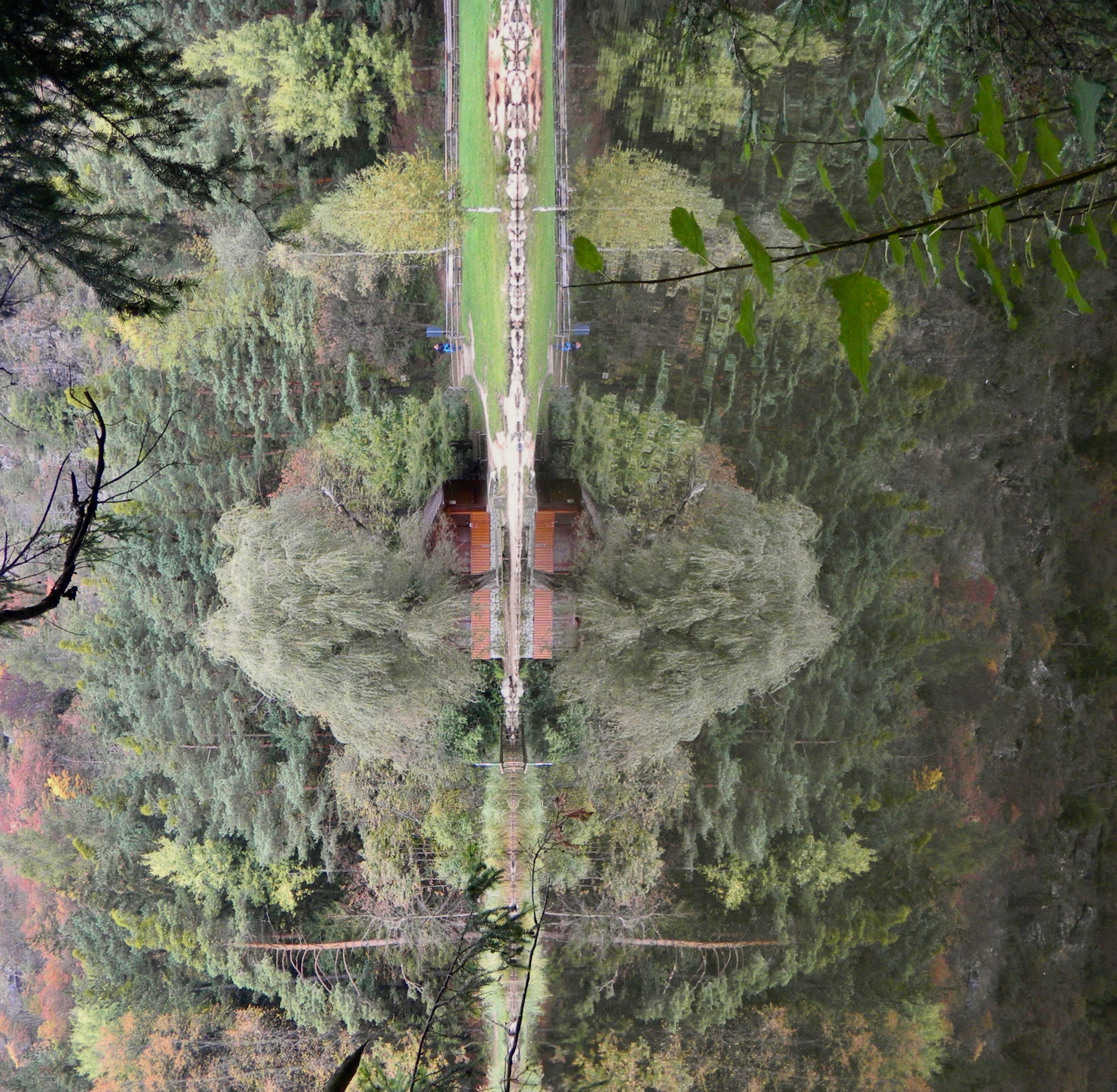
 Sughra Raza. Seeing is Believing. Vahrner See, Südtirol, October 2013.
Digital photograph.
Enjoying the content on 3QD? Help keep us going by donating now.

Sughra Raza. Seeing is Believing. Vahrner See, Südtirol, October 2013.
Digital photograph.
Enjoying the content on 3QD? Help keep us going by donating now.
by Richard Farr
 It’s a ritual now. Every Sunday morning I go into my garage and use marker pens and sticky tape to make a new sign. Then from noon to one I stand on a street corner near the Safeway, shoulder to shoulder with two or three hundred other would-be troublemakers, waving my latest slogan at passing cars.
Others are waving the Ukrainian or Canadian flag. Or Hire a Clown and Get a Circus. Or Support Our Troops: Fire Hegseth. In my small town we’re perhaps 2% of the population — not yet one of those mass movements to which the future’s textbooks will devote a chapter, but we are fearful enough to need the hope of that outcome. With America’s vaunted institutions and much-hyped freedoms on fire, we desperately want more people to (as one of my own signs says) Join Us Before It’s Too Late.
We try to take comfort from the fact that we occupy three corners of the intersection, greatly outnumbering the Trumpers, a dozen people blasting patriotic country music on the northwest corner. But we know the truth: the only consequence of our protests, at least until ICE comes to town and starts handing out free tickets to El Salvador, is that it buys us a little dignity, a little solidarity, a little courage in the face of disaster.
Some of us are “leftists,” which is American English for “centrist neoliberals who look back wistfully to the era of Barack and Hillary.” Some are “radical leftists,” which is American English for “people so naïve that they actually care about things like climate change, the minimum wage, Citizens United, Gaza, nuclear command and control, universal healthcare, starving Yemeni children, and Ukraine.” All of us are appalled that Donald Trump and his one-eyed yellow minions are vandalising central functions of the state, especially the ones that involve anti-corruption oversight.
So that makes us the statists and him the anarchist, right? Read more »
What happens, happens before & after,
every time, without fail, always— yet, is singular,
is a one-note affair in a symphony of nows
each moment of which then becomes
before & after, simultaneously.
If this seems confusing, blame time,
or life, or God which, in particular,
has been a widespread explanation
of the fact-of-being during millennia
of befores & afters since the
beginning-was-the-word,
and the word was,
………………………… Now
and always is.
But this is not an explanation,
nor was it meant to be anything
more than a statement of fact,
that of the breadth and depth
of our life-long ignorance of,
why being?
Jim Culleny
6/1/25
Enjoying the content on 3QD? Help keep us going by donating now.
by Gary Borjesson
And these two [the rational and spirited] will be set over the desiring part—which is surely most of the soul in each and by nature the most insatiable for money—and they’ll watch over it for fear of its…not minding its own business, but attempting to enslave and rule what is not appropriately ruled by its class, thereby subverting everyone’s entire life. —Plato’s Republic 442a
I want to share my vision for a tool that helps inform, direct, and scale consumer power.
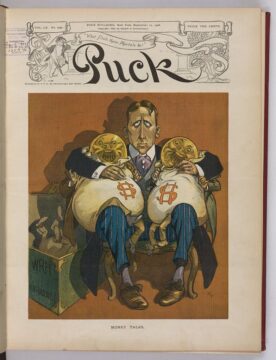
It would be a customized AI that’s free to use and accessible via an app on smartphones. At a time when many of us are casting about for ways to resist the corruption and authoritarianism taking hold in the US and elsewhere, such a tool has enormous potential to help advance the common good. I’m surprised it doesn’t already exist.
Why focus on consumer power? Because politics in the US has largely been captured by monied interests—foreign powers, billionaires, corporations and their wealthy shareholders. Until big money is out of politics (and the media), to change the country’s social and political priorities we will need to encourage corporations and the wealthy to change theirs.
As Socrates observed in the Republic, these “money makers” operate in society like the appetitive part operates in our souls. This part seeks acquisition and gain; it wants all the cake, and wants to eat it too. If unregulated, this part (perfectly personified by Donald Trump) acts selfishly and tyrannically, grasping for more, bigger, better, greater everything—and subverting the common good in the process.
The solution, as Socrates saw, is not to punish or vilify this part, but to restrain and govern it, as we do children. For the more spirited (socially minded) and rational parts of ourselves and society recognize the justice and goodness of sharing the cake. Thus the AI I envision will have a benevolent mindset baked into its operating constraints. But before seeing how this might work, let’s consider how powerful aggregated consumer spending can be. Read more »
by Derek Neal
 I first started reading Jon Fosse’s Septology in a bookstore. I read the first page and found myself unable to stop, like a person running on a treadmill at high speed. Finally I jumped off and caught my breath. Fosse’s book, which is a collection of seven novels published as a single volume, is one sentence long. I knew this when I picked it up, but it wasn’t as I expected. I had envisioned something like Proust or Henry James, a sentence with thousands and thousands of subordinate clauses, each one nested in the one before it, creating a sort of dizzying vortex that challenges the reader to keep track of things, but when examined closely, is found to be grammatically perfect. Fosse isn’t like that. The sentence is, if we want to be pedantic about it, one long comma splice. It could easily be split up into thousands of sentences simply by replacing the commas with periods. What this means is the book is not difficult to read—it’s actually rather easy, and once you get warmed up, just like on a long run, you settle into the pace and rhythm of the words, and you begin to move at a steady speed, your breathing and reading equilibrated.
So this is how the words work, but what do they say? After reading the first two books in the collection, which together are called The Other Name, the best way I can explain it is by quoting a passage from the book itself:
and that’s how it also is with all the paintings by other people that mean anything to me, it’s like it’s not the painter who sees, it’s something else seeing through the painter, and it’s like this something is trapped in the picture and speaks silently from it, and it might be one single brushstroke that makes the picture able to speak like that, and it’s impossible to understand, I think, and, I think, it’s the same with the writing I like to read, what matters isn’t what it literally says about this or that, it’s something else, something that silently speaks in and behind the lines and sentences (italics mine)
The narrator who is talking, an elderly painter named Asle who lives in rural Norway, spends much of the book like this, thinking about his paintings and trying to explain what they mean. He is unable to explain their meaning, however, because language and painting are two different things, and something gets lost in translation. What he says about writing takes things even further, suggesting that words don’t mean what we say they mean—“what matters isn’t what it literally says about this or that, it’s something else, something that silently speaks in and behinds the lines and sentences.” I would like to suggest that this is the true subject of Fosse’s book (or at least the first two that I’ve read), the idea that words do not mean what we say they mean, but something else, something behind the words.
Fosse’s challenge, of course, is to express this idea through language. How do we say one thing with words that mean something else? Read more »
by Barry Goldman
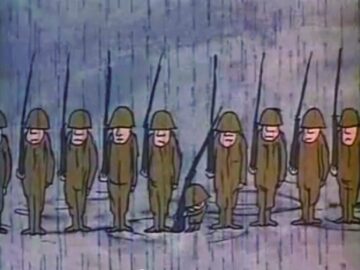
The brilliant and recently departed Jules Feiffer drew a cartoon many years ago called Munro. It was later made into an Academy Award-winning animated short. You can watch it here.
Munro was only four years old, but somehow he got drafted into the army. He went to see his sergeant and said, “I’m only four.” The sergeant said:
It is the official policy of the army not to draft men of four. Ergo you cannot be four.
We see this form of reasoning in many contexts. It is the official policy of the United States that we do not torture prisoners of war. Therefore, waterboarding, which has been used to torture prisoners since the 14th century, cannot be torture.
Alternatively, the prisoners captured after 9/11, detained at Guantanamo, and waterboarded regularly cannot be “prisoners of war.” Instead, they are “alien enemy combatants” to whom the protections of the Geneva Convention do not apply.
This kind of reasoning can be difficult and complex and may require many years of rigorous training. Only a highly-trained and rigorous thinker like John Yoo, now the Emanuel S. Heller Professor of Law at UC Berkeley, could produce a document like Military Interrogation of Alien Unlawful Combatants Held Outside the United States. Try to read it and you will see.
My point is: This is what lawyers do. As the Devil’s Dictionary put it:
LAWYER, n. One skilled in circumvention of the law.
But there is a larger point that is both more important and less discussed. Even if there were a clear and unambiguous law, duly approved by Congress and signed by the president that said “Torturing prisoners is perfectly fine,” it would not be fine. If anything is wrong, torture is wrong. It doesn’t matter what Mr. Yoo or Congress or the President says. An atrocity enacted into law does not cease to be an atrocity. Read more »
by Rachel Robison-Greene

Many people who have thought carefully about AI are anxious about certain uses of it, and for good reason. Many are concerned that people (young people in particular) are increasingly offloading their critical thinking development and responsibilities to Chat GPT and other large language learning models. We may fail to flourish as citizens, neighbors, and friends because we allow AI to do so many of the tasks that would otherwise prepare us for the challenges we’ll encounter in our lives. That said, some applications of AI seem like they offer tremendous benefits. For example, there is promising research being done into using AI models to understand non-human language. Doing so will help us to better understand non-human consciousness. This has the potential to change how we see and treat other animals and how we view ourselves as members of biotic communities.
Some AI companies, such as the Chinese company Baidu are looking to fulfill very human impulses. Their products focus on deciphering the communication of companion animals such as cats and dogs. What pet caretaker wouldn’t be interested in knowing what their furry friends are trying to communicate? Other AI applications focus on the communication patterns of big-brained animals such as sperm whales. These creatures engage in an impressive amount of vocalization and there is good reason to believe that mapping whale sounds can tell us all sorts of important things about the mental and social lives of whales. These scientific advances have the potential to finally pull us out the philosophical rut we’ve been in with respect to animal minds for the entire history of human philosophical engagement. Read more »
by Eric Schenck

My sister and I have always been close. But for the last few years, something has bonded us like nothing before: trashy television. We love nothing more than to watch reality TV shows and rejoice that we are not these people.
90 Day Fiancé (hereafter affectionately referred to as 90 Day) is one of those shows. The premise is simple: people find each other (usually an American and non-American, typically online), develop some kind of virtual relationship, and then finally meet up in person.
The name comes from the “K-1 visa”. This legally gives a foreigner 90 days to get married to a U.S. citizen after they have entered the country if they want to stay. For our delight at home, that’s usually when things go to shit.
There are different versions of 90 Day, but no matter which one we watch, one truth remains: the show really is a master class in love. Not necessarily what you should do to ensure a healthy relationship – but what you should avoid at all costs.
What follows are 20 lessons in love that 90 Day Fiancé has taught me. I hope you learn as much as I have! Read more »
by Muhammad Aurangzeb Ahmad

You are scrolling through photos from your childhood and come across one where you are playing on a beach with your grandfather. You do not remember ever visiting a beach but chalk it up to the unreliability of childhood memories. Over the next few months, you revisit the image several times. Slowly, a memory begins to take shape. Later, while reminiscing with your father, you mention that beach trip with your grandfather. He looks confused and then proceeds to tell you that it never happened. Other family members corroborate your father’s words. You inspect the photo more closely and notice something strange, subtle product placement. It turns out the image was not really taken by a human. It had been inserted by a large retailer as part of a personalized advertisement. You have just been manipulated into remembering something that never happened. Welcome to the brave new world of confabulation machines, AI systems that subtly alter or implant memories to serve specific ends. Human memory is not like a hard drive, its reconstructive, narrative, and deeply influenced by context, emotion, and suggestion. Psychological studies have long shown how memories can be shaped by cues, doctored images, or repeated misinformation. What AI adds is scale and precision. A recent study demonstrated that AI-generated photos and videos can implant false memories. Participants exposed to these visuals were significantly more likely to recall events inaccurately. The automation of memory manipulation is no longer science fiction; it is already here.
I have had my own encounter with false memories via AI models. I have written and talked about my experiences with the chatbot of my deceased father. Every Friday whenever I would call him, he would give me the same advice every time in the Punjabi language. In the GriefBot, I had transcribed his advice in English. After I had interreacted with the GriefBot for a few years, I caught myself remembering my father’s words in English. The problem is that English was his third language and we seldom communicated in English and certainly never said those words in English. Human memory is fickle and easily reshaped. Sometimes, one must guard against oneself. The future weaponization of memory won’t look like Orwell’s Memory Hole, where records are deleted. It will look more like memory overload, where plausible-but-false content crowds out what was once real. As we have seen with hallucinations, generation and proliferation of false information need not be intentional. We are likely to encounter the same type of danger here i.e., unintentional creation of false memories and beliefs through the use of LLMs.
Our memories can be easily influenced by suggestions, imagination, or misleading information, like when someone insists, “Remember that time at the beach?” and you start “remembering” details that never occurred. People can confidently recall entire fake events if repeatedly questioned or exposed to false details. Read more »
by Thomas R. Wells
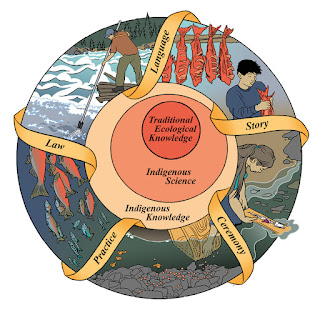
The idea that ‘indigenous’ knowledge counts as knowledge in a sense comparable to real i.e. scientific knowledge is absurd but widely held. It appears to be a pernicious product of the combination of the patronising politics of pity and anti-Westernism that characterises the modern political left (dumb, but still preferable to the politics of cruelty that characterises the modern political right!).
My point is simple: knowledge is knowledge. Where it comes from doesn’t matter to its epistemic status. What matters is whether it deserves to be believed. The scientific revolution has provided a general approach – systematic inquiry – together with specialist methodologies appropriate to different domains (such as mathematical modeling, taxonomy, statistical analysis, and experimental manipulation and measurement). It is irrelevant that this approach first appeared in North-Western Europe and that many of the domain specific techniques were first developed and refined by white men from the ‘west’. What is relevant is that modern science allows a degree of confidence in factual and theoretical claims that has never been warranted before, and made this capability equally available to everyone around the world as the new standard for objective knowledge, i.e. knowledge that is reliably true no matter from what perspective you look at it.
If indigenous peoples have observational data and successful technologies to contribute to this kind of systematic inquiry into what makes an ecosystem resilient, or what plants might contain molecules with pain-relieving properties, or the history of climactic events, then that should be welcomed. But the test of whether these are an actual contribution must come from whether they survive scientific scrutiny, not the authenticity of their indigenous origins.

Center of a peony in Vahrn, South Tyrol. Happy Spring!
Enjoying the content on 3QD? Help keep us going by donating now.
by Kevin Lively

Introduction
It is a well-worn observation that a sense of fatalism seems to be settling across the peoples of the world. There is a wide-spread feeling that global developments are echoing trends from the 1930s. Economic centers in the USA are gearing up their domestic industrial capacity, while the defense department speaks of Great Power Competition. China does the same, while trenches and mines scar the fields of Ukraine. With the NATO alliance under question, Europe begins to look after its own industrial base while refugees from drought-stricken, strife-torn lands drown in the Mediterranean. Those who manage a safe arrival, both in Italy as in Texas, often struggle to integrate into an aging society despite a desperate need for young workers. Substantial and growing fractions of the US and European populations are of the mind that this influx of hands — ready and eager to work — should not be turned to repairing crumbling bridges or staffing overworked retirement homes. Rather they should be banished and sent away in disgrace, regardless of the final destination.
An unspoken thought seems to be flowing among the currents beneath many people’s minds. More and more often now, it seems to break to the surface at unexpected times. Here’s a drinking game: every time you hear some variation of the phrase “in today’s geopolitical climate”, take a shot. Depending on where you work and what topics your lunch conversations drift towards, it may be unwise to play this game on a weekday. These events increasingly beg for certain pressing questions to be asked.
For example: how do we, as a species, deal with these dislocations of people, and the disruptions to their means of supporting themselves? How do we, as a species, plan for the future dislocations to come, as crop cycles grow increasingly unpredictable and failure-prone, while the ocean’s fish are replaced with plastic as ever more forms of pollution with unknown consequences accumulates? How do we, as a species, allocate this planet’s apparently dwindling resources between ourselves in order support a simple life of dignity and peace, unburdened by the deprivation of extreme poverty and the chaos it brings?
Discussions around such questions are, by necessity, discussions of death, religion, power and land — among the topics best avoided both at Thanksgiving and a bar. Thus there is a tendency to tread carefully around them while in polite company. Yet in today’s geopolitical climate it increasingly behooves us all to address such questions in a sober and critical manner. Ideally we should all have some mutually understood context for the stage on which these events are playing out, whether we’re in the audience, on the gantry or elsewhere, busy prepping the smoking lounge in your bunker. Read more »
by Dick Edelstein
According to today’s newspaper, Spain is expected to lose some 30% of its population over the next 75 years, based on current birth rate projections, a loss of over eight million inhabitants—too great to cover through the influx of migration (La Vanguardia, 17 May). And what about other European countries? The study cited above predicts a still greater per capita drop in Italy’s population. So why aren’t people more worried about who will supply the labor power that we will need to secure future social benefits, rather than heeding absurd declarations by right wing populists like Meloni and Trump on the supposed dangers of migration?
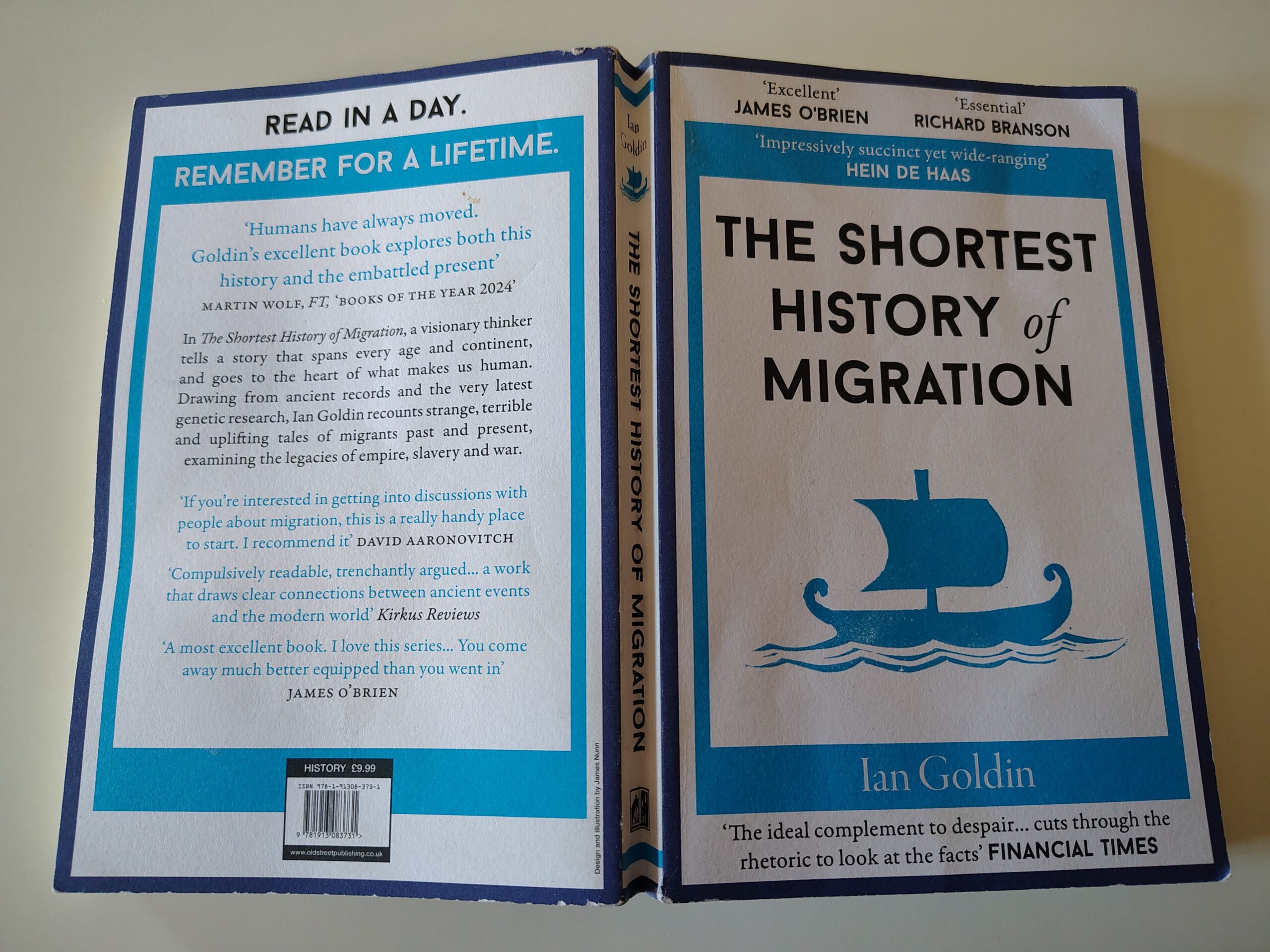
At a time when it is essential to be able to separate the facts and realities of migration from the myths and lies, author Ian Goldin offers us timely assistance in a brief book entitled The Shortest History of Migration, an indispensable guide when the facts of migration are obscured by a baseless hysteria whose effects span the political spectrum, influencing the attitudes of groups and individuals on the left as well as the right. This is an opportune moment to take a good look at those facts. The author, with a gift for synthesizing detailed material, has produced a concise book, with an apt cover blurb that says: “Read in a day. Remember for a lifetime.” Goldin takes a very long view, explaining to readers how migration has always been an intrinsic part of the evolution and development of the human race as he traces the phenomenon throughout all of the eras of human history.
As a migrant myself, and someone whose recent ancestors migrated from Europe to the New World for some of the reasons succinctly described in this book, for me this is a personal as well as a social question, although most people have some personal interest in migration as well as their own viewpoint. Read more »
by Jochen Szangolies
Mind, it seems to us, is a closed-door affair: without taking any strong stance on how, it is surely related to what the brain does; and the brain does its thing in the dark cavern of the skull. Thus, the content of your mind and mine seem divided by an unbridgeable gap. How could then disparate minds ever come together to form a greater unity?
For a first hint of how the mind might flee its bony confines, consider the extended mind thesis of philosophers Andy Clark and David Chalmers. They observe that many of our cognitive functions are not restricted to the tools internal to our brains: rather, we use various technologies that enhance our abilities beyond what would be possible using our grey matter alone. Think, for instance, of a simple notebook, the paper kind: writing things down can enormously enhance memory of those of us that tend towards a certain forgetfulness. Using pen and paper, calculations can be performed that are impossible to keep in the mind all at once. A diary allows you to recall what you had for breakfast today ten years ago, which is far beyond most people’s memories. To say nothing of more sophisticated gadgets, like calculators, computers, or smartphones.
Clark and Chalmers substantiate their thesis by discussing the case of Otto, who has Alzheimer’s disease, and for whom a notebook acts like a kind of cognitive prosthesis: it is not too difficult to imagine that, as long as Otto has access to his notebook, he could perform much in the same way as he did before cognitive deterioration started to set in. Concretely, they posit that he navigates a museum together with Inga, whose cognitive faculties are unimpaired. Both find their way equally well; the only difference is that Inga’s memory is processed internally, while Otto relies on an external aid.
That this should be possible in principle follows from the idea of substrate independence. It seems exceedingly chauvinistic to claim that mind could only exist within the sort of neural circuitry that constitutes human gray matter. What if we eventually encountered aliens that use some different machinery for their cogitation? Should we consider them barred from club conscious just on principle? This does not seem a reasonable stance. Rather, whatever fulfills the same role that neural circuitry does in our case should do just as well. But then, why not a notebook? Read more »
 Jeanne Moutoussamy-Ashe. Mine Dancers, Alexandra Township, South Africa, 1977.
Enjoying the content on 3QD? Help keep us going by donating now.
by Malcolm Murray
Aella, a well-known rationalist blogger, famously claimed she no longer saves for retirement since she believes Artificial General Intelligence (AGI) will change everything long before retirement would become relevant. I’ve been thinking lately about how one should invest for AGI, and I think it begs a bigger question of how much one should, and actually can, act in accordance with one’s beliefs.
Tyler Cowen wrote a while back about how he doesn’t believe the AGI doomsters actually believe their own story since they’re not shorting the market. When he pushes them on it, it seems to be that their mental model is that the arguments for AGI doom will never get better than they already are. Which, as he points out, is quite unlikely. Yes, the market is not perfect, but for there to be no prior information that could convince anyone more than they currently are seems to suggest a very strong combination of arguments. We need “foom” – the argument, discussed by Yudkowsky and Hanson, that once AGI is reached, there will be so much hardware overhang and things will happen on timescales so beyond human comprehension that we go from AGI to ASI (Artificial Super Intelligence) in a matter of days or even hours. We also need extreme levels of deception on the part of the AGI who would hide its intent perfectly. And we would need a very strong insider/outside divide on knowledge, where the outside world has very little comprehension of what is happening inside AI companies.
Rohit Krishnan recently picked up on Cowen’s line of thinking and wrote a great piece expanding this argument. He argues that perhaps it is not a lack of conviction, but rather an inability to express this conviction in the financial markets. Other than rolling over out-of-the-money puts on the whole market until the day you are finally correct, perhaps there is no clean way to position oneself according to an AGI doom argument.
I think there is also an interesting problem of knowing how to act on varying degrees of belief. Outside of doomsday cults where people do sell all their belongings before the promised ascension and actually go all in, very few people have such certainty in their beliefs (or face such social pressure) that they go all in on a bet. Outside of the most extreme voices in the AI safety community, like Eliezer Yudkowsky whose forthcoming book literally has in the title that we will all die, most do not have an >90% probability of AI doom. What makes someone an AI doomer is rather that they considered AI doom at all and given it a non-zero probability. Read more »
by Barbara Fischkin
Warren Wilson College
Swannanoa, North Carolina
Winter 1989
Now, it sounds exciting. And unusual. Back then I was terrified. I would be moving with my foreign correspondent husband from Mexico City to Hong Kong—a place I had never been—with a toddler and a Mexican nanny in tow.

Mari, the nanny, was calm. She was ready. And if she wasn’t, she knew how to fake it. Also, she had experience with children—and with difficult but necessary situations. She had left her own little ones with relatives back home in her small village to earn money in the capital. She was a mother who understood the long game. Sometimes short term pain was necessary for the goal of giving them a better life.
Still, I needed to make sure she really was ready for the big move, from one continent to another. She had never been out of Mexico.
Mari did not know it at the time but taking her from Mexico City to North Carolina—which one could do in those days without fear—was a test. If she could babysit while I attended a two-week fiction-writing residency at an isolated American college, close by an Appalachian mountain range, she could do Asia.
Why fiction? I already had a flourishing career in journalism. In Mexico City, I’d written a piece for the New Yorker and another one for the New York Times. But since I was a little girl, I wanted to be able to make up stories, too.
My first attempt at this, at around eight years old, horrified my mother. For good reason. I presented her with a short story about a child who swallowed her grandmother’s pills—as an “experiment”— and died. Although I did not understand this at the time, the story was my fictional turnaround of a real-life incident. At the age of two, I had found my real-life grandmother, my mother’s mother, dead in her bed from heart failure. It actually was a better-than-expected demise for my grandmother. She was born in an Eastern European shtetl. A brigade of Cossacks ransacked the shtetl. She survived, along with her husband and children, through a combination of luck and fortitude. Nevertheless, I don’t think my mother ever got over the fact that she was downstairs when I found grandma dead.
I have no idea why my first attempt at fiction switched a dead grandmother for a dead grandchild. These days, a mother presented with such “creativity,” would probably march her child off to the nearest kid-centered shrink. My mother just gulped. She also discouraged writing fiction. Read more »
maybe flower petals are held to stems by thought
and the wind’s a counter-thought that plucks
and sets them elsewhere in the grass
to grow in contemplative resolution
beside my notion of a grub-pulling crow
maybe the wind itself is a palpable bright idea,
something about motion and the abhorrence of vacuums,
something about coming and going,
about ferocity and stillness,
about war and its absence
maybe the moon’s the concept of fullness,
loss, abatement, regeneration from slivers,
hope at the hour of the wolf, the opposite of
darkness at the break of noon, the
upside of shadow
maybe Descartes had it right
and this from horizon to horizon is
a simple ontology,
an inherent daisy chain of ideas chasing its tale
regardless—
one
idea hatched in this synapse nest
is to harvest thought from thought
under a perception of blue
while the conception of breeze
riffles a hint of hair and I place them
like dreams of plums into the
essence of basket and give them
with the intention of love
to my belief in the naturally
beautiful being of you
by Jim Culleny
February 26, 2011-Rev, 5/23/25
Enjoying the content on 3QD? Help keep us going by donating now.
by Rafaël Newman
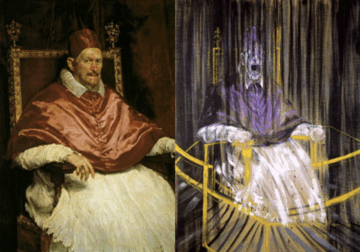
On September 29, 1978, Albino Luciani, who had been elected Pope John Paul I just 33 days earlier, on August 26, 1978, was found dead in his bed, his death likely due to a heart attack. Luciani had succeeded Paul VI, who was himself preceded by John XXIII—the two Popes were commemorated in their short-lived successor’s double-barreled appellation—and would be followed on October 16, 1978, by John Paul II.
I was 14 years old at the time and had recently begun studying ancient languages, so the Latin pronouncements from the Vatican press office aroused my exhibitionist adolescent spirit. This, combined with the salience of a solemnly pronounced “Year of Three Popes,” which echoed a similarly multiple interregnum in Roman imperial history; a perverse will to deflate overblown expressions of gravity, my own included; and a natural tendency to pomposity and sententiousness, all inspired me to write a poem:
Paulum sed magnopere
Pro Papa Ioanne Paulo PrimoNow the golden hammer has struck,
The pastor’s ghost is lost.
Oh, his great gain is our bad luck,
Ere the tomb of the VIth is moss’d.Oh, thou bless’d and humble man
Who in thy bare feet stand:
Cleanse our rude souls and spirits fan
With calm empower’d hand.Why art thou gone so soon from here?
Why was thy term so small?
And why is one who was so dear
Held tight in heaven’s thrall?
Not long afterwards, my father, himself a published poet and novelist and in those days a professor of creative writing at the University of British Columbia, asked what I had been up to recently. I passed on to him some of the verses I had been setting down in my journal, among them my poem on the death of John Paul I. He responded, along with words of cautious praise for other of my efforts, in surprise at my having found something so admirable in the late Pope that I had been moved to write him this encomium.
I was mortified. Read more »