
by Rafaël Newman
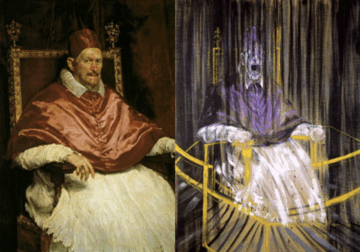
On September 29, 1978, Albino Luciani, who had been elected Pope John Paul I just 33 days earlier, on August 26, 1978, was found dead in his bed, his death likely due to a heart attack. Luciani had succeeded Paul VI, who was himself preceded by John XXIII—the two Popes were commemorated in their short-lived successor’s double-barreled appellation—and would be followed on October 16, 1978, by John Paul II.
I was 14 years old at the time and had recently begun studying ancient languages, so the Latin pronouncements from the Vatican press office aroused my exhibitionist adolescent spirit. This, combined with the salience of a solemnly pronounced “Year of Three Popes,” which echoed a similarly multiple interregnum in Roman imperial history; a perverse will to deflate overblown expressions of gravity, my own included; and a natural tendency to pomposity and sententiousness, all inspired me to write a poem:
Paulum sed magnopere
Pro Papa Ioanne Paulo PrimoNow the golden hammer has struck,
The pastor’s ghost is lost.
Oh, his great gain is our bad luck,
Ere the tomb of the VIth is moss’d.Oh, thou bless’d and humble man
Who in thy bare feet stand:
Cleanse our rude souls and spirits fan
With calm empower’d hand.Why art thou gone so soon from here?
Why was thy term so small?
And why is one who was so dear
Held tight in heaven’s thrall?
Not long afterwards, my father, himself a published poet and novelist and in those days a professor of creative writing at the University of British Columbia, asked what I had been up to recently. I passed on to him some of the verses I had been setting down in my journal, among them my poem on the death of John Paul I. He responded, along with words of cautious praise for other of my efforts, in surprise at my having found something so admirable in the late Pope that I had been moved to write him this encomium.
I was mortified. Had my father not realized that my poem was a send-up? Did he really think that, having raised me in an agnostic version of his parents’ Jewish tradition—together with my mother, an atheist Freudian and secular rationalist who had been sent to Anglican girls’ school by her socialist German parents—he had somehow managed to produce a tiny Catholic? Could he not discern the mockery in my cod archaicisms? Did he truly believe me capable of such fawning sincerity? Had he not understood the irreverent pun in my Latin title?
I should, I suppose, have simply been grateful to my poet father for not pointing out the obvious: that I had written something, whether in jest or in earnest, trite and mediocre.
This early foray of mine into simulated hagiography was called to mind by recent events, in particular by the effusive, broadly disseminated, “liberal” praise for the newly elected Pope Leo XIV and the cautious hopes for a progressive papacy (whatever that might mean in present circumstances), including from some unlikely quarters, with the authors of commendations identifying themselves variously as “atheist” or “Jewish”. Then there were too the laudatory obituaries of the deceased Pope Francis, most of them, in the spirit of De mortuis nil nisi bonum, eliding the ways in which Jorge Mario Bergoglio might have disappointed the similar hopes once placed in his tenure. Meanwhile, all the praise for Francis prompted Tariq Ali to repost Colm Tóibín’s 2021 critical assessment of Bergoglio’s relationship with the Argentine military junta, an essay Ali called “The only obit worth reading.”
And there were also voices of dissent in the general chorus of welcome for Leo XIV: would he really be as reformist as all that? Had he not been overly moderate in his condemnation of child abuse in the Church? Could he resist the conservative call of his compatriot Catholics and emerge as a proper counterpole to the other, more notorious American leader of the moment? Had his long sojourn in Peru genuinely softened the chauvinism of his native culture?
All of these paeans and polemics now reminded me of 1978, when the death of “The Smiling Pope” gave rise to Cold War conspiracy theories, while his Polish-born successor moved the Catholic center of gravity from the Eurocommunist Mediterranean to the grimmer environs of the Iron Curtain. Perhaps my dad, whose own father had been born in one of the early modern iterations of Poland but had inculcated in his son a visceral contempt for that country, which he considered a cradle of anti-Semitism, was sorry to see the keys of Saint Peter pass to a scion of that hated quondam homeland; perhaps he was ready to join me in what he thought was my sincere grief at the death of the last Italian pope.
Or perhaps what my father was responding to in the poem—albeit subconsciously, if not with the same degree of self-ignorance in which its author had composed it—was its allegorical potential as the expression of a rather more complex, more personal emotion. In August of 1978, the month of Paul VI’s death and John Paul I’s election, my siblings and I had left our home in suburban British Columbia to join our mother in her life with a new partner in Toronto. And with that home we also left our father, who had been living separately from us for the past six years but who had shared custody of me, my younger brother and sister as we grew from young childhood to early adolescence.
Our parting from dad at Vancouver International Airport in late August, after a special valedictory summer spent with him (instead of the weekend visits that had punctuated the last years), was awful: mostly because he was plainly weeping as he sent us off to the departure gate. His tears were an utterly unfamiliar sight, and quite devastating. I was filled with sorrow at leaving him, and racked with guilt in the knowledge that I would be taking up residence with a stepfather (for all that none of this was my choosing). So I am not surprised, looking back across the intervening decades, that I was prepared to be moved by the death of one Pope—one Papa—and his replacement with another. Or that I immediately channeled these uncomfortable feelings into a sardonic artifact.
Nor am I surprised now by the magnetic attraction the papacy exerts, including over those beyond its confessional jurisdiction. The ideal of the Pope as a benevolent, forgiving, unconditionally loving, universalist, non-sexual father—however much a fantasy that may always have been, not merely since the 16th century—answers a powerful need, despite (or perhaps on account of) the systemic violence of the real existing patriarchal order.
It was there for me, in 1978, as I moved from one paternal regime to another, and was confronted by the challenge of maintaining both simultaneously. And it is there for me still today, oddly, in the absence of both stepfather and father—gone in 2019 and 2024, respectively—and as I move from being a young father myself, to a father in late middle age, with the prospect of becoming a grandfather growing ever more realistic.
Especially since, by a trick of providence, versions of the name Francis have been handed down for generations on my mother’s side of the family—her father, my German grandfather, was Franz; her own name is Frances; my middle name is Francis; and we gave our younger daughter Fanny as a middle name—while Leo was my Jewish grandfather’s “goyishe” name.
And finally, in a world currently beset by such hideously malevolent, transactional, unforgiving, vengeful, rapacious, tribalist “fathers”—Netanyahu, Putin, Trump—it is unsurprising that I should feel the same need as so many others: to vest my hopes for the future in yet another idealized avatar of the Papa from whom I was once compelled to take my leave.