

A Painless Wealth Tax

by Jerry Cayford

Rich Brooks from Scarborough, ME, CC BY 2.0, via Wikimedia Commons

The wealth tax was reintroduced a few months ago. Sponsors of the Ultra-Millionaire Tax Act are leading progressive Democrats Elizabeth Warren, Pramila Jayapal, and Brendan Boyle. The sixty or so co-sponsors are all Democrats (plus independent Bernie Sanders)—hardly a surprise, since taxing wealth, rather than just income, is a progressive policy. But the wealth tax need not end in another long-shot partisan battle. I propose a different approach to the politics here.

Another big story in this political season is the national debt, which just passed forty trillion dollars. Forty trillion! Our debt is far bigger now than our country’s gross domestic product. The interest on that debt is a quarter of the federal budget. Interest alone costs us more each year than we pay for social security, the military, or Medicare—more for debt than for our comfort, our protection, our health, or anything else. Traditionally, fiscally conservative Republicans are the ones who worry about debt.

Put these two stories together. Progressive wealth taxation and conservative debt reduction could be surprisingly symbiotic. What if Democrats pledged half of any wealth tax directly to paying down the national debt?

The politics of this proposal are what interest me. Arguments about the policy details of various wealth tax designs are easy to find. The figures generally put potential revenue at two to six trillion dollars (over ten years). Discussions of the politics of a wealth tax, though, seem to just presume a rigidly partisan and polarized battle ahead.

For example, the Ultra-Millionaire Tax Act (UMTA) press release says the plan is “to pay for investments like universal child care, free community college, Medicare expansion, and more.” The “more” includes schools, clean energy, new housing, and universal paid family leave. Bernie Sanders and Ro Khanna introduced their own wealth tax bill expressly to “use this revenue to address some of the major crises facing working families, the children, the elderly, the sick and the most vulnerable.” The wealth tax framing is indisputably partisan, and many discussions simply assume that Democrats therefore need a supermajority to pass one. But what if we approach the politics differently? Read more »
Sunday, June 1, 2025

Encouraging Good Actors: Using AI to Scale Consumer Power for the Common Good

by Gary Borjesson

And these two [the rational and spirited] will be set over the desiring part—which is surely most of the soul in each and by nature the most insatiable for money—and they’ll watch over it for fear of its…not minding its own business, but attempting to enslave and rule what is not appropriately ruled by its class, thereby subverting everyone’s entire life. —Plato’s Republic 442a

I want to share my vision for a tool that helps inform, direct, and scale consumer power.

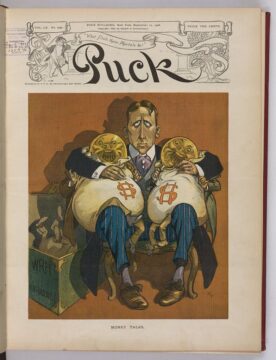
Money Talks, by Udo J Keppler. William Randolph Hearst sitting with two large, animated, money bags resting on his lap; on the floor next to Hearst is a box labeled “WRH Ventriloquist.” Courtesy of Library of Congress.

It would be a customized AI that’s free to use and accessible via an app on smartphones. At a time when many of us are casting about for ways to resist the corruption and authoritarianism taking hold in the US and elsewhere, such a tool has enormous potential to help advance the common good. I’m surprised it doesn’t already exist.

Why focus on consumer power? Because politics in the US has largely been captured by monied interests—foreign powers, billionaires, corporations and their wealthy shareholders. Until big money is out of politics (and the media), to change the country’s social and political priorities we will need to encourage corporations and the wealthy to change theirs.

As Socrates observed in the Republic, these “money makers” operate in society like the appetitive part operates in our souls. This part seeks acquisition and gain; it wants all the cake, and wants to eat it too. If unregulated, this part (perfectly personified by Donald Trump) acts selfishly and tyrannically, grasping for more, bigger, better, greater everything—and subverting the common good in the process.

The solution, as Socrates saw, is not to punish or vilify this part, but to restrain and govern it, as we do children. For the more spirited (socially minded) and rational parts of ourselves and society recognize the justice and goodness of sharing the cake. Thus the AI I envision will have a benevolent mindset baked into its operating constraints. But before seeing how this might work, let’s consider how powerful aggregated consumer spending can be. Read more »