
Encouraging Good Actors: Using AI to Scale Consumer Power for the Common Good

by Gary Borjesson

And these two [the rational and spirited] will be set over the desiring part—which is surely most of the soul in each and by nature the most insatiable for money—and they’ll watch over it for fear of its…not minding its own business, but attempting to enslave and rule what is not appropriately ruled by its class, thereby subverting everyone’s entire life. —Plato’s Republic 442a

I want to share my vision for a tool that helps inform, direct, and scale consumer power.
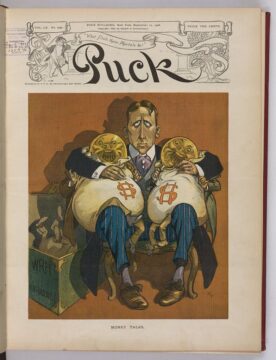
Money Talks, by Udo J Keppler. William Randolph Hearst sitting with two large, animated, money bags resting on his lap; on the floor next to Hearst is a box labeled “WRH Ventriloquist.” Courtesy of Library of Congress.

It would be a customized AI that’s free to use and accessible via an app on smartphones. At a time when many of us are casting about for ways to resist the corruption and authoritarianism taking hold in the US and elsewhere, such a tool has enormous potential to help advance the common good. I’m surprised it doesn’t already exist.

Why focus on consumer power? Because politics in the US has largely been captured by monied interests—foreign powers, billionaires, corporations and their wealthy shareholders. Until big money is out of politics (and the media), to change the country’s social and political priorities we will need to encourage corporations and the wealthy to change theirs.

As Socrates observed in the Republic, these “money makers” operate in society like the appetitive part operates in our souls. This part seeks acquisition and gain; it wants all the cake, and wants to eat it too. If unregulated, this part (perfectly personified by Donald Trump) acts selfishly and tyrannically, grasping for more, bigger, better, greater everything—and subverting the common good in the process.

The solution, as Socrates saw, is not to punish or vilify this part, but to restrain and govern it, as we do children. For the more spirited (socially minded) and rational parts of ourselves and society recognize the justice and goodness of sharing the cake. Thus the AI I envision will have a benevolent mindset baked into its operating constraints. But before seeing how this might work, let’s consider how powerful aggregated consumer spending can be. Read more »
Monday, February 19, 2024

Why Biden Matters

by Jerry Cayford

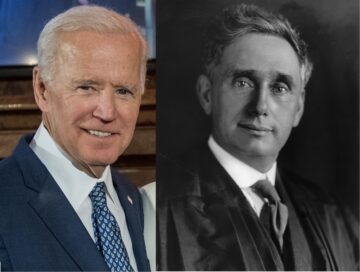
Biden: Mueller / MSC, CC BY 3.0 DE; Brandeis: Harris & Ewing, photographer, Public domain; both via Wikimedia Commons

Biden matters because he is taking on the real problems that are wrecking America, the deep structural problems, created over decades, that benefit powerful people who will do anything to prevent change (the way fossil fuel companies do anything to block climate solutions that hurt profits). He is the first president since LBJ to take on problems that big.

“How can that be?” you ask. “Joe Biden hasn’t transformed the Middle East into peaceful democracies like George W. Bush did. Nor has he ended racial and partisan animosity in America like Barack Obama did, or drained the swamp like Donald Trump did. What has Biden done?” He has taken on a challenge as big as his three predecessors’ ambitions: breaking corporate monopoly power and restoring healthy competition.

“Competition policy” is the innocuous name for this program. It’s big because it seeks to cure the root malady ailing America. Obviously, I was being sarcastic about the successes of Biden’s predecessors: they got nowhere on their signature ambitions, because they did not even try. Bush’s program for the Iraq transition was an arrogant experiment in free-market fantasy, uninterested in democracy. Obama announced in an apology letter to supporters after winning the nomination that he was not going to change our corrupt and toxic politics. (I wrote a Daily Kos piece about it in July 2008.) And Trump, as the very embodiment of the swamp, would no more drain the swamp than a bullfrog would. But Biden is serious. Read more »

Monday, October 30, 2023

Less than Zero

by Jerry Cayford

(Rspeer at the English-language Wikipedia, CC BY-SA 3.0, via Wikimedia Commons)

We think we live in a democracy, though an imperfect one. Every election, our frustrations bubble up in a list of proposed reforms to make our democracy a little more perfect. Usually, changing the Electoral College heads the list, followed by gerrymandering and a motley of campaign finance, voter suppression, vote count integrity, the dominance of swing states, etc. My own frustration is the very banality of this list, its low-energy appearance of arcane, minor, and futile wishes, like dispirited longshot candidates carpooling to Iowa barbecues. Enormous differences among these reforms are masked by the generic label, “electoral reform.”

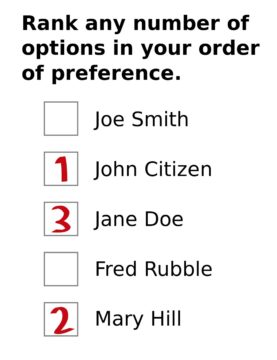
One change—Instant Runoff Voting—should stand alone, for it’s far more important than the others, or even than all of them put together. Democracy is supposed to keep government and voter interests aligned, with elections correcting the government’s course; without runoffs, though, that alignment is elusory because no electoral mechanism really tethers the government to the public interest. Where other flaws in our electoral process have in-built, practical limits on the damage they can do, elections that lack runoffs have no limit on the divergence they allow between leaders and citizens. Which may explain a lot about where we are today.

Many years ago, during the Cold War, I worked for a military policy research company. I had an epiphany there: foreign policy was heavily influenced by the fact that two-player, zero-sum games are easy to analyze. If everything that’s good for the Soviet Union is equally bad for the United States, and vice versa, and no other players matter, it’s easy to settle on a logical action in any situation. Today’s polarized, cutthroat domestic politics is eerily reminiscent of those Cold War foreign policy days. First-past-the-post elections—the kind we mostly have in the U.S., where whoever gets the most votes wins, with or without a majority—produce two parties with perfectly opposed interests and easy “for us or against us” answers. Everyone is familiar with the electoral logic that drives this result: the logic of “spoilers.” The further consequences of spoiler logic, though, are much less familiar. Read more »