
by Rachel Robison-Greene
Many people who have thought carefully about AI are anxious about certain uses of it, and for good reason. Many are concerned that people (young people in particular) are increasingly offloading their critical thinking development and responsibilities to Chat GPT and other large language learning models. We may fail to flourish as citizens, neighbors, and friends because we allow AI to do so many of the tasks that would otherwise prepare us for the challenges we’ll encounter in our lives. That said, some applications of AI seem like they offer tremendous benefits. For example, there is promising research being done into using AI models to understand non-human language. Doing so will help us to better understand non-human consciousness. This has the potential to change how we see and treat other animals and how we view ourselves as members of biotic communities.
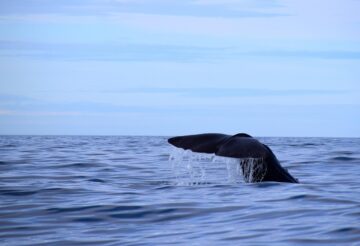
Some AI companies, such as the Chinese company Baidu are looking to fulfill very human impulses. Their products focus on deciphering the communication of companion animals such as cats and dogs. What pet caretaker wouldn’t be interested in knowing what their furry friends are trying to communicate? Other AI applications focus on the communication patterns of big-brained animals such as sperm whales. These creatures engage in an impressive amount of vocalization and there is good reason to believe that mapping whale sounds can tell us all sorts of important things about the mental and social lives of whales. These scientific advances have the potential to finally pull us out the philosophical rut we’ve been in with respect to animal minds for the entire history of human philosophical engagement.
Historically, human philosophical taxonomies of living things have included at least two constants: an emphasis on difference and an insistence on hierarchy. We’ve assumed that humans are different in kind from other animals and that these differences make us better, more deserving of respect, and that we have more meaningful lives than our fellow creatures. We’ve arguably started in the wrong place: we’ve assumed significant difference and then philosophized about the exact nature of that difference. In both Nicomachean Ethics and On the Soul, Aristotle argues for hierarchy on the basis of difference. He claims that plants have nutritive souls that allow them to take nutrition and grow, animals have nutritive souls and animate souls that allow for perception and mobility, and humans and only humans possess, in addition to the two lower types, souls with the power of intellect or reason. For these reasons, he concludes in Politics that
after the birth of animals, plants exist for their sake, and that the other animals exist for the sake of man, the tame for use and food, the wild, if not all at least the greater part of them, for food, and for the provision of clothing and various instruments. Now if nature makes nothing incomplete, and nothing in vain, the inference must be that she has made all animals for the sake of man.
If animals differ from humans in their skills and abilities, or, for Aristotle, in their function, they are naturally subservient to beings with a more significant function—reason. In other words, functions give rise to hierarchies, with advanced cognitive capacities at the top.
Aristotle’s’ hierarchy of living things was tremendously influential and the human role in that taxonomy was nearly deified by subsequent thinkers. Aquinas, for instance, argues that,
Of all the parts of the Universe, intellectual creatures hold the highest place, because they approach nearest to the divine likeness. Therefore, divine providence provides for the intellectual nature for its own sake, and for all others for its sake.
Aquinas also argues that, because of their intellect, humans have control over their own actions. A human is free because he is capable of being a “cause of himself.” As a result, “Every other creature is naturally under slavery; the intellectual nature alone is free.” Humans, as free intellects, have dominion over non-human animals who, it is assumed, have neither intellect nor the power of self-direction. These accounts of hierarchies in nature are explicitly teleological; differences don’t simply occur by chance, they are purposeful.
In Discourse on Method, Descartes, similarly, argued that the ability to use language or other signs to express thoughts was the evidence available to us that another being has a soul. He argued that the fact that non-human animals only express passions through behavior and not thought in a language demonstrates that,
They have no reason at all, and that it is nature which acts in them according to the disposition of their organs, just as a clock, which is only composed of wheels and weights is able to tell the hours and measure the time more correctly than we can do with all of our wisdom.
The idea that the behavior of non-human animals is directed “only from the disposition of their organs” is an early modern precursor to the discourse one commonly hears now about whether non-human animals are acting “merely on instinct.” People are often admonished for anthropomorphism when they attribute beliefs or intentionality to animals; they are told that they are making a category mistake—animals act on instinct, humans endowed with intellect are motivated by reasons—reasons that they are only capable of formulating through the use of language.
In Sand County Almanac, philosopher and conservationist Aldo Leopold argued that the history of ethical reasoning has involved progressively extending our circles of concern. He argues that we will only understand our obligations to the world properly when we see that our orientation to the land and the life on it is not properly understood from the perspective of a conqueror, but, instead, from the perspective of a biotic citizen. Instead of ruling over a world populated by other creatures, we are members of it—members with obligations of stewardship. Technology that could potentially allow us to know our fellow creatures better can help us understand ourselves and our place in nature better as well.
Enjoying the content on 3QD? Help keep us going by donating now.