
The Estuary Of Being III: Mind Beyond Minds

by Jochen Szangolies
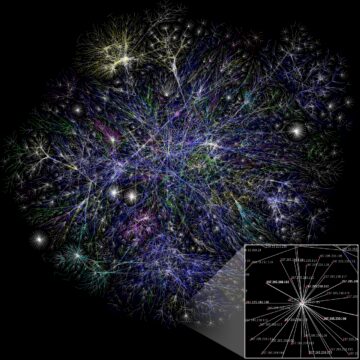
Map of the internet in 2005. Image credit: The Opte Project, CC BY 2.5, via wikimedia commons

Mind, it seems to us, is a closed-door affair: without taking any strong stance on how, it is surely related to what the brain does; and the brain does its thing in the dark cavern of the skull. Thus, the content of your mind and mine seem divided by an unbridgeable gap. How could then disparate minds ever come together to form a greater unity?

For a first hint of how the mind might flee its bony confines, consider the extended mind thesis of philosophers Andy Clark and David Chalmers. They observe that many of our cognitive functions are not restricted to the tools internal to our brains: rather, we use various technologies that enhance our abilities beyond what would be possible using our grey matter alone. Think, for instance, of a simple notebook, the paper kind: writing things down can enormously enhance memory of those of us that tend towards a certain forgetfulness. Using pen and paper, calculations can be performed that are impossible to keep in the mind all at once. A diary allows you to recall what you had for breakfast today ten years ago, which is far beyond most people’s memories. To say nothing of more sophisticated gadgets, like calculators, computers, or smartphones.

Clark and Chalmers substantiate their thesis by discussing the case of Otto, who has Alzheimer’s disease, and for whom a notebook acts like a kind of cognitive prosthesis: it is not too difficult to imagine that, as long as Otto has access to his notebook, he could perform much in the same way as he did before cognitive deterioration started to set in. Concretely, they posit that he navigates a museum together with Inga, whose cognitive faculties are unimpaired. Both find their way equally well; the only difference is that Inga’s memory is processed internally, while Otto relies on an external aid.

That this should be possible in principle follows from the idea of substrate independence. It seems exceedingly chauvinistic to claim that mind could only exist within the sort of neural circuitry that constitutes human gray matter. What if we eventually encountered aliens that use some different machinery for their cogitation? Should we consider them barred from club conscious just on principle? This does not seem a reasonable stance. Rather, whatever fulfills the same role that neural circuitry does in our case should do just as well. But then, why not a notebook? Read more »

Friday, May 2, 2025

The Estuary Of Being II: Life Comes To Mind

by Jochen Szangolies

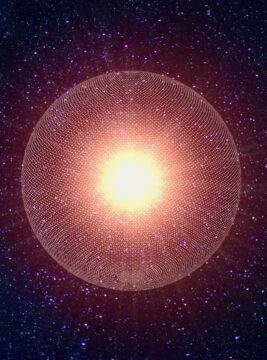
A Dyson swarm, a hypothetical habitat for a mature civilization making optimal use of its star’s energy. Image credit: By Archibald Tuttle, CC BY-SA 4.0, via wikimedia commons

The previous essay in this series argued that, given certain assumptions regarding typicality, almost every sentient being should find themself part of a ‘galactic metropolis’, a mature civilization that either has extended across the galaxy, or filled whatever maximal habitat is attainable to capacity. That this is not our experience suggests a need for explanation. One possibility is impending doom: very nearly every civilization destroys itself before reaching maturity. Another is given by the simulation argument: almost every sentient being is, in fact, part of an ‘ancestor simulation’ studying the conditions before civilizational maturity. Both succeed in making our experience typical, but neither seems a terribly attractive option.

Hence, I want to suggest a different way out: that we stand only at the very start of the evolution of mind in the universe, and that the future may host fewer individual minds, not through extinction, but rather, through coalescence and conglomeration—like unicellular life forms merging into multicellular entities, the future of mind may be one of streams of sentience uniting into an ocean of mind.

If this is right, the typical individual experience may be of just this transitory period, but this does not entail a looming doom—rather, just as the transition from uni- to multicellular life, may mean an unprecedented explosion in the richness and complexity of mind on Earth.

It is clear that this would solve the conundrum of our implausibly young civilization: the arguments above hinge ultimately on a faulty generalization to the effect that because human existence up to this point was one of individual minds locked away in the dark of individual bony brain-boxes, that would always be the case. But perhaps, a mature civilization is one in which every agent partakes of a single, holistic mind, or few shifting coalitions of minds exist, or the notion of individuality is eroded to the point of obscurity.

As it stands, this surely seems a fantastical suggestion. While it may receive some credence thanks to explaining the puzzle of our existence during this age of civilizational infancy, that alone seems hardly enough to justify belief in such a far-fetched scenario. Moreover, to many, the prospect might seem scarcely more attrative than that of living in a simulation—or even, that of near-term doom: don’t we loose what’s most important about ourselves, if we loose our individuality? After all, who wants to be the Borg?

Yet I will argue that there are good reasons to take this scenario seriously beyond its solution of the likelihood problem. Read more »

Thursday, April 3, 2025

The Estuary Of Being I: The Wrong Question

by Jochen Szangolies

An estuary delta: single streams of water coming together into the vastness of the ocean. Image credit: Jordan Heath via Unsplash

In 1950, during a lunch conversation with colleagues at the Los Alamos National Laboratory, Enrico Fermi asked the wrong question. Famously, after a discussion on the subject of recent UFO sightings, extra-terrestrial life, and the possibility of faster-than-light travel, Fermi blurted out: “But where are they?”

In that context, it was a sensible question: even given the magnitude of interstellar distances and the difficulties of bridging them, the vastness of cosmic time provides ample opportunity for an enterprising civilization to have visited any star within the galaxy several times over (for a brief recapitulation of the reasoning behind this assertion, see this previous essay). Certainly, it has been a stimulating one: it has spawned volumes of discussion, with potential solutions ranging from the optimistic to the dismal, from us inhabiting a carefully curated cosmic ‘zoo’ to every civilization self-destructing shortly after developing nuclear weapons.

But, as fruitful as this discourse has been, I want to suggest that there is a more interesting question that Fermi could have asked, one that might end up telling us much more about our place and future in the universe: “Why aren’t we them?”

Under seemingly reasonable assumptions, almost every sentient being in the universe should expect to find themselves as part of a galaxy-wide, ancient and prosperous civilization (the galactic metropolis); or, should interstellar space travel be fundamentally impossible, find whatever maximal niche they occupy (their ancestral home planet, the worlds of their solar system, a Dyson swarm around their star) filled nearly to capacity, for a time that’s of the order of magnitude of how long that niche can accommodate such a population. The argument for this is simply that for the vast majority of beings to ever exist, it will be true that they find themselves in such a situation, given ‘business as usual’—essentially, if life continues to ‘be fruitful and multiply’.

If it makes sense to apply such reasoning to our own situation (and I will argue that it does), the fact that we find ourselves very far from such a scenario demands explanation. Broadly, there are two possible answers. Read more »