
Encouraging Good Actors: Using AI to Scale Consumer Power for the Common Good

by Gary Borjesson

And these two [the rational and spirited] will be set over the desiring part—which is surely most of the soul in each and by nature the most insatiable for money—and they’ll watch over it for fear of its…not minding its own business, but attempting to enslave and rule what is not appropriately ruled by its class, thereby subverting everyone’s entire life. —Plato’s Republic 442a

I want to share my vision for a tool that helps inform, direct, and scale consumer power.
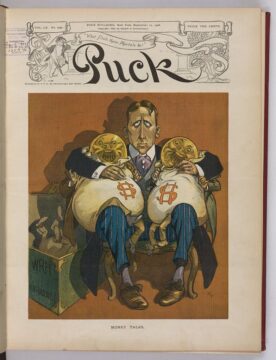
Money Talks, by Udo J Keppler. William Randolph Hearst sitting with two large, animated, money bags resting on his lap; on the floor next to Hearst is a box labeled “WRH Ventriloquist.” Courtesy of Library of Congress.

It would be a customized AI that’s free to use and accessible via an app on smartphones. At a time when many of us are casting about for ways to resist the corruption and authoritarianism taking hold in the US and elsewhere, such a tool has enormous potential to help advance the common good. I’m surprised it doesn’t already exist.

Why focus on consumer power? Because politics in the US has largely been captured by monied interests—foreign powers, billionaires, corporations and their wealthy shareholders. Until big money is out of politics (and the media), to change the country’s social and political priorities we will need to encourage corporations and the wealthy to change theirs.

As Socrates observed in the Republic, these “money makers” operate in society like the appetitive part operates in our souls. This part seeks acquisition and gain; it wants all the cake, and wants to eat it too. If unregulated, this part (perfectly personified by Donald Trump) acts selfishly and tyrannically, grasping for more, bigger, better, greater everything—and subverting the common good in the process.

The solution, as Socrates saw, is not to punish or vilify this part, but to restrain and govern it, as we do children. For the more spirited (socially minded) and rational parts of ourselves and society recognize the justice and goodness of sharing the cake. Thus the AI I envision will have a benevolent mindset baked into its operating constraints. But before seeing how this might work, let’s consider how powerful aggregated consumer spending can be. Read more »
Monday, March 17, 2014

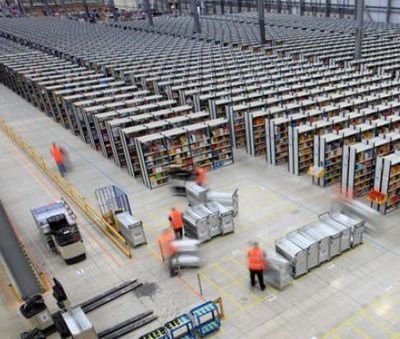
Why Amazon Reminds Me of the British Empire

by Emrys Westacott

“Life—that is: being cruel and inexorable against everything about us that is growing old and weak….being without reverence for those who are dying, who are wretched, who are ancient.” (Friedrich Nietzsche, The Gay Science)

ScreenHunter_562 Mar. 17 10.40A recent article by George Packer in The New Yorker about Amazon is both eye-opening and thought-provoking. In “Cheap Words” Packer describes Amazon's business practices, the impact of these on writers, publishers, and booksellers, and the seemingly limitless ambitions of Amazon's founder and CEO Jeff Bezos whose “stroke of business genius,” he says, was “to have seen in a bookstore a means to world domination.”

Amazon began as an online book store, but US books sales now account for only about seven percent of the seventy-five billion dollars it takes in each year. Through selling books, however, Amazon developed perhaps better than any other business two strategies that have been key to its success: it uses to the full sophisticated computerized collection and analysis of data about its customers; and it makes the interaction between buyer and seller maximally simple and convenient. It also, of course, typically offers lower prices than its competitors. Bezos' plan to one day have drones provide same-day delivery of items that have been stocked in warehouses near you in anticipation of your order is the logical next step in this drive toward creating a frictionless customer experience.

Amazon's impact on the world of books has been massive. Over the past twenty years the number of independent bookstores in the US has been cut in half from four thousand to two thousand, and this number continues to dwindle. Because Amazon is by far the biggest bookseller, no publisher can afford to not use its services, and Amazon exploits this situation to the hilt. Publishers are required to pay Amazon millions of dollars in “marketing discount” fees. Those that balked at paying the amount demanded had the ‘Buy' button removed from their titles on Amazon's web site. Amazon used the same tactic to try to force Macmillan to agree to its terms regarding digital books. And of course Amazon's Kindle dominates the world of e-books, another major threat to traditional publishers and booksellers.

The argument for viewing Amazon in a positive light is not difficult to make.

Read more »