
Mari, A Free-Range Mexican Nanny in Hong Kong—Part Two—The Memoir Continues

by Barbara Fischkin

 Warren Wilson College
Swannanoa, North Carolina
Winter 1989

Now, it sounds exciting. And unusual. Back then I was terrified. I would be moving with my foreign correspondent husband from Mexico City to Hong Kong—a place I had never been—with a toddler and a Mexican nanny in tow.
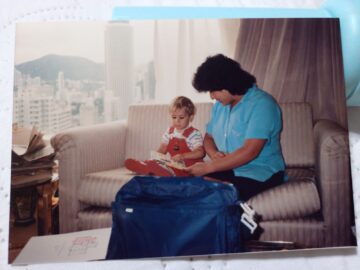
Mari and my son Danny at the Regent Hotel in Hong Kong, after their Rolls Royce ride from the airport. Towers in background are Hong Kong’s Central district.

Mari, the nanny, was calm. She was ready. And if she wasn’t, she knew how to fake it. Also, she had experience with children—and with difficult but necessary situations. She had left her own little ones with relatives back home in her small village to earn money in the capital. She was a mother who understood the long game. Sometimes short term pain was necessary for the goal of giving them a better life.

Still, I needed to make sure she really was ready for the big move, from one continent to another. She had never been out of Mexico.

Mari did not know it at the time but taking her from Mexico City to North Carolina—which one could do in those days without fear—was a test. If she could babysit while I attended a two-week fiction-writing residency at an isolated American college, close by an Appalachian mountain range, she could do Asia.

Why fiction? I already had a flourishing career in journalism. In Mexico City, I’d written a piece for the New Yorker and another one for the New York Times. But since I was a little girl, I wanted to be able to make up stories, too.

My first attempt at this, at around eight years old, horrified my mother. For good reason. I presented her with a short story about a child who swallowed her grandmother’s pills—as an “experiment”— and died.  Although I did not understand this at the time, the story was my fictional turnaround of a real-life incident. At the age of two, I had found my real-life grandmother, my mother’s mother, dead in her bed from heart failure. It actually was a better-than-expected demise for my grandmother. She was born in an Eastern European shtetl. A brigade of Cossacks ransacked the shtetl. She survived, along with her husband and children, through a combination of luck and fortitude.  Nevertheless, I don’t think my mother ever got over the fact that she was downstairs when I found grandma dead.

I have no idea why my first attempt at fiction switched a dead grandmother for a dead grandchild. These days, a mother presented with such “creativity,” would probably march her child off to the nearest kid-centered shrink. My mother just gulped. She also discouraged writing fiction. Read more »
Wednesday, April 2, 2025

Mari, A Free-Range Mexican Nanny in Hong Kong—And Other Comparable Characters—The Memoir Continues

by Barbara Fischkin

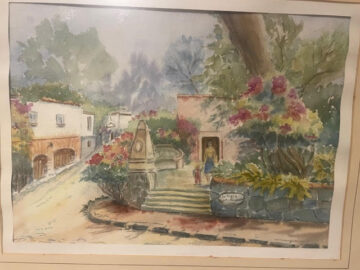
An impressionistic watercolor by Marta Camarena: Barbara Fischkin and her first-born son in the plaza in front of of her young family’s rented home in the Plaza de los Arcangeles, in San Angel, Mexico City

Part One: Before Mari Saved Us

This is the back story: Maria Angeles Garcia, known to us as “Mari,” was a godsend to our family. In part two, which I plan to publish in May, readers will find out more about how this young, single mother from a small village in northern Mexico moved with us to, of all places, Hong Kong.

That move was in 1989. A few years earlier Mari had left her children with relatives with plans to earn money as a domestic worker in la capital, Mexico City—and then return home to give her family a better life. Eventually she came to work for us. Within a year, my husband was notified he would be transferred to Hong Kong. We asked Mari if she would come with us for a short while. We never expected her to say yes. But she did.

Mari grew up hearing both Spanish and an indigenous language. In Hong Kong, most people speak English and Cantonese. Regardless of geography, the underlying job wouldn’t change. When I was working as a journalist, from a home office or out doing interviews, I needed a nanny to take my first-born toddler son on small excursions. I didn’t want him locked behind the walls of our palatial home. I wanted him out and about, playing with neighborhood kids and savoring the bright colored flowers. I wanted him to suck oranges Mari picked right off the tree and to enjoy the aroma of elote— corn—roasting on sidewalk barbeques.

 Mari knew that in Hong Kong, things would change. She mustered the courage, the fortitude and a free-range sensibility to spend a few months with us in Asia. She could have easily found another position in Mexico City. But she was intent on doing her job and frankly wanted to make sure our family, especially the child, transitioned safely.

After watching Mari in action, I knew so much more about assessing and hiring good household help. Typically, I did a good job. This chapter, though, is about the ones who came before Mari. Some had their moments of glory. Most get lost in her shadow. Read more »