by Tim Sommers
Most of the evidence available to us suggests that there is something.
There are probably electrons and other fundamental particles, as well as fields and fundamental forces, likely there are planets, stars, black holes, and galaxies, and there are probably even, what Quine called, “medium-sized” objects: tables, chairs, dogs, and us.
As far as I understand it, however, there is nothing that we know of that couldn’t not exist or go out of existence – including electrons. Although, an electron’s lifespan is long – something like 66,000 yottayears. (I know, I know yottayears sound made up, but it’s 1028 years.) This is a much longer life span than the life span of the universe itself – which won’t extend to more than 100 trillion years or so.
Anyway, if every single thing could not exist, then everything could not exist all at once, and so there would and could be nothing. And if there could be nothing, why isn’t there nothing? Existing is more complicated – and energy intensive – than not existing, so, it would seem that the universe would tend towards nothing.
On the other hand, when I said that the lifetime of the universe, though long, is finite, I was following cosmologists who don’t really mean that the universe will literally go out of existence eventually. They mean that the universe will undergo heat death.
Everything interesting thing about the universe – including life and information – is a result of energy gradients. They cool your coffee, make your computer compute, and create waterfalls. Energy gradients make stuff happen.
Energy gradients exist wherever two points sufficiently proximate to one another have different levels of energy, causing the energy to flow from the more energetic point to the less energetic point. Energy gradients, in action, eliminate themselves by spreading their energy out more evenly. Entropy is the measure of this process. Energy gradients push the universe towards a state where everything is distributed uniformly and nothing interesting can ever happen again. Heat death.
However, the point is that heat death is not itself, literally, the end of the universe. Nevertheless, if the fundamental particles have finite life-spans, no matter how long, the universe as a whole will eventually experience heat death and then, some time later, go out of existence entirely.*
Nothing is coming. And nothing can come from nothing. As Heidegger put it, “The Nothing Nothings.” So, once there is nothing, the conventional wisdom goes, there can’t ever be anything again. Read more »



 One argument for the existence of a creator /designer of the universe that is popular in public and academic circles is the fine-tuning argument. It is argued that if one or more of nature’s physical constants as mathematically accounted for in subatomic physics had varied just by an infinitesimal amount, life would not exist in the universe. Some claim, for example, with an infinitesimal difference in certain physical constants the Big Bang would have collapsed upon itself before life could form or elements like carbon essential for life would never have formed. The specific settings that make life possible seem to be set to almost incomprehensible infinitesimal precision. It would be incredibly lucky to have these settings be the result of pure chance. The best explanation for life is not physics alone but the existence of a creator/designer who intentionally fine-tuned physical laws and fundamental constants of physics to make life physically possible in the universe. In other words, the best explanation for the existence of life in general and ourselves in particular, is not chance but a theistic version of a designer of the universe.
 Sughra Raza. Scattered Color. Italy, 2012.

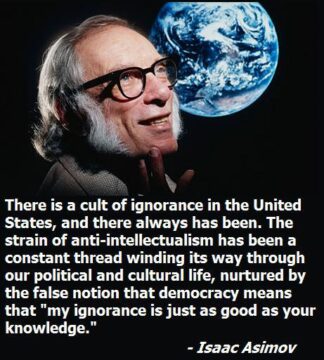



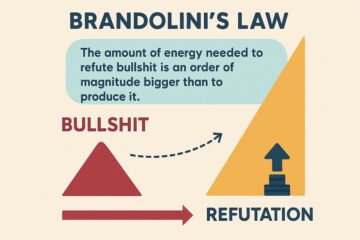 As atrocious, appalling, and abhorrent as Trump’s countless spirit-sapping outrages are, I’d like to move a little beyond adumbrating them and instead suggest a few ideas that make them even more pernicious than they first seem. Underlying the outrages are his cruelty, narcissism and ignorance, made worse by the fact that he listens to no one other than his worst enablers. On rare occasions, these are the commentators on Fox News who are generally indistinguishable from the sycophants in his cabinet, A Parliament of Whores,” to use the title of P.J. O’Rourke’s hilarious book. (No offense intended toward sex workers.) Stalin is reputed to have said that a single death is a tragedy, a million deaths is a statistic. Paraphrasing it, I note that a single mistake, insult, or consciously false statement by a politician is, of course, a serious offense, but 25,000 of them is a statistic. Continuing with a variant of another comment often attributed to Stalin, I can imagine Trump asking, “How many divisions do CNN and the NY Times have.”