by Thomas Fernandes
Interest often begins in surprise. It may arise from the encounter of something new or the clarity of insight, when a complex thing finds a simple resolution. We may also be blind in two ways. The first lies in what we fail to notice, and thus cannot be surprised by. The other lies in what we take for granted, missing the complexity.
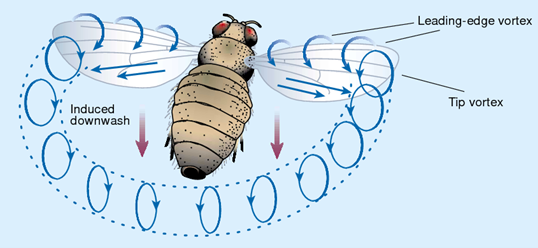
Consider something you’ve likely seen all your life and are possibly afraid of: the honeybee. Honeybees represent but a few species of the 20 000 species of bees, most of which are solitary bees laying their eggs in tunnels or dead wood. Yet they are the most notorious. But how well do we see them?
We notice them flying, but are we surprised? Until the 2000s, scientists could not explain how bees fly. As the story goes, in the 1930s, engineers considered bee flight aerodynamically impossible. It was found that, by all accounts, their wings shouldn’t be able to lift their bodies. Yet the answer was found in a very different mechanism of controlled turbulence. Specifically, it was found that bees rely on leading edge vortices. Insects in general do not rely on steady flow of air but create controlled turbulence called a vortex at the top of their wings. By sweeping their wings at a sharp angle bees generate “horizontal mini-tornadoes” that are then pinned on top of the wing. The low-pressure zones of the “eyes” of those mini tornadoes carries them aloft. This is very similar to staying aloft in water by sculling: moving your hand back and forth at an angle in a figure-eight movement. In this pattern both directions create lift, contrary to bird flight. Slow-motion footage reveals bees “swimming through the air” more vividly.
This discovery only brings about a new deeper mystery that might fail to surprise us. To keep those vortices anchored to the wings, bees must beat their wings fast, 230 beats per second on average. Read more »
 When Representative (now House Speaker) Mike Johnson




 The stock market, social media, award contests, product reviews, beauty contests, social media, fashion styles, job applications, award contests, product reviews, and even elections, don’t seem to belong in the same crowded sentence. What do they have in common? Before I get there, a couple of abstract analogues to pave the way.







 groups of citizens. Let’s call them the Shirts and the Skins. The Shirts believe homosexuality is an abomination that stinketh in the nostrils of the Lord, and abortion is baby murder. The Skins believe homosexuality is perfectly normal and natural, and abortion is a woman’s right. How can we build a society where those groups can get along without killing each other?