
God Is Dead And No One Cares

by Kevin Lively

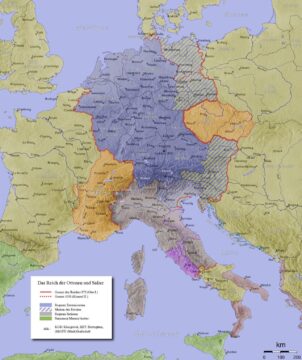
The fragmented Holy Roman Empire (HRE) around 1000 AD in many senses formed the kernel of all subsequent geopolitics in Central Europe. Lotharingia originally comprised the territories stretching from the Netherlands in the north to Burgundy in modern south-eastern France. Lorraine, whose name derives from this region, was in perennial dispute between French and German elites from the treaty of Verdun (843 AD) until WWII. The Eastern Slavic-Hungarian Marches, or border regions, run from the Northern March encompassing modern Berlin, south to the Balkans. These Eastern Marches roughly formed the Western edge of the Soviet satellite states throughout the cold war.

Nietzsche saw it coming early. The Europeans drowned God in the gore of Lotharingia during WWI. They dismembered the body on the Marca Geronis in WWII. They immolated the corpse with a funeral pyre made from human beings during the Holocaust. Purging these residual “ethnic impurities” sealed the millennia of ritualistic slaughter which constituted the history of nation-state formation in Europe from Charlemagne until the modern system of international relations.

With the latest brazen attack by the United States on a sovereign nation in utter disregard for the legal formalism of international diplomacy, the current framework of diplomacy between states is likewise prostrate upon the altar, with another pyre in the making.

The Fading of Past International Orders

The organs of International Law which were instituted after the conclusion of WWII were intended to be the framework in which nation-states non-violently adjudicate disagreements between themselves. Due to centuries of expanding and re-expanding the Marches, by 1945 the empires of Western Europe, the USA and the Soviet Union were in direct control of, or possessed a preponderance of influence over, the bulk of the world’s labor capacity and resources. However, by squinting somewhat, one can see an analogy of limited usefulness between the United Nations and some aspects of the various roles the Catholic Church played for the centuries from about 920 AD until about the Protestant reformation circa the 1520s.

That is to say, the church was a long-lived institutional and cultural supra-structure which transcended the loss of power by any one individual or group of individuals. The Church claimed some universalistic authority over moral approval of conflicts between the various medieval warlords and regional hegemons. Similarly, the UN of course is theoretically invested with the capacity to collectively approve of inter-state war or sanctions under some semi-transparent legalistic process. Read more »
Sunday, June 29, 2025

We Who Play With The World: On the Long Second World War and the origins of the fight to preserve colonialism

by Kevin Lively

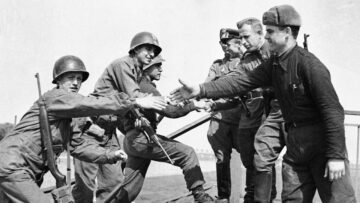
The first line of contact is established between the Allied and Russian armies on the Elbe river near Torgau, Germany on April 25, 1945.

Introduction

This article is part two of a longer series. Check out part one for my framing of the Cold War Military-Keynesianism which characterized the US and USSR economies at the dawn of the space-age.

I’ve opened many questions in my last article and I shan’t be able to close them. Oceans of ink have been spilt trying to satisfactorily answer questions of war and peace; I am not deluded enough to believe that I shall be able to do so. Nonetheless I would humbly submit to your consideration a collection of stories from the perspective of people who found themselves in a rare moment of history, when the old world order had drowned in an orgy of blood and a new one was rising from the ashes. At this inflection point in history, questions of land, power and death were in open debate within global centers of power which were endowed with a freedom of decision-making rarely seen in the long history of international affairs. If you fear, as I do, that this historical precedent bears increasing relevance in today’s geopolitical climate, then we should seek to understand the perspectives of these long dead warlords, the considerations which shaped the world and the consequences which we as a species continue to grapple with.

Topics this large must necessarily be broken into multiple essays. In this one I shall begin with the choices made at the end of WWII to recover from what may as well have a stage rehearsal for the apocalypse. I want to chart how, in quieting some of the guns around the world, US military spending transitioned through its low-point in 1949 into an abrupt reversal — leading to a steady-state war economy at the outset of the Cold War in 1950. The course of events underlying this coincided with an onset of USSR nuclear capability, the “loss of China” to the Chinese Communist Party, and the beginning of the Korean war, all while setting the stage for Vietnam. Here I will only have space to begin this story.

Framing the Narrative

Captain Hindsight is the patron saint of historians and armchair generals alike. After the primary actors are long buried and the security situation so changed as to make classification irrelevant, the internal planning documents which weren’t hastily burned are finally released. The USA in particular used to have a strong commitment to regular declassification of non-technically sensitive material. Internal planning documents from WWII and its immediate aftermath were slowly released within a roughly 30-40 year time horizon, continuing into the 1970s. One can peruse to their hearts content much of the internal records of US administrations up to Carter before the share of still-classified topics begins to balloon out of proportion. Nowadays one is reliant on the occasional leak, either from sites like Wiki leaks, The Intercept or somewhat bizarrely and with increasing frequency, video game servers like War Thunder. Read more »