
God Is Dead And No One Cares

by Kevin Lively

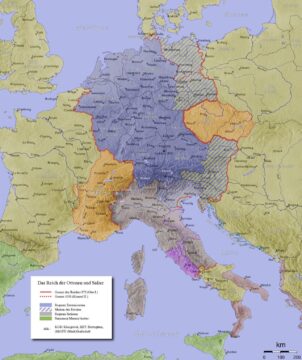
The fragmented Holy Roman Empire (HRE) around 1000 AD in many senses formed the kernel of all subsequent geopolitics in Central Europe. Lotharingia originally comprised the territories stretching from the Netherlands in the north to Burgundy in modern south-eastern France. Lorraine, whose name derives from this region, was in perennial dispute between French and German elites from the treaty of Verdun (843 AD) until WWII. The Eastern Slavic-Hungarian Marches, or border regions, run from the Northern March encompassing modern Berlin, south to the Balkans. These Eastern Marches roughly formed the Western edge of the Soviet satellite states throughout the cold war.

Nietzsche saw it coming early. The Europeans drowned God in the gore of Lotharingia during WWI. They dismembered the body on the Marca Geronis in WWII. They immolated the corpse with a funeral pyre made from human beings during the Holocaust. Purging these residual “ethnic impurities” sealed the millennia of ritualistic slaughter which constituted the history of nation-state formation in Europe from Charlemagne until the modern system of international relations.

With the latest brazen attack by the United States on a sovereign nation in utter disregard for the legal formalism of international diplomacy, the current framework of diplomacy between states is likewise prostrate upon the altar, with another pyre in the making.

The Fading of Past International Orders

The organs of International Law which were instituted after the conclusion of WWII were intended to be the framework in which nation-states non-violently adjudicate disagreements between themselves. Due to centuries of expanding and re-expanding the Marches, by 1945 the empires of Western Europe, the USA and the Soviet Union were in direct control of, or possessed a preponderance of influence over, the bulk of the world’s labor capacity and resources. However, by squinting somewhat, one can see an analogy of limited usefulness between the United Nations and some aspects of the various roles the Catholic Church played for the centuries from about 920 AD until about the Protestant reformation circa the 1520s.

That is to say, the church was a long-lived institutional and cultural supra-structure which transcended the loss of power by any one individual or group of individuals. The Church claimed some universalistic authority over moral approval of conflicts between the various medieval warlords and regional hegemons. Similarly, the UN of course is theoretically invested with the capacity to collectively approve of inter-state war or sanctions under some semi-transparent legalistic process. Read more »

Thursday, May 1, 2025

Masters of War

by Kevin Lively

“What this country needs is a good war.”, my Grandfather declared in 2008 while we were gathered at his table in Buffalo with Fox News playing in the background, the TV lit up red with crashing market charts. “It’s the only thing that will fix the economy” he continued. No one pointed out that as these words were spoken, there were, put together, around 200,000 US troops deployed in Afghanistan and Iraq. Now, my grandfather was a good man, hard working, pious, and hardly prone to such statements. Yet, like many Americans who lived through the Great Depression, it was also deeply ingrained in his psyche that the event which led to prosperity during his adulthood, the greatness many are eager to return to, was also the bloodiest human driven catastrophe in history, WWII.

Hamburg, Germany after Allied bombing, left, and Levittown NY, in 1959 right

This is of course a widely accepted truism among US economists and historians, as the state department’s Office of the Historian will tell you. It is also part of the cultural fabric to extol the moral virtues of this particular war, given that it destroyed a regime which essentially defines the modern conception of evil. Of course, as with everything else in history, some of this triumphalist patting ourselves on the back is white-washed. It turns out there was more support in the USA for Nazism before the war than is often remembered, including in the business arrangements of the Bush dynasty’s progenitor. This should not be too surprising given that leading medical journal editors in the USA were urging that the public be persuaded on moral grounds to adopt similar eugenics policies as the Nazis enforced in the 1930s.

In any case, the other accepted truism about this turn of events is that America, as the victorious industrial superpower, realized that its isolationism had only helped lead to the calamity. Therefore, like it or not, it must shoulder the burden of power, stand against the rising communist threat to make the world safe for democracy, and establish the Pax Americana which we have enjoyed since.

As with any good myth, much of this is true. Read more »