
Uff Da! Yeah, You Betcha.

by Mark R. DeLong

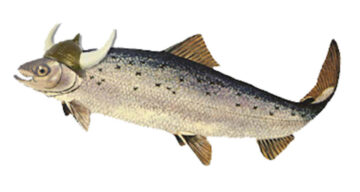
A colorful ocean fish (cod?) with its tail curled as if swimming wears a Viking helmet with two horns.
Ingebretsen’s Nordic Marketplace, “Maybe Lutefisk Isn’t What You Think It Is”

My mother ordered the annual parcel of lutefisk from Olsen Fish Company in Minneapolis, Minnesota. Determined to bring some of her Minnesota Norwegian Christmas tradition to our home in Oklahoma, where our family moved when I was in high school, she phoned in the order in November or even earlier. The package appeared a few days later, fish solidly frozen in dry ice—probably the only package of lutefisk to arrive in the state. When she nestled the butcher-paper wrapped lump into the freezer, I knew we were doomed.

She was trying to invoke Christmases she had lived in Minnesota, and a big part of that had to do with smell, the sense especially tied with memory.

Lutefisk dinners were common in Lutheran church basements in the upper Midwest US, and still happen even though some never recovered from the disruption of the Covid pandemic. Nationally, lutefisk sales slumped then and only recovered to about 300,000 pounds in 2022, significantly lower than the 800,000-or-so pounds made in the early 1990s. In small towns like the one I grew up in, the feasts always took place around Christmas, and the rumor in my home village was that churches, despite their doctrinal differences, would coordinate schedules such that it was possible to have a lutefisk dinner several times during the season. The fish, I guess, drove a true ecumenical movement and drew together the large community of families whose ancestors had immigrated from Scandinavia. Generations knew the odd pleasures of lutefisk first-hand, though, no doubt, the draw of the Christmas dinner fish puzzles many of them (including me).

Lutefisk, to put it bluntly, stinks. And that, ironically, might be part of its charm. Read more »
Sunday, July 27, 2025

A Warmer View of The Disturbed Paternal Grandparents I Never Knew—The Memoir Continues

by Barbara Fischkin

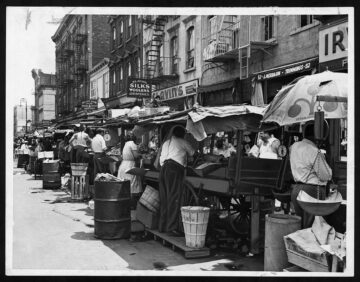
Brownsville, Brooklyn, New York, 1930’s. “Pushcart Market,” similar to one frequented by the shared paternal grandmother of Barbara Fischkin and her Cousin Bernie.  Source:  Library of Congress. Photographer: Alan Fisher.

Cousin Bernie’s Own Memoir Surfaces Years After His Death

(a.k.a Cousin Bernie, Free-Range Professor-Part Three)

As much as I loved my late Cousin Bernie, I figured that in regard to my own memoir, I was done with him. Cousins are great but those two earlier chapters—on just one cousin—were more than enough.

Then… I heard from Bernie.

A heavenly nudge.

Years after his death, I believed I could identify his voice with its gravelly Brooklyn twang, slightly tempered by a slower drawl acquired during decades in the Midwest.

“There is a lot more to write about me. And if it is about me, then it is also about you.”

I wish I could report that this actually came from the afterlife.

Nope.

It came from the post office.

Joan Hamilton Morris, Cousin Bernie’s widow, mailed his unpublished memoir to me, after she found it while moving to a new assisted living residence. That was about a month ago. I never knew it existed. Now, I had it in hand—Cousin Bernie’s memoir, written quietly in an adult education class he took after retiring as an honored professor of Psychology and Mathematics at a public university in Indianapolis, Indiana.

I flipped through the typewritten, hard copy pages, stopping early at a description of my Grandpa Phillip. He had died before I was born and all I knew about him, from my parents, was that he had been a handsome, drunken, sporadically employed, womanizer who beat his sons and his long-suffering wife, Grandma Toby. Nice. Grandma Toby died young. Grandpa Phillip subsequently romanced a new bevy of women and then, sort of made up for past sins by marrying one of them.

Despite being decades apart in age, Bernie was my first cousin. This explains why we had the same paternal grandparents. Except, unlike me, he had known them. And so, thanks to Cousin Bernie, I read about a different version of Grandpa Phillip. And learned more about Grandma Toby, too. Read more »