A Warmer View of The Disturbed Paternal Grandparents I Never Knew—The Memoir Continues

by Barbara Fischkin

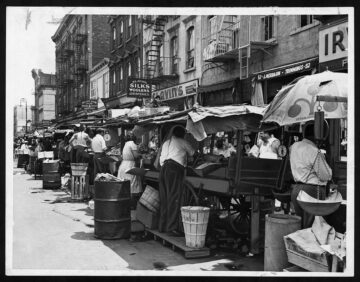
Brownsville, Brooklyn, New York, 1930’s. “Pushcart Market,” similar to one frequented by the shared paternal grandmother of Barbara Fischkin and her Cousin Bernie.  Source:  Library of Congress. Photographer: Alan Fisher.

Cousin Bernie’s Own Memoir Surfaces Years After His Death

(a.k.a Cousin Bernie, Free-Range Professor-Part Three)

As much as I loved my late Cousin Bernie, I figured that in regard to my own memoir, I was done with him. Cousins are great but those two earlier chapters—on just one cousin—were more than enough.

Then… I heard from Bernie.

A heavenly nudge.

Years after his death, I believed I could identify his voice with its gravelly Brooklyn twang, slightly tempered by a slower drawl acquired during decades in the Midwest.

“There is a lot more to write about me. And if it is about me, then it is also about you.”

I wish I could report that this actually came from the afterlife.

Nope.

It came from the post office.

Joan Hamilton Morris, Cousin Bernie’s widow, mailed his unpublished memoir to me, after she found it while moving to a new assisted living residence. That was about a month ago. I never knew it existed. Now, I had it in hand—Cousin Bernie’s memoir, written quietly in an adult education class he took after retiring as an honored professor of Psychology and Mathematics at a public university in Indianapolis, Indiana.

I flipped through the typewritten, hard copy pages, stopping early at a description of my Grandpa Phillip. He had died before I was born and all I knew about him, from my parents, was that he had been a handsome, drunken, sporadically employed, womanizer who beat his sons and his long-suffering wife, Grandma Toby. Nice. Grandma Toby died young. Grandpa Phillip subsequently romanced a new bevy of women and then, sort of made up for past sins by marrying one of them.

Despite being decades apart in age, Bernie was my first cousin. This explains why we had the same paternal grandparents. Except, unlike me, he had known them. And so, thanks to Cousin Bernie, I read about a different version of Grandpa Phillip. And learned more about Grandma Toby, too. Read more »

Monday, February 5, 2024

A Tale of Two Appliances

by Barbara Fischkin

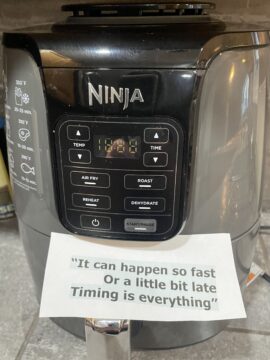
Our air fryer adorned with lyrics by Garrett Hedlund

Part One

This story begins, as no great story ever has, with a dustbuster.

That’s right: A cordless, rechargeable handheld vacuum cleaner. If you don’t know, consider yourself lucky. It means you have had so much household help, that you never needed to recognize that dustbusters exist. Align yourself with George H.W. Bush, amazed, as he was, by a supermarket scanner.

A dustbuster once infiltrated my life and as much as I would like to make it the culprit of part one of this story, I blame two other operatives. For a dustbuster to be an actual culprit it would have to star in an anime film—or take on the alternative meanings assigned to it by the Urban Dictionary. (Don’t go there for this particular word, unless  you want to read about raunch—or worse—ice hockey.)

As for the actual culprits, they are my husband Jim Mulvaney and his late mother, Eileen O’Keefe Mulvaney. My husband is an intrinsically good guy. But nobody is perfect. My mother-in-law—whom I loved deeply—had her own flaws. Super practical, but  more about other people’s needs as opposed to her own. When we cleaned out her house, we found scores of nearly identical striped, button-down oxford shirts in their original packaging. I realized it was the shirt she wore on a daily basis. She was not a serious hoarder. She just hated going to the dry cleaners. Read more »

Monday, January 8, 2024

War and Coincidence: My new-old friend in Ukraine

by Barbara Fischkin

Oksana Fuk of Ukraine. Fuk Family photo

At dawn on February 24, 2022, Russian President Vladimir Putin announced a “special military operation,” in Ukraine—a euphemism for war, if ever there was one. Since that morning, the fortitude of the Ukrainian people has resounded, even as the Middle East vies for our attention. For me, evidence of this grit—as fertile as Ukraine’s soil—arrives weekly, if not daily, in messages from a young woman in a western city. She writes from Ternopil, a relatively safe place. But from her I have heard that no place in Ukraine is truly safe.

 I have also heard that its people are determined to stay, survive and rebuild.

My contact is not a war correspondent. She is an English language instructor, a teacher, a college administrator and the mother of two small children. In other words: A regular citizen. Her name is Oksana Fuk and we have been corresponding since hours after that terrifying dawn, almost two years ago, when Russia invaded her country.

We may have met in person years ago, when she was an internationally-recruited counselor at a camp for developmentally disabled children and adults in the upstate New York Catskill Mountains. What we are sure about is that she knows our elder son, Daniel Mulvaney, who has non-speaking autism and attended this camp for many summers.

On February 24, 2022, as I was searching for more news about the invasion—my mother was born in Ukraine—Oksana’s name popped up on my Facebook feed. I saw that she had worked at Dan’s camp.

When we first connected it was 4 p.m. on Long Island where I live. By then the invasion that morning had been front page news worldwide. It was 11 p.m. in Ternopil. Read more »

Monday, December 11, 2023

For My Jewish Refugee Family, Brooklyn Was The Promised Land

by Barbara Fischkin

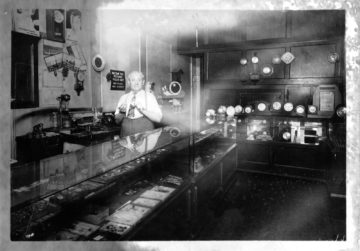
My refugee grandfather, Isaac Siegel, in his New York City  watchmaking shop, on St. John’s Place in Brooklyn, probably in the 1940s. The black and white sign on the wall behind his head is an advertisement for an accountant—my father, David Fischkin, who was his son-in-law. Family photo.

In 1919, after a brutal anti-Semitic pogrom in a small Eastern European shtetl, my grandfather knew that his wife and three young children would be better off as refugees. He prepared them to trek by foot and in horse-drawn carts from Ukraine to the English Channel and eventually to a Scottish port. Finally they sailed in steerage class to the United States. My grandfather was a simple watchmaker—and one of the visionaries of his time. Europe, he told his tearful wife, was not finished with murdering Jews, adding that things were likely to get much worse. And so, my grandmother became a hero, too. She said farewell to her mother and sister, knowing she would never see them again. In Scotland, she descended to the lower level of a ship with her children—my mother, the eldest, was seven years old. My grandmother traveled alone with her children. My grandfather was refused entry to the ship. He had lice in his hair. He arrived in the United States weeks, or possibly months, later.

My grandfather, Ayzie Zygal of Felshtin, Ukraine became Isaac Siegel of Brooklyn, New York, where he lived for the rest of his life. In his later years he spent summers in the Catskill Mountains, always asking to be let out of the family car a mile before reaching Hilltop House, a bungalow colony. My grandfather wanted to walk that last mile along the local creek. It reminded him of the River Felshtin. He never regretted coming to America.

My grandparents died, in Brooklyn in their early sixties. My grandfather had been poisoned by the radium he used on the paint brushes in his shop to make the hours glow. He licked them, with panache, to make them sharper. My grandmother had a heart condition, exacerbated by diabetes. They were both gone before I turned three.

They had lived much longer than they had expected they would in 1919.

I was told my grandfather left Europe to save his family’s life. And because my mother narrowly escaped death. I was told he did not believe there would be any more miracles. Read more »