
by Mike Bendzela
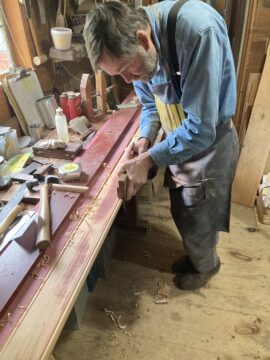
This concludes the story from last month about the ongoing restoration of a Maine farmhouse by woodworker Don Essman, who is also my spouse. Over the years, Don had built up enough trust with the southern states descendents of the historic property to be permitted to live on the farm rent-free, in exchange for his completing yearly construction and restoration projects. Before I arrived on the scene in 1985, he had re-sided parts of the kitchen ell with clapboards; installed a hand-pumped cistern in the attic to supply running water to the kitchen; and bought a wood-fired Glenwood cook stove from a neighbor with a piped-in water front to heat hot water as needed. A calf waterer set up in the kitchen and filled with hot water was suitable enough for him as a bathtub. He also put new sill timbers under the front of the main house; he reframed walls, insulating with fiberglass as he went; and he began replacing the large windows installed in the late 19th century to “Victorianize” the place with smaller, more period appropriate nine-over-six window sashes.
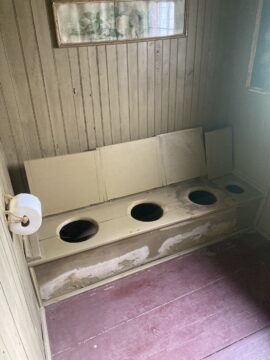
For years he used the old privy or “four-holer” (an outhouse connected to the barn), which never bothered him. The one time his parents visited Maine in those early years, his mother understandably wouldn’t use the privy and asked to be driven to a gas station to use the restroom. Only at the urgings of the owner and a future roommate did Don install an electric water pump and a modern bathroom. The facilities were completed by the time I moved in with him in 1986.
Don’s parents were well-educated, middle class professionals who raised him in the fifties and sixties in suburban Concord, Massachusetts, so his country digs in Maine were completely foreign to his upbringing. When I asked him whether Thoreau’s writings had influenced his decision to live “the simple life” (he worked at the Concord library in high school and swam in Walden Pond as a kid), his answer surprised me: “Not really. Modern life just never appealed to me much.” This is no “Luddite” speaking: He was a technologies major who did all his own plumbing, wiring, and construction on the house. He believes, though, that “modern life is just more complex than it needs to be.” This is ironic considering that our everyday, DIY lifestyle together is much more complex than the average American’s. It has taken decades to bring the old farmhouse up to standards that most would consider modern, though we continue to use mostly wood for fuel and raise a lot of our own food. As I like to say, “The simple life ain’t so simple.”
For income after college, Don began working out of the farm’s woodshop repairing furniture, making tall clocks, and doing home improvements for neighbors. In 1984, the southern owners, who were now in their seventies and requiring all modern amenities for when they came up north to visit for the summer, asked Don to build a cottage for them in the old style, a post-and-beam Cape Cod, a “half-Cape,” meaning it has half the profile of the old farmhouse. In exchange, Don got eight acres of adjoining land on which to build his own house in the future. It was on the cottage project that I first learned how complex and difficult construction is, and I became impressed with Don’s abilities to manage the project. I helped raise the frame, nailed off sheathing and clapboards, put up gypsum wall board, did a lot of painting–things an English major can accomplish without hurting himself or having to deal with too much of a learning curve.
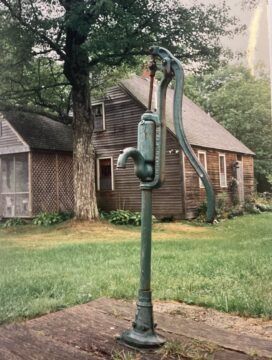
The projects on the main farmhouse resumed, room-by-room, over the decades I lived with Don at the place, until the structure was completely restored, from the repointed granite cellar walls and rebuilt chimneys (done by a mason who is a good friend), to the replaced framing and timbers in floors, to the repaneled walls and wainscotting, to the new roof, replaced twice, the first time with wood shingles, the second time with metal. His efforts have earned him a Maine Preservation Honor Award (there are excellent pictures and a video of the place on their website), and his work was featured in the book Restoring Your Historic House by Scott T. Hanson.
As a part-time writer, I have always been struck by the stories associated with the rooms, artifacts, and furniture in the house. Because Don had developed a good rapport with one of the owners of the property, Claude White (“Uncle Claude”), he became familiar with the entire known history of the place and its furnishings, from Claude’s Aunt Pearle taking him and his sister out to the old privy, to Grandfather Herbert Dow allowing Claude as a boy to ride on his lap while he mowed hay with his team of horses, to stories about the contents of the house and attic that had been stolen by the time Don arrived there.
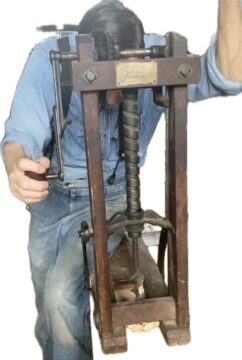
One such artifact: Don had always wanted a hand-operated boring machine to help him cut mortises in timbers. You drill large holes at the correct intervals for the pockets then use chisels to square up the corners. One day when he was out with his roommate at the time at a local antiques auction in the next town over, the roommate said, “They have one of those boring machines you’ve been looking for . . . And he’s bringing it up for bidding right now!” When the auctioneer called out for a bid, the roommate grabbed Don’s arm and lifted it into the air to initiate his involvement. “Sold!” the auctioneer said, as there were no others bidders.
When Don got the boring machine home, he noticed a label that had the name of a Dow family relative on it, Claude’s uncle Edgar. Don learned later from Claude that that very machine was a piece he remembered seeing in the farm’s wood shop as a kid, one of two boring machines that had been used to construct the big barn in the 1870s. Don surmises both boring machines had been stolen from the wood shop in the 1970s, and the one he bid on ended up at the local auction, where he was able to buy it and bring it back home. He has used Edgar Dow’s boring machine to cut all the mortises for timbers he has replaced on the farmstead since about 1983.
Another house piece that found its way back home through a tortuous series of events is an 1830s, birch-and-bird’s-eye-maple, ball-and-cannon style rope bed. A neighbor who worked at a chicken barn down the road informed Don that “Jerry has drunk the farm away.” Before the bank took it over, the foreclosed-upon owner had invited neighbors to come over and “help themselves because I got what I want.” Why let the bank get it all? So, Don and another neighbor went down the road to the chicken farm to see what was there. Don found the stripped and shellacked bed and immediately recognized that the legs had been cut down and the corner posts had been notched to accommodate a full-size modern box spring mattress. He took the bed home, along with an early 19th century ogee clock with strawberries painted on the glass.
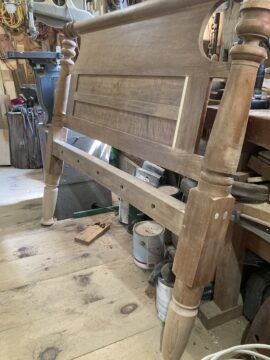
When Don showed the bed to a neighbor who had been the original owner of the chicken farm (not Jerry, the foreclosed-upon farmer), he said, “Oh, Pearle gave me that long ago,” meaning Aunt Pearle, the last continuous occupant of Dow Farm. She had given him the ogee clock as well. The neighbor had cut off the legs because the modern box spring sat too high on the rope bed.
The bed and clock had probably been sitting in the woodshed attic until the 1930s when the neighbor needed them. And when he had sold the chicken farm to the drunk, the bed and clock stayed with the property. Since I’ve lived here that property has exchanged hands numerous times and the chicken farm has been wiped off the map. At least the bed is back home, with four newly-turned corner post legs. This story has a jarring ending: While in his shop turning one of the replacement corner post legs, the maple block came free of the lathe and bonked Don on the forehead, requiring a trip to the emergency room and several stitches.
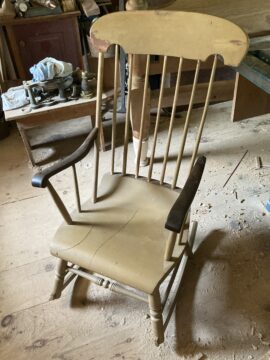
To me, the most charming story concerns a Boston rocker I call “The Frankenchair.” After the house had been pillaged of oak furniture in the 70s, the family put the remaining furniture in storage (which, ironically, was from an even earlier period but out of style at the time when oak was all the rage), leaving behind broken pieces and parts in the attic. Later rummaging under the eaves, Don found pine rocking chair seats, broken maple spindles and chair backs, and walnut arms. Sorting through these ruins, he discovered parts from at least three different chairs of similar style. Don “made a marriage” of the old parts, combining pieces and fabricating new ones, including turning and steaming new spindles, to create a lovely–and comfortable–painted Boston rocker with walnut arms. It’s a project that has spanned decades, as parts continually break out of the chair and have to be replaced. One day, it will receive its final touch, a grained painted finish.
I find Don’s accomplishments to be extraordinary, out-of-the-times, even. Who makes furniture with their own hands anymore? Even though time turns all our accomplishments to dust, and this Maine farmhouse is just one dwelling out of billions on the planet, Don’s work is still worth documenting. It’s “a small, good thing,” to borrow a phrase from story writer Raymond Carver, something that positively affects a few people’s lives while preserving a bit of northern New England history.
Before finishing this piece, I asked Don what he thinks I should now know about American life that I wouldn’t know about had I not lived here with him in this place all these years. I expected a concrete answer but received something more philosophical:
“Money isn’t everything. Advertising lies to you. You don’t need the latest gadget.”
I would add, “And doing things with your own hands is worth the effort.”
Images
Photographs by the author.
Enjoying the content on 3QD? Help keep us going by donating now.