
God Is Dead And No One Cares

by Kevin Lively

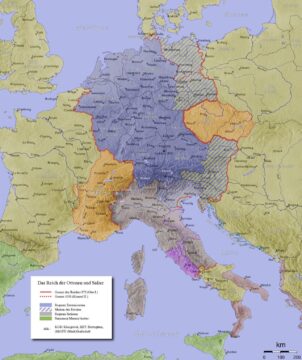
The fragmented Holy Roman Empire (HRE) around 1000 AD in many senses formed the kernel of all subsequent geopolitics in Central Europe. Lotharingia originally comprised the territories stretching from the Netherlands in the north to Burgundy in modern south-eastern France. Lorraine, whose name derives from this region, was in perennial dispute between French and German elites from the treaty of Verdun (843 AD) until WWII. The Eastern Slavic-Hungarian Marches, or border regions, run from the Northern March encompassing modern Berlin, south to the Balkans. These Eastern Marches roughly formed the Western edge of the Soviet satellite states throughout the cold war.

Nietzsche saw it coming early. The Europeans drowned God in the gore of Lotharingia during WWI. They dismembered the body on the Marca Geronis in WWII. They immolated the corpse with a funeral pyre made from human beings during the Holocaust. Purging these residual “ethnic impurities” sealed the millennia of ritualistic slaughter which constituted the history of nation-state formation in Europe from Charlemagne until the modern system of international relations.

With the latest brazen attack by the United States on a sovereign nation in utter disregard for the legal formalism of international diplomacy, the current framework of diplomacy between states is likewise prostrate upon the altar, with another pyre in the making.

The Fading of Past International Orders

The organs of International Law which were instituted after the conclusion of WWII were intended to be the framework in which nation-states non-violently adjudicate disagreements between themselves. Due to centuries of expanding and re-expanding the Marches, by 1945 the empires of Western Europe, the USA and the Soviet Union were in direct control of, or possessed a preponderance of influence over, the bulk of the world’s labor capacity and resources. However, by squinting somewhat, one can see an analogy of limited usefulness between the United Nations and some aspects of the various roles the Catholic Church played for the centuries from about 920 AD until about the Protestant reformation circa the 1520s.

That is to say, the church was a long-lived institutional and cultural supra-structure which transcended the loss of power by any one individual or group of individuals. The Church claimed some universalistic authority over moral approval of conflicts between the various medieval warlords and regional hegemons. Similarly, the UN of course is theoretically invested with the capacity to collectively approve of inter-state war or sanctions under some semi-transparent legalistic process. Read more »
Monday, July 7, 2025

Iran and the burden of knowledge

by Ashutosh Jogalekar

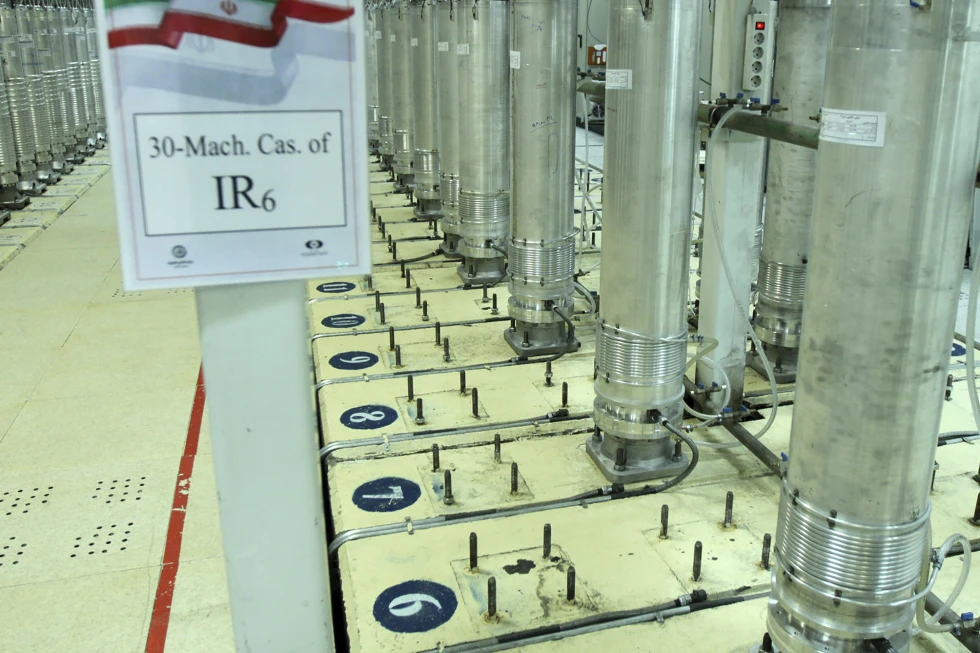
A cascade of IR6 centrifuges at the Natanz facility in Iran: a single IR6 can enrich a kilogram of U-235 from 60% to weapons grade (90%) in about 10 months.

After World War II ended, there began a running debate between American scientists and the American government about how to properly wield the fearsome nuclear power that America had discovered and unleashed. The government believed that this power could be hoarded and used by the U.S. to play geopolitical games in which they held all the cards. The scientists argued that the power that the government thought it possessed exclusively depended on discovering the basic laws of physics, chemistry and engineering, laws that were accessible to scientists in any country.

The scientists were right. Estimates of when the Soviet Union would get nuclear weapons ranged from three to twenty years, revealing a gulf between the scientists and the political and military establishments, with the latter betting on the longer timelines. As it turned out, the Soviets detonated their first bomb in August 1949, a little more than four years after the bombs fell on Hiroshima and Nagasaki. In 1955 they detonated their first thermonuclear bomb. While the Soviet fission bomb was aided by espionage, the discovery of the critical Teller-Ulam mechanism that makes thermonuclear weapons possible was an independent discovery, attesting to the ubiquity of scientific know-how. Britain, China and other countries followed with their own atomic and thermonuclear tests. The Soviet event marked the beginning of an eternal struggle between science and politics in which the government tried to use science for their national interests and the scientists, while sympathetic to this goal, tried to use their expertise to tell the government what was wishful thinking and what wasn’t.

That debate continues to this day and ignores a fundamental truth about science and weaponry that is so deep, fundamental and simple that it seems to be easily misunderstood and misused. That truth is the sheer inevitability of science in enabling the construction of weapons of mass destruction. The latest example of this misunderstanding is the U.S. strike on Iran’s nuclear facilities on June 21, 2025. The military used 14 “bunker busters” (Massive Ordnance Penetrators) to destroy Iran’s nuclear facilities at Natanz, Fordow and Isfahan. These bombs are designed to destroy targets that are 200 feet deep and were targeted at Iran’s uranium enrichment facilities.The enrichment facilities contain centrifuges that can enrich uranium to both reactor grade (4%) and weapons grade (90%) levels. Read more »