The Prevalence of Recursive Reckoning in Everyday Life
by John Allen Paulos The stock market, social media, award contests, product reviews, beauty contests, social media, fashion styles, job applications, award contests, product reviews, and even elections, don’t seem to belong in the same crowded sentence. What do they have in common? Before I get there, a couple of abstract analogues to pave the way.…
Bullshit and Cons: Alberto Brandolini and Mark Twain Issue a Warning About Trump
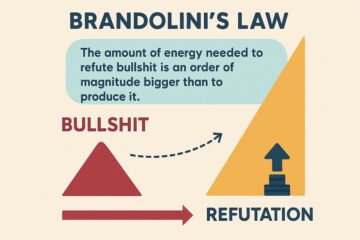
by John Allen Paulos As atrocious, appalling, and abhorrent as Trump’s countless spirit-sapping outrages are, I’d like to move a little beyond adumbrating them and instead suggest a few ideas that make them even more pernicious than they first seem. Underlying the outrages are his cruelty, narcissism and ignorance, made worse by the fact that…
A Simple Model of Lazy Voters and Partisan Politics
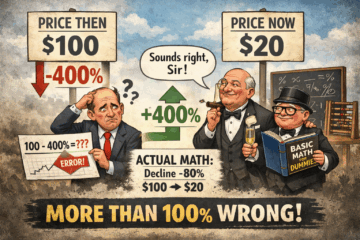
by John Allen Paulos Voters are lazy and often pay little or no attention to numbers and facts presumably relevant to their concerns. I remember initiating a discussion of the housing crisis in the US. I mentioned a headline I claimed to have just read, which stated “Experts Fear Annual Housing Costs in the U.S. –…
Newcomb’s Paradox Revisited
by John Allen Paulos Despite the fact that Newcomb’s paradox was discovered in 1960, I’ve been prompted to discuss it now for three reasons, the first being its inherent interest and counterintuitive conclusions. The two other factors are topical. One is a scheme put forth by Elon Musk in which he offered a small prize…
Chaos, Horseshoes, and Us
by John Allen Paulos When studying a technical field there is a strong temptation, especially among those without a scientific background, to apply its findings in areas where they may not make sense or are merely metaphors. (“Merely” is perhaps unnecessarily dismissive since much of our understanding of these fields is metaphorical.) Quantum mechanics and…
The Statistical Margin of Error – Evaluating the Polls, Weighing the Cows
by John Allen Paulos Every time I read or watch anything about the election I hear some variant of the phrase “margin of error.” My mathematically attuned ears perk up, but usually it’s just a slightly pretentious way of saying the election is very close or else that it’s not very close. Schmargin of error…
The Paradoxical Efficient Market Hypothesis
by John Allen Paulos Election season has put an increased focus on the stock market, but little attention is ever paid to the Efficient Market Hypothesis (the EMH, for short). As I’ve written in A Mathematician Plays the Stock Market, it is a fundamental and important notion, but it is also a little weird. Its…
Mutual Knowledge, Common Knowledge, and Joe Biden
by John Allen Paulos Several years ago the Nobel committee selected two economists, Thomas Schelling of the University of Maryland and Robert Aumann of Hebrew University, to receive the prize for their stellar work on game theory. Aumann has contributed many seminal ideas with real-world applications, one in particular that is especially relevant today. It…
Deep Utopia – Will We Be Terminally Bored or Pleasure Blobs?
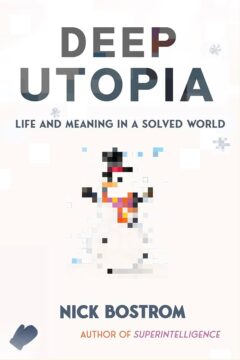
by John Allen Paulos With apologies to Charles Dickens, it will be the best of times, it will be the worst of times. In his recent book, Deep Utopia: Life and Meaning in a Solved World, philosopher Nick Bostrom, the author of Superintelligence, speculates about human and trans-human lives after AI has developed to a kind of…
For a Dollar, For a Battle
by John Allen Paulos An abstract paradox discussed by Yale economist Martin Shubik has a logical skeleton that can, perhaps surprisingly, be shrouded in human flesh in various ways. First Shubik’s seductive theoretical game: We imagine an auctioneer with plans to auction off a dollar bill subject to a rule that bidders must adhere to.…
Aging Gracefully, Infinity, and the Oceanic Feeling
by John Allen Paulos Bertrand Russell’s advice for aging gracefully is rather simple: Broaden your horizons. He recommends that we should try to expand our interests and concerns. Doing so will help us become less focused on ourselves and more open to the world around us. He adds metaphorically, “An individual human existence should be…
Dreams, Stories, and Self-Revelation
by John Allen Paulos Philosopher Daniel Dennett’s new book, I’ve Been Thinking, just came out, and I was reminded of a party game he’s written about. A variant of the child’s game of twenty questions, it is relevant to an increasingly pressing question: How do different social bubbles, media subcultures, or cults develop. Let me…
Try This – A Final Exam in Finite Math
Kurt Gödel’s Loophole, the Israeli Supreme Court, and Strange Loops
by John Allen Paulos Kurt Gödel was a logician whose work in mathematical logic was seminal and fundamental. His famous incompleteness theorems, in particular, have changed our view of mathematics and computer science. He was born in Austria and lived through political turmoil there before fleeing the country after the Nazis annexed it in 1938.…
99 Exercises in Style
by John Allen Paulos Raymond Queneau was a French novelist, poet, mathematician, and co-founder of the Oulipo group about which I wrote last year here. The group is primarily composed of French writers, mathematicians, and academics and explores the use of mathematical and quasi-mathematical techniques in literature. Their work is funny, experimental, weird, and thought-provoking. A reader of…
A Cautionary Note: The Chinese Room Experiment, ChatGPT, and Paperclips
by John Allen Paulos Despite many people’s apocalyptic response to ChatGPT, a great deal of caution and skepticism is in order. Some of it is philosophical, some of it practical and social. Let me begin with the former. Whatever its usefulness, we naturally wonder whether CharGPT and its near relatives understand language and, more generally,…
Some Comments on Writing Popular Mathematics
by John Allen Paulos Intelligibility or precision: to combine the two is impossible. ―Bertrand Russell. Please forgive the long letter; I didn’t have time to write a short one. ―Blaise Pascal I have always resonated with the two quotes above and believe they’re particularly germane to writing popular mathematics. Let me start with Russell. If his…
Numerology, Quantum-Generated Numbers, and Coincidences
by John Allen Paulos Numerology can easily result from free association and, given its assertions, it certainly seems like it has been. In any case, I thought I’d try my hand at it. In particular, the date 9-11 and the destruction of the WTC twin towers have together given rise to all sorts of numerological…
Apophenia and Extreme Confirmation Bias
by John Allen Paulos I recall a party game I once wrote about. The game, described by philosopher Daniel C. Dennett in his book “Consciousness Explained,” is a variant of the familiar childhood game requiring that one try to determine by means of Yes or No questions a secretly chosen number between one and one…