
The Empty Throne: Emergent Conspiracies And Causal Cherries

by Jochen Szangolies
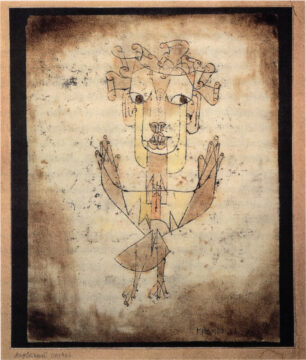
Angelus Novus, by Paul Klee. In the interpretation of Walter Benjamin, this is the angel of history, blown inexorably into the future by the storm of progress, while its gaze remains fixed on the past. Image credit: public domain

Stephen King’s Dark Tower-series takes place in a world that has ‘moved on’, and appears to be deteriorating. The story’s main protagonist, Roland Deschain, last of an ancient, knight-like order of gunslingers, is seeking the titular Dark Tower, which forms a sort of nexus of all realities, to perhaps halt or even reverse the decay. His greatest fear is that once he reaches the top of the tower, he finds it empty: God or whatever force is supposed to preside over the multiverse dead, or absent, or perhaps never having existed in the first place.

There is substantive debate on what forces shape history: the actions of great leaders, the will of the people, material conditions, conflict, or perhaps other forces entirely. For our purposes, however, we can group these into two categories: the microcausal view, where history is nothing but the sum total of millions upon millions of individual actions, and the macrocausal view, where there exists some form of overarching driver of history, be it fate, a Hegelian world spirit, or some form of laws of history that dictate its unfolding. This second option is perhaps most simply explained by there being an occupant to the room at the top of the Dark Tower: some entity that, by whatever means or design, holds the reins and shapes the course of the world.

In today’s world, this is a less widely held opinion than might have once been the case. But does this mean that history is just comprised of actions at the individual level, and it is thus this level that we should best appeal to for explanatory force? Is there, as Margaret Thatcher claimed, ‘no such thing as society’?

My aim in this column is to investigate the possibility that there is a middle being excluded here. Just as the theory of evolution has shown us that there can be design without a designer, I propose that, at least in certain respects, there can be a sort of ‘plan’ without a planner to history—that, in other words, it can make sense to analyze its course as if it were following a design not reducible to the actions of individuals. Read more »
Monday, May 13, 2024

“I wear the chain I forged in life”

by Jerry Cayford

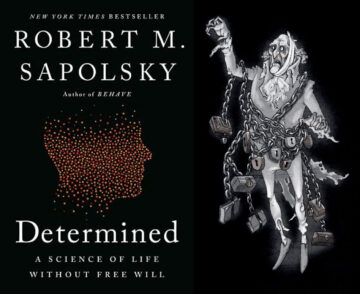
Marley’s Ghost by Lisa K. Weber

Robert Sapolsky claims there is no free will. Jacob Marley begs to differ. Let us consider their dispute. Sapolsky presents his case in Determined: A Science of Life Without Free Will: everything has a cause, so all our actions are produced by the long causal chain of prior events—never freely willed—and no action warrants moral praise or blame. He supports this position with a great deal of science that was not available back when Marley was alive, though “alive” seems an awkward way to put it, since Marley is a fictional ghost, possibly even a dreamed fictional ghost (depending on your interpretation of A Christmas Carol), dreamed by fictional Ebenezer Scrooge. Marley’s standing to bring objections against Sapolsky seems pretty tenuous.

Nevertheless, Marley forthrightly rejects Sapolsky’s thesis: “‘I wear the chain I forged in life,’ replied the Ghost. ‘I made it link by link, and yard by yard; I girded it on of my own free will, and of my own free will I wore it.’” That there is a real dispute here is proven by Scrooge presenting a very Sapolskian argument against Marley’s right to bring a case at all: “You may be an undigested bit of beef, a blot of mustard, a crumb of cheese, a fragment of an underdone potato.” That is, only a chain of physico-chemical causes makes me, Scrooge, see you at all, let alone give any credence to your arguments about morality. If this rebuttal seems sophisticated for a fictional Victorian businessman, it at least reminds us that Sapolsky’s philosophical position is quite old and well known.

Unlike Scrooge, Sapolsky does not inhabit the same fictional realm as Marley’s ghost. He cannot argue that Marley’s sins were caused by prior conditions and events, because Marley’s sins and choices don’t really exist, not in the causal universe in which Sapolsky makes his argument. As he so emphatically puts it: “But—and this is the incredibly important point—put all the scientific results together, from all the relevant scientific disciplines, and there’s no room for free will.…Crucially, all these disciplines collectively negate free will because they are all interlinked, constituting the same ultimate body of knowledge” (8-9). Marley’s ghost, though, is not of that body—an “incredibly important point” indeed—and that’s precisely the reason to choose him as our spokes-“person.” Read more »