Here’s your chance to say what you want to the large number of highly educated readers that make up 3QD’s international audience. Several of our regular columnists have had to cut back or even completely quit their columns for 3QD because of other personal and professional commitments and so we are looking for a few new voices. We do not pay, but it is a good chance to draw attention to subjects you are interested in, and to get feedback from us and from our readers.
We would certainly love for our pool of writers to reflect the diversity of our readers in every way, including gender, age, ethnicity, race, sexual orientation, etc., and we encourage people of all kinds to apply. And we like unusual voices and varied viewpoints. So please send us something. What have you got to lose? Click on “Read more »” below…
One common theory of intelligence is that it is an emergent phenomenon. One-on-one, termites aren’t exactly geniuses. But get enough of them together, and they build incredibly elaborate communities that can be 30 meters across with sophisticated ventilation systems to control heating and cooling. And these communities can last for thousands of years.
It’s a bit of a mystery how this happens. After all, even the Frank Lloyd Wright of termites doesn’t know how to keep a towering nest from falling over, or the physics of passive HVAC design. Heck, they probably aren’t even aware of the far side of their nest. Nevertheless, amazingly, termites as a collective have evolved to do something far beyond their individual capabilities.
Similarly, our individual neurons are each busy doing their own thing. They are responding to inputs and communicating with neighbors. From these simple cells and their many interconnections arises something greater than the sum of the parts: a person who can paint, create music, tell jokes, and build skyscrapers [1].
It is a founding dogma of the current AI bubble that scale is all you need: with enough data, computational power, and dollars, all you have to do is sit back and let super-intelligence emerge from the digital soup. Not really, of course. Progress in AI also involves a good dose of intelligent design.
Remarkably, sometimes you don’t need evolution or intelligent design. Read more »
“Happiness is that which all things aim at” according to Aristotle. All virtues – arete (ἀρετή) or “excellences” – are the mean between two extremes. We should choose courage over cowardice, sure, but also over being too bold. Stick to the tame middle.
Epicureans and Stoics counsel against risk and in favor of moderation and in cultivating simple tastes in all things.
Confucius was strongly against reckless behavior. The Daoist counseled, “He who knows when to stop does not find himself in danger.”
But it is Jeremy Bentham, the father of Utilitarianism, that I think about when I think about philosophy’s historical distaste for thrill-seeking. According to Bentham the only human good is happiness. Happiness is just pleasure minus pain. Just as we are morally obligated to seek, above all, the greatest happiness for the greatest number, for ourselves we should also want only happiness. Nietzsche retorted, “Man does not strive for happiness; only the Englishman does that.”
Unfair. John Stuart Mill took Bentham’s view of happiness a step further, unintentionally, providing a rare and beautiful thing: an actual argument for thrill-seeking. Read more »
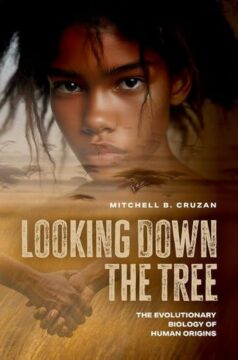
This book has an ambitious and praiseworthy agenda, to discuss a wide range of specifically human characteristics, in the context of the selection pressures operating on our ancestors once the forests of East Africa were replaced by savanna. The more open terrain favoured bipedalism, and bipedalism led on to a cascade of further changes. These, we are told, included loss of fur, bulbous breasts, female orgasm, monogamy, large penis size, cooperation, and exclusive homosexuality. Anatomical side-effects of bipedalism gave us hands capable of fine movements, which in turn favoured the development of large brains, and hence prolonged infancy and the development of cooperative social structures. This evolution took place under circumstances very different from those under which almost all of us live today, and we need to understand the constraints imposed by our evolutionary pathway if we are to understand ourselves as we are now. The book is well produced, and fully illustrated with drawings and diagrams.
The approach is laudably multidisciplinary. As the author puts it, his aim is
“To facilitate an understanding of the origin of human traits, I draw upon evidence and inferences from fossils, genomics, phylogenetics, coalescence theory, analyses of calcium isotopes, and the anatomy and physiology of our ancestors and other animals.”
Cruzan follows the account of humans having emerged in East Africa, with more than one out-of-Africa migration, but anatomically modern humans outside Africa having most of their genetic material from a group that left there around 70,000 years ago. As a narrative device, he follows a fictional woman (Launua) from childhood to her eventual death, pointing out the specific challenges she is presented with, and the evolved abilities with which she overcomes them. Much of the argument is controversial, but this is not necessarily a bad thing, and the style makes the material accessible to a wide audience. I would warn the reader, however, that there are questions about his heavy use of selection at the clan level, and the assumption that the individual clans would have been highly inbred. There is some evidence that by 34,000 years ago, admittedly halfway between the time under discussion in the present, anatomically modern humans had formed networks that avoided inbreeding. More details (paywall) here.
Is your uncle racist? Is the American educational system? Are military beard standards? Is our president? I won’t try to answer those questions here. I don’t even know your uncle. Instead, I want to talk about what we mean when we use that term—and the confusion we experience as a result of the ways we use it. This won’t solve our underlying problems having to do with race; but it might help us address those problems more clearly.
The terms “racist” and “racism” appear daily in our political debates, social media, and institutional communications. They shape hiring decisions, educational curricula, and corporate policies. They can end careers, transform elections, and rupture communities. Yet for all their prominence—or perhaps because of it—we rarely pause to notice that we use these words in fundamentally different ways.
This semantic multiplicity creates dysfunction. We believe we are engaged in substantive disagreements about race and justice when we are often simply talking past one another. One person declares a policy racist, meaning it produces disparate outcomes; another hears an accusation of malicious intent and responds defensively. One person insists they are not racist, meaning they bear no personal animus; another hears a denial of systemic advantage and reacts with frustration. The confusion compounds: accusations of racism are met with accusations of bad faith, which generate accusations of fragility, which prompt accusations of ideological extremism. The cycle accelerates, positions harden, and the possibility of genuine exchange evaporates.
Before attempting to map these different uses, let me address two predictable responses. Read more »
One of my favorite ways of beginning the morning is by having Siri put on “Grand Canyon Suite” by Ferde Grofe. It’s pleasant and gives a sense of the day beginning and going on its way. Also, in the middle, if you’re an old guy like me, you’ll hear the music that used to introduce “Call For Phillip Morreez,” the voice of Johnny, the hotel bell boy calling across America inviting us all to smoke. At one time I wanted to be an ad man. I wonder if I would have refused to work on a cigarette ad at the possible cost of my job. Of course, the question wouldn’t have come up when I was younger and smoked, but if I had been older and knew better, what would I have done. In truth, I’m not sure. There are many ways of convincing yourself that you’re not doing a wrong thing.
I have the door to the patio outside my second floor flat (I like that British word better than the American apartment) to let some fresh air in in the morning. I never sit on my patio though it would often seem to be attractive except it overlooks Greenwood Avenue N where the traffic is constant and noisy. Just now a car went by claiming it’s place for a larger share of world domination by having its muffler removed. There are many of those and we live too by a fire house and emergency vehicles emerge both night and day. I’ve just ordered some earpods with a noise cancelling feature. Maybe that can recover lost space or at least the ability to listen to music with the door open.
I wanted to write this this morning because of a sentence in my notebook that I read in the NY Times Book Review. The book (it’s so long ago now, I can’t remember title or author) is about a woman’s attempt to live “an honest life. More than that,” actually: “a good life. You can do nothing or you can do better.” What a helpful last sentence. It relieves you from the burden of solving the world’s difficulties while offering a way to live well. “You can do nothing or do better.” I hope I can at least do something in some ways. While I was brooding over this, Facebook recovered something I wrote years ago, forgot about, but now find helpful. Read more »
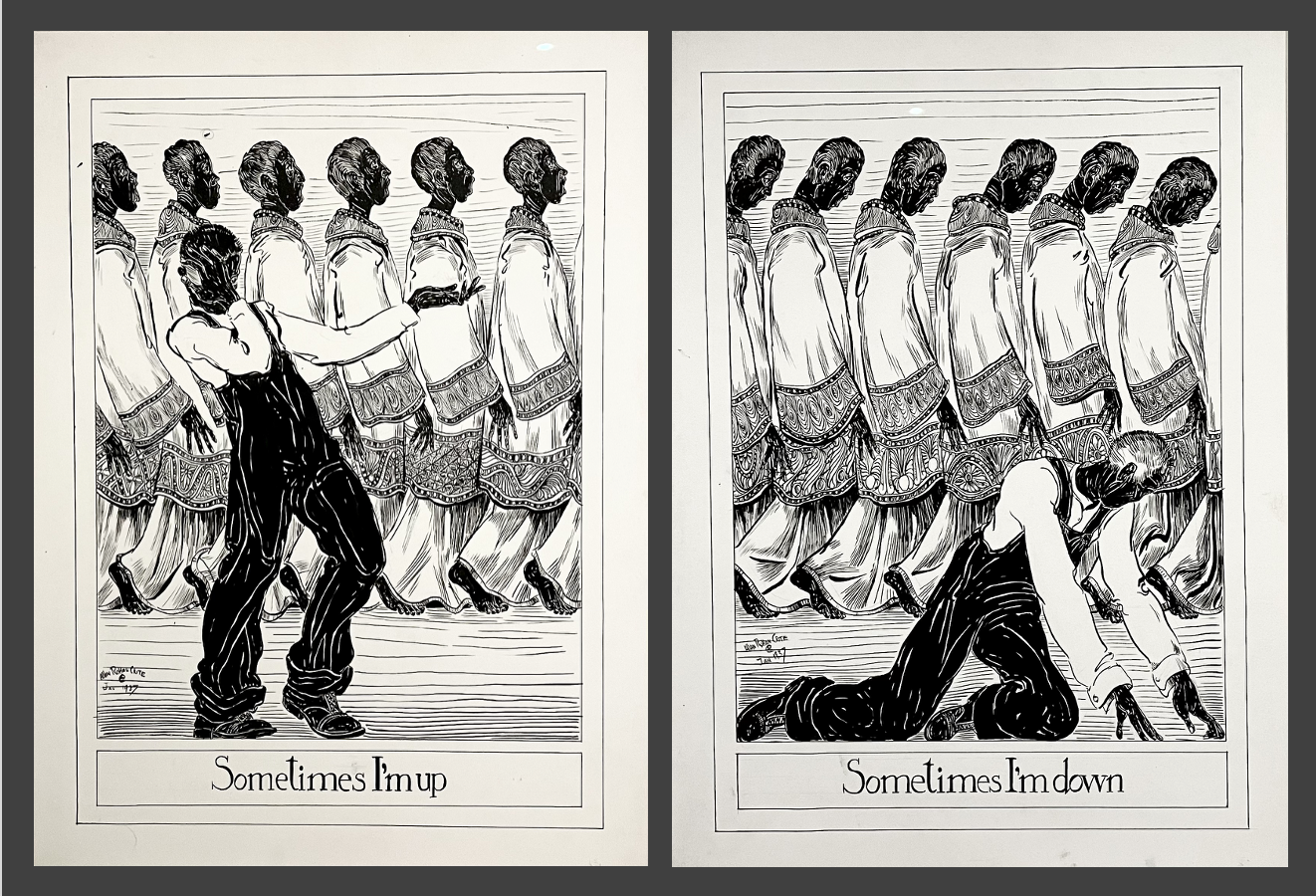
Allan Rohan Crite. Sometimes I’m Up, Sometimes I’m Down. Illustration for Three Spirituals from Earth to Heaven (Cambridge, Mass., 1948),” 1937.
(Photographs of framed prints by Sughra Raza).
“… Back there in the ’30s, the concept of Blacks was usually of somebody up in Harlem, or the sharecropper from the Deep South, or what you might call the jazz Negro,” Crite said in a 1979 interview for the Smithsonian’s Archives of American Art. “But the ordinary person—you might say middle-class—you just didn’t hear about them. So what I did in my drawings was just to try to do the life of people as I saw them round about me.”
Crite’s “neighborhood paintings,” while his most famous works, are just one facet of a long and varied career. A devout Episcopalian, he combined his love of religious art with his affection for his city, creating urban vignettes with Christian themes.”
The Supreme Court’s power does not rest on brute force but on the power of authority. This power of authority heavily rests upon public perception of the Supreme Court’s legitimacy as a fair and impartial arbiter of the law. That perception has seriously eroded. With its current case docket that will address the breadth and limits of presidential power, the Supreme Court is at a crossroads on how it will be perceived by the American people. The country in turn is at a crossroads as a constitutional republic and democracy depending on how the Supreme Court rules and is perceived.
The Supreme Court’s Public Approval Rating is at a Historic Low
Polling by a variety of pollsters shows approval of the Supreme Court is at an all-time low. For example, the court’s Gallup poll approval rating was 39% in 2025–the lowest in Gallup’s years of polling on the question. The Economist in 2025 had the court’s approval rating even lower at 35%.
This cannot be attributed simply to political party divisions. The Supreme Court has for decades been dominated by justices appointed by Republican presidents. Since 1910 there have been 11 chief justices. Nine of those were appointed by Republican presidents. Appointed for life, Republican appointed chief justices since 1910 have served for a total of a little over 100 years—Democratic appointed chief justices in turn have served for about 12. Since 1970, that is for more than half a century, the Supreme Court has continuously consisted of a majority of Republican appointed justices. Yet, despite this one-sided dominance, the Supreme Court received for several years favorable poll ratings and was afforded respect, sometimes even reverence, by the public. This has drastically changed.
The Supreme Court’s Declining Public Image is Due to Itself but also to Political Changes in the Supreme Court Justice Nomination Process
This erosion of public confidence in the Supreme Court was a long time in coming. A starting point is the Supreme Court’s 5 to 4 decision in Bush v. Gore –with the majority consisting solely of Republican appointed justices—that guaranteed Republican candidate Bush would become president. Republican appointed Justice Stevens in his dissent said the decision “can only lend credence to the most cynical appraisal of judges throughout the land.” Justice Sandra Day O’Connor, who was in the majority, years later publicly declared the court’s decision was in retrospect probably a regrettable mistake that “stirred up the public” and “gave the court less than a perfect reputation.” Read more »
Walk through the architecture of memory which spaces are rooms of moments that define the layout of now. …………………………………… —Roshi Bob
The Architecture of Memory
every room has its story— the back of the house is darkest but light floods the porch where we sit after a long day rising now and then from its steps, momentarily leaving our drinks to wander back through old doors and rummage among the stuff we’ve stacked against walls and under beds reaching for the odd object we’d just nudged with a recollection as we moseyed through conversation, as if a salvaged thought were a lamp which, being disturbed, clicks on automatically, becomes a sun in a dimming universe or lightning strike in a new storm, either way a big brilliant thing massive as the posts & beams of a venerable house —the bellied bones of time upholding the spirit of the place ‘
by Jim Culleny 8/8/12, Edit:1/18/26
Enjoying the content on 3QD? Help keep us going bydonating now.
Here’s your chance to say what you want to the large number of highly educated readers that make up 3QD’s international audience. Several of our regular columnists have had to cut back or even completely quit their columns for 3QD because of other personal and professional commitments and so we are looking for a few new voices. We do not pay, but it is a good chance to draw attention to subjects you are interested in, and to get feedback from us and from our readers.
We would certainly love for our pool of writers to reflect the diversity of our readers in every way, including gender, age, ethnicity, race, sexual orientation, etc., and we encourage people of all kinds to apply. And we like unusual voices and varied viewpoints. So please send us something. What have you got to lose? Click on “Read more »” below…
For about six years now, since a cancer diagnosis put what really matters in life in perspective, I have finally made peace with myself and especially my body. I have accepted my directness in most situations, even though shyness and false innocence were valued in my adolescence, in the culture where I grew up. I have embraced being told that “I tell it as it is,” and learned to look away at the judgment that comes with that description: basically, not being savvy enough to enrobe the truth in a softer garment. Dancing around real issues and pretending the elephants are not lined up to enter the room has never been my strength, yet I also value the ability to soften blows when needed.
My body, unlike my mind, has had a different trajectory in this journey. From being looked at and leered at, to being touched and loved, to being sexualized, to being criticized, I finally began to recognize who I was, outside of my body. I took the reins I had given away freely to others and called her my own, reclaiming her and making her my friend and confidante instead of the burden she had become. I wrote a list of things I felt I had to apologize for, and every time my body felt unloved for whatever reason, either by me or by others, I went back to my list and comforted her.
Dear body,
I apologize for feeding you when you weren’t hungry for food, but wanted love and acceptance. Food and alcohol sometimes took the pain of loneliness away, especially during the long years of being the only parent in attendance at my youngest’s choir performance or at his soccer games. Food comforted my child and me as we navigated those years together. I created a pseudo family with some people, but I didn’t always feel connected to them, yet I thought it was better than not having anyone.
I apologize for putting cigarette smoke in your face and lungs when you were younger and wanted to flirt, but was insecure. Smoking was a cover-all for stalling a difficult situation, ready to leave a risky place, and sometimes needing extra time to plan my exit. I smoked so much at an outdoor party one evening that the inside of my mouth hurt, yet I didn’t have the courage to say that I didn’t belong there. Trying hard to blend in and fit in, when all I needed was a familiar and kind person to hold my hand and lead me away. Read more »
One day you spot the young enchanter you’ve had a crush on for months, but haven’t yet found the gumption to speak to. Still, you’re affected in ways you’ve heard about forever. You know – maybe you feel your heart beat faster? Maybe you think it skips a beat or three? You know the feeling, no doubt. But is your heart actually beating faster, or skipping beats?
I’m no expert on such hypotheticals. But I will suggest here that if you had a choice, you might be better off with skipping, rather than faster beats. Because there’s a sense in which if your heart beats more quickly, your life shortens. Having said that, I also don’t want you to worry too much about the possibility. We’re not exactly talking about years, or months, or even days, shorter. We’re talking … well, I don’t know. But there is a point here, and I’ll return after a short digression.
Now you may have noticed that you, the human that you are, live somewhat longer than your pet budgerigar who is, I’m guessing, smaller than you. You live a whole lot longer than the pesky mosquito that buzzes in your ear at night – and that’s even if its existence doesn’t suddenly end between your palms. And what of your pet giant tortoise who is, I’m guessing, larger than you? He lives somewhat longer than you.
Noticing patterns like this – for it is a pattern – makes mathematicians (well, other scientists too) say “By Toutatis! We have a correlation!” (Words to that effect.) In this case, a correlation between body mass and life expectancy: the heavier an animal, the longer it lives. For example, you, about 1000 times heavier than your budgie, will live about 5.5 times longer than she does. Your tortoise, about five times heavier than you, will live two or three times longer than you.
In fact, a scientist in Switzerland called Max Kleiber found a double-edged correlation lurking here. Heavier animals don’t just live longer, their hearts beat slower too. Your pulse rate is at least twice as speedy as the tortoise’s, but 5.5 times slower than the budgie’s. (Why 5.5? That’s both interesting and contentious, but of that, another time).
“A little man is a whole man as well as a great man” – Montaigne
Adolph Wolgast is born on a farm in 1888. Chores make him strong. The company of lumbermen makes him tough. “Little Addie” is not tall. But he can spin his arms like a windmill. And if you are in his vicinity, you’d better hope your chin isn’t in the way.
After knocking down everyone worth fighting in his hometown, Addie hits the road. He is 16. He hops freights, works in sawmills, fights in improvised rings. Falls in with a guy named “Hobo” Dougherty.
“Those are my pork-and-bean years,” he chuckles about his youthful wanderings many years later. By then he can afford to laugh—wearing a bearskin coat that cost a thousand dollars, owning a ranch up in Oregon. A popular man, the lightweight champion of the world. “The most likeable little pug you’re ever going to meet,” one sportswriter called him. And yet—though he has no way of knowing it—Addie is already well along the road that ends in a hospital for the insane, where, on a darkling plain swept with confused alarms of struggle and flight, he will face one last grim fistic encounter in the dark.
Little Addie and his buddy Hobo Dougherty land in Grand Rapids in 1906, where they fall in with the fight crowd. He gets taken on as a sparring partner in a gym. The older boxers don’t like him. He doesn’t play pit-a-pat. Once he’s put on the gloves, he doesn’t see any reason he shouldn’t knock the other fellow down.
Fight promoters like the boy’s aggression and put him in the ring. Addie goes pro. He gets booked on undercards. Sometimes he makes as much as $5 a fight. He fights in saloons, “athletic clubs”, basements, vacant lots. Betting is rife. It is cockfighting with humans. Read more »
The important thing to remember about “extraordinary popular delusions” (in Charles Mackay‘s words) is that there is nothing you can do about them. And they are legion. The best you can do is avoid them, and this takes diligence and a certain resolve: The subject gets changed. The screens go off. No television comes near your eyeballs. The radio is switched to a music station. “Social” media are eschewed. And when people needle you about your lack of engagement, you ignore them. Whose approval do you think you need anyway? Let the rowdies enjoy their bandwagon in peace. I’m wondering whether the time will come when the shiny new plagiarist technologies undermine themselves to the point that nothing seen on a screen will be trusted anymore, when electronic becomes a synonym for fake. It’s an open invitation to reclaim such quaint sensual pleasures as face-to-face conversation and the scratch of pencil against paper.
Bogus seems to be the new name of the game: One pops in an assignment description, and out pops a tidy little poem with one’s name in the byline, ready to be safely uploaded to the class website. Therefore, in my writing classes I am taking steps to get away from screens, which means increasing the use of paper and pens/pencils. One must walk forward into the past. One learns that to be a writer one scribbles and fails, scribbles and fails. For the same reason that most business ventures shutter and most species go extinct, most writing never sees the light of publication. The learning is in the doing, not in the dung heap at the end of the process. Why take a cooking course if you are just going to order out? Why take a technical rock climbing class (as I did as an undergraduate geology major) if you are only going to hire a helicopter to fly you to the top of the peak?
Gosh, how does my online article about this subject square with itself ?? It may make for an interesting classroom discussion of irony and paradox. The class is the process. This article? The dung heap at the end of the process. Read more »
We sometimes say that someone is living in the past, but it seems to me that the past lives in us. It lives in our houses; it lies all around us. As I write this, I’m sitting on the couch under two blankets crocheted by my grandmother, who was born around the turn of the 20th century. The laptop sits on a folded blanket that came from Mexico via a friend years ago. And that’s just the surface layer. My closets and file cabinets are also full of the past.
I’ve thought about the ways that objects can keep the past alive, to some degree, by conjuring other times. Even as a child, I was inclined to save things that seemed to mark a particular moment that had meaning for me. As Mary Oliver put it, I’ve tried to “keep as I can some essence of the hour, even as it slips away.” I do this in part by keeping journals, but I’m also fond of saving things that call to mind certain times or places or people.
A friend who retired last year expressed a conundrum that’s familiar to me. He has time now to sort through the things in his house, and he’s thinking about which emotionally meaningful books and art he wants to keep, and which he’d like to pass along to others. “I don’t want to lose the fondness,” he said, “but I’m not sure if I need the things.” I understand the need to sometimes let go of things that have meant a lot to me, and the need to leave space (physical and emotional) for growth and change. Some things, though, are so charged with meaning that it’s hard to imagine ever letting them go. Read more »
Being obligate scavengers, vultures are highly dependent on finding carrion, an unpredictable and patchy resource. This sometimes means going without food for two to three weeks while actively scouting 200 km per day. Unlike other animals that evolved strategies to enable them to secure food by hunting, vultures have evolved remarkable adaptations for energy conservation, enabling them to survive extended fasting periods.
Energy expenditure arises from three main sources: basal metabolism (organ function), thermoregulation, and activity such as flight. Vultures basal metabolic rate is already 40% lower than expected for birds of their size even if the mechanism behind it remains unclear. The second component, thermoregulation, can usually increase metabolic cost by ~15% under moderate conditions. However, vultures are exposed to extreme temperatures, from the intense desert heat on the ground to the very cold of high-altitude flight and desert night.
In other desert birds, when heat rises too much, they resort to panting to dissipate heat (as birds cannot sweat). This strategy is very energy intensive, increasing the metabolic rate drastically as the temperature rises, up to 150% in the most extreme case. In addition, this strategy uses water, again not ideal in deserts. If we approximate panting to the increased respiratory rate in flying pigeon it would cause an 8 fold increase in respiratory water loss which represented 30% of total water loss during flight.
Vultures instead rely on passive thermoregulation strategies, much like insulating a house reduces energy used in active air conditioning. Read more »
Frozen edge of a stream in Brixen, South Tyrol. It seems the level of the water went down a bit after the freezing, as it is an inch or so below the frozen part. Anyway, it looked cool to me. Pun intended, I guess!
Enjoying the content on 3QD? Help keep us going by donating now.
In a previous post, I joked that one of the most annoying things about living in an American world is the cultural hegemony that US soft power sort-of imposes everywhere. In that piece, I was concerned with the connotations that political concepts such as liberalism and libertarianism receive in US commentary, as these meanings vary to how these terms have been traditionally understood in Europe, where they originated, and some shifting of meaning has taken place in European discourse recently because of American influence, especially, as ever, in the UK (similarly for fascism, and even worse, sadly; see here). In the event, I did note in the article (endnote 1) that I was joking: the worst thing about living in an American world is US imperialism, with all the violence that derives therefrom.
More recently, in a series of posts on the legacy of Francisco Franco (last here), the Spanish dictator who provoked a civil war and then ruled Spain for close to 40 years, I argued that Franco’s actual legacy is the staggering number of dead people he left behind, many of whom were executed and buried in mass graves, their remains unlocated to this day.
Putting these two strands together, and in the context of the recent, blatant violation of Venezuelan sovereignty and the kidnapping of its head of state by US forces, I couldn’t help but feel that the human cost of the raid was not being discussed enough in most commentary. Yes, there are many important ramifications and some interesting discussions out there regarding previous US interventions in the region (here and here), the mostly meek response of US media (here), or the role of Venezuelan oil in all this (here), but one issue is usually mentioned only in passing: more than 50 people lost their lives in the raid, many of whom were simply doing their job, and some were in fact just bystanders (here and here).
And so I thought that instead of adding to contemporary commentary and write about this or that political aspect of the raid, I would this time post a list of conflicts the US has been involved with since the second world war, along with the number of people killed in these conflicts. Read more »

 Dear Reader,

 Allan Rohan Crite. Sometimes I’m Up, Sometimes I’m Down. Illustration for Three Spirituals from Earth to Heaven (Cambridge, Mass., 1948),” 1937.
  Dear Reader,
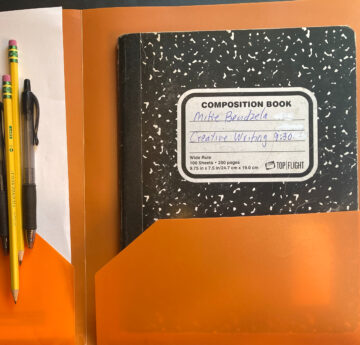
 We sometimes say that someone is living in the past, but it seems to me that the past lives in us. It lives in our houses; it lies all around us. As I write this, I’m sitting on the couch under two blankets crocheted by my grandmother, who was born around the turn of the 20th century. The laptop sits on a folded blanket that came from Mexico via a friend years ago. And that’s just the surface layer. My closets and file cabinets are also full of the past.