
by Peter Topolewski

Happy New Year, and not soon enough. Out with the old. Good riddance, too. The laundry list of doom and gloom from 2025 looks long. If you shake out the cobwebs, and gaze back across December and the months prior, the list keeps unfurling. No let up, it seems. Time to forge ahead, buck up, steal yourself for good times. As tech commentator James Meigs recently put it, “…don’t listen to the naysayers. The future is coming and it’s going to be great.”
No denying that, the future is coming. It’s always coming.
Might need to squint a bit to get around his assumption that past science and tech advancements ensure future success, but we’re all team players here. Don’t dig too deep into the specifics of, say, how “AI will make our lives better and our economy massively more productive.” Makes holding the line tougher. What with the industry’s business model built on intellectual property theft. The absence of any foreseeable profits doesn’t help, nor does OpenAI’s plan to spend $150 billion over the next four years to get ChatGPT to answer our queries. That doesn’t include the cost of the building or improving our little AI friend, just the cost to operate it.
The finances might give the impression AI is a botched socialist pipedream, but it’s no such thing. Nor is it a horribly inefficient project run by inept government bureaucrats. AI is the domain of hard-hearted capitalists who know better than anyone how to create and capture value. Take their word for it. Ignore past promises about breakthroughs. Those were so 2025. Elon Musk, the brain behind the AI company creatively named xAI, has a new one for 2026: Grok, the company’s chatbot, has a 10% chance of reaching artificial general intelligence when it launches later this year.
What’s that mean? Read more »
 Dear Reader,

 Sughra Raza. Bey Unvaan. January, 2026.
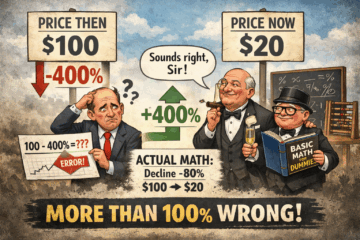 Oy. Where to start? Let me begin with a recent abuse involving percentages. Trump’s absurd claims about price declines of more than 100% have elicited a lot of well-deserved derision. How could someone with an undergraduate degree in business from Wharton make these mathematically impossible claims?
 2025 was a good year for books.



 “This is the mentality of our society. If someone is speaking English, he or she is really good, he or she is from a very good background,” one subaltern English learner tells the researchers in this study. “When someone speaks good English, Shah says, people assume that person is educated, knows how to carry himself, and is, crucially, ‘a good person’,” notes another.
 Dear Reader,
 The town had only one grocery store, and Steve wondered where the locals did their shopping. Certainly not here, but perhaps in a supermarket outside of town, one that required a car. Along with Julia, he picked up some Italian cheese, prosciutto, grapes, and a bottle of local wine, and they made their way up the hill to the house they’d rented for the week.