by Michael Liss
Wise men never sit and wail their loss, but cheerily seek how to redress their harms. —William Shakespeare, Henry VII
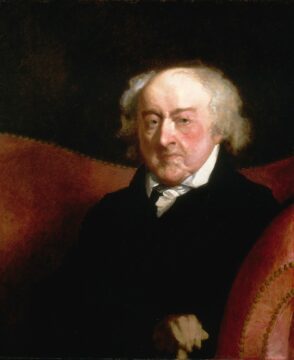
One would think that a man like John Adams, who called Shakespeare a “great teacher of morality and politics,” might heed the Bard’s advice.
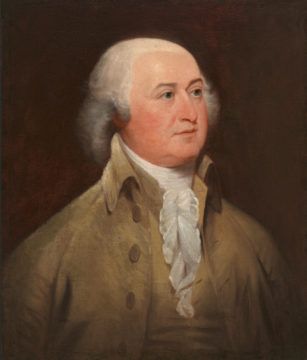
One would be wrong. He couldn’t help himself. Lose he did, and wail he would, so when he climbed into that pre-dawn stagecoach headed north from Washington D.C., the bags he carried contained both physical and emotional weight. It had been just yesterday, March 3, 1801, that he had been the President of the United States. Today, March 4, he was a has-been, chased from office by a fickle electorate, not to be lionized as his predecessor George Washington, but scorned and mocked as a loser, a man to be rejected and isolated. The truth was he had failed—failed at the job he never wanted, to be a party leader, and failed at the job he desperately did want, to be a two-term President. He failed, and the taste was acrid in his mouth.
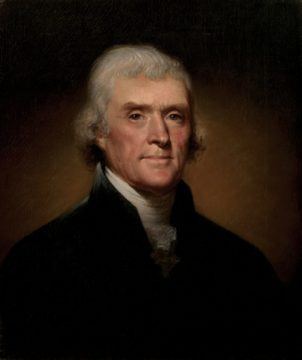
For most in the Inaugural audience, Adams was gone and good riddance to him. A new sheriff had come to town, tall and handsome, a writer of words that, like Joshua’s trumpet, blew so hard as to cause the walls of English tyranny to come down. Thomas Jefferson was a thoroughly modern man, a man of the future, the man to lead a new country to its destiny. John Adams, the last President of the 18th Century, with his old-fashioned, allegedly monarchal values and his odd sense that a President ought to be above it all, as a non-partisan player, was definitely a figure of the past.
That “past” of Federalist rule was to be closed off, packed away in metaphorical steamer trunks and relegated to a space in the attic. The American Revolution, propelled by the Declaration of Independence, had freed the colonies from the harsh hand of a grasping king. The “Second Revolution,” as Jefferson came to call it, would free the country from the stultifying ideas and intrusive reach of the Federalist way of governance. Men would be liberated to achieve their best destinies.
The worthies gathered, the sun rose and smiled, and Jefferson, a man of prodigious talents, the political “Natural” of his day, stepped up to the plate, ready to hit it out of the park. Read more »
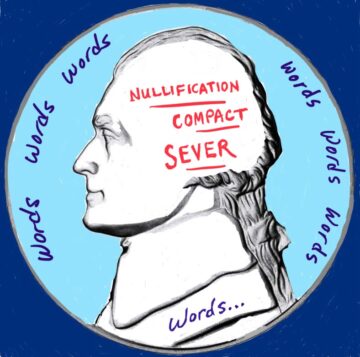 Words, so many words. Words that inspire “Ask Not,” and those that call upon our resolve “[A] date that will live in infamy.” Words that warn about the future “[W]e must guard against the acquisition of unwarranted influence, whether sought or unsought, by the military-industrial complex,” and those that express optimism about it “I’ve been to the mountaintop.” Words that deny their own importance “[T]he world will little note nor long remember what we say here,” while elevating themselves and the dead they honor to immortality.
 In 1790, shortly after the 13 states ratified the U.S. Constitution, the new federal government conducted its first population census. Its tabulations revealed an astonishingly rural nation. No less than 95% of all Americans lived in rural areas, either on a fairly isolated homestead (typically a farm) or in a very small town. How small? Fewer than 2,500 people. Meanwhile, just 1/20 of Americans lived in a town with more than 2,500 people. All told there were only 26 such towns, only half of which had so many as 5,000 people