To love someone else is easy, but to love what you are, the thing that is yourself, is just as if you were embracing a glowing red-hot iron: it burns into you and that is very painful. Therefore, to love somebody else in the first place is always an escape which we all hope for, and we all enjoy it when we are capable of it. But in the long run, it comes back on us. You cannot stay away from yourself forever, you have to return, have to come to that experiment—whether you can love yourself, and that will be the test. —Carl Jung, lecturing on Nietzsche
L’amitie, Pablo Picasso, 1908. Permission of the State Hermitage Museum, US.
1. Friendship Born of Self
It is commonly, and truly, said that you can only love someone as well as you love yourself. For many of us, myself included, this is a hard teaching. As Jung says in the epigraph, we hope that we can love others without figuring out how to love ourselves, but eventually “it comes back on us.” The love I’m talking about is friendship. (It should come as no surprise that philosophers and psychologists haven’t looked to familial or romantic relationships as exemplars of enlightened love!) I want to explore how this curious relation between befriending ourselves and befriending others works. Along the way I show how we can use our discoveries to become better at both.
The notion that loving others depends on loving ourselves is not new. Aristotle discusses how the kind of friend we are to ourselves will be reflected in the kind of friendships we have with others. Where there is “internal conflict,” where, as he puts it, “souls are divided against themselves,” they will not be able to love themselves, or others. I think of people I’ve known who end up in therapy because a friend or partner made it clear that the relationship would be over if they didn’t address their depression or anxiety or addiction—examples of how internal discord causes troubles for others.
2. It’s Mutual, Actually
But friendships don’t just reflect who we are. Who we are, and how we show up in relationships, depends also on how we have been treated by others. If you grew up with a hypercritical rejecting mother, your attachment pattern and personality will reflect this. In other words, our way of being with others is informed by the way others have been with us; in particular, by how attentive and attuned (friendly) early caregivers were. Read more »
Attachment theory is part of the vernacular now. Even the Norwegian show Porni mentions it, and the dramatic eldest daughter blames her mom for her “relational damage”! We’ve largely accepted the questionable idea that mom’s attentiveness in childhood creates our attachment patterns for life — the gist of the theory as it’s largely understood, but what’s usefully generalizable from the actual studies? There are many criticisms of the theory, yet some university psych courses applaud it without reservation. I’m dubious about it, but I also don’t want to entirely throw this baby out with the bathwater.
This is a huge topic, and I’ll hardly do it justice here. There are a few excellent books on it, but part of the problem with how we understand the studies might be that the most nuanced books seem to be the most academically written, and likely the least read. As it morphed into popular consumption it may have strayed further from the original intention. On top of the reading, I went to a couple workshops on attachment to find the magic solution to all our relationship ills, and my big takeaway is this (for free!): if you’re a bit distant, consider being open to getting closer, and if you’re a bit clingy, try to step back a bit. It’s good advice to notice and change patterns that are a problem, absolutely, but I’m not sure it merits the number of workshops, courses, and self-help books that it’s provoked. At worst, some books actually counsel people to avoid any “avoidant or disordered people” as if there’s no saving them from their dastardly origins. Therapeutic discussions of childhood misconnections definitely have helped people better understand themselves, but I think this theory produces such volumes of celebration and condemnation because, in difficult relationships, it feels like theanswer, but to parents, it feels like blame. Read more »
CW: As the title suggests, there will be discussion of death and dying and some mention of suicide in this post.
I thought nothing of following up my last post on Irvin Yalom on the meaning of life with Yalom on the meaning of death, until I started writing here. The very reality of being a bit wary of broaching the subject reveals the strength of societal taboos against admitting that we’re all going to die. Until it’s staring us in the face, we delude ourselves into thinking we will get better and better, mentally and physically, despite that our brain starts to shrink in our 30s, and our joints and organs will start to give out not so long after. We work hard to keep death clean and sanitized so the reality doesn’t seep in too much, and we try to do all the right things to keep death at bay: exercise, various special diets, wearing masks to avoid viruses. We can fix some evidence of erosion with meds and surgeries, sometimes miraculously, but some people even hope to keep their brain going long after their body dies.
A few recent shows and films have me thinking of death further. The final episode of How To with John Wilson explores the cryogenics world, which appears to be an incredibly lucrative insurance scam. The movie Mickey 17 lightheartedly explores what it might be like to regenerate over and over again, and it doesn’t look pleasant. But Lee, the story of photographer Lee Miller, who took famous photos of the holocaust, helps us feel the resolve it requires to look death in the face. Kate Winslet captures the instinct to turn away and then intentionally turn back to open that door over and over. The ending takes a slightly different path, exploring how little we might be known even as we live. In burying our past, we can end up hiding from life. Yalom wants us to come to terms with the endpoint of our lives, and points out that the desire to be fully known, which is impossible, is yet another defence against accepting the finality of death by remaining alive in memories. We look for any loophole to refuse to believe we’ll be well and truly gone.
In the documentary, Yalom’s Cure, Yalom explains that he started out working with a support group for people dying of cancer. One of the participants said that it’s too bad it took dying of cancer to learn how to live, and Yalom decided we need to figure out how to do that sooner. It was then he noticed how strongly we defend ourselves from any acknowledgement of death.Read more »
Digital technology and AI are transforming our lives and relationships. Looking around, I see a variety of effects, for better and worse, including in my own life and in my psychotherapy practice. My last column, The Fantasy of Frictionless Friendship: why AIs can’t be friends, explored a specific psychological need we have—to encounter resistance from others—and why AIs cannot meet this need. (To imagine otherwise is analogous to imagining we can be physically healthy without resistance training, if only in the form of overcoming gravity!) In this essay, I reflect on some research that drives home why our animal need for connection cannot be satisfied virtually.
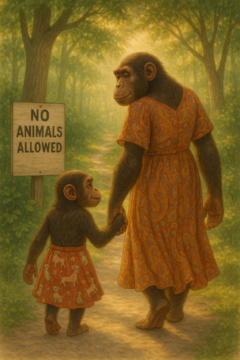
How I imagine it, with the help of ChatGPT
I use and delight in digital technology. My concern here is not technology itself, but the so-called displacement effect accompanying it—that time spent connecting virtually displaces time that might have been spent connecting irl. As Jean Twenge, Jonathan Haidt, and others have shown, this substitution of virtual for irl connection is strongly correlated with the increase in mental disorders, especially among iGen (defined by Twenge as the first generation to spend adolescence on smartphones and social media).
The question—What is lost when we’re not together irl?—is worth asking, now and always, because the tendency to neglect our animal needs is as old as consciousness. I smile to think of how Aristophanes portrayed Socrates floating aloft in a basket, his head in The Clouds, neglecting real life. But even if we’re not inclined to theorizing and airy abstractions, most of us naturally identify our ‘self’ with our conscious egoic self. We may be chattering away on social media, studying quantum fluctuations, telling our therapist what we think our problem is, or proposing to determine how many feet a flea can jump (measured in flea feet, of course, as Aristophanes had Socrates doing). But whatever we may think, and whoever we may think we are, our animal needs persist.
You know all this, of course. But I want to speak to the part of us that, nonetheless, posts signs in shop windows and city parks saying “No animals allowed,” and then walks right in—as though that didn’t include us! This subject is a warm one for me, as I work with the mental-health consequences of neglecting our animal need for connections. Sadly, we therapists are not helping matters, readily embracing as many of us do the convenience of telehealth sessions without asking ourselves: what is lost when we’re not in the room together?
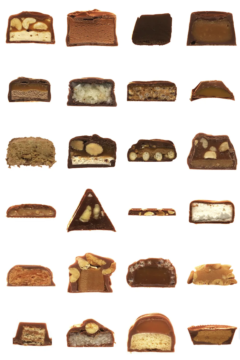
The first time I came across the “candy bar interiors” quiz, I was not disturbed by how many I got wrong, but rather how many I got right. While a few of the pictured confections were alien to me (Zagnut? who the hell eats a Zagnut? did Charlie Chaplin enjoy one in Modern Times?), I was intimately familiar with enough of the images that I could extrapolate the rest.
I just picked the weirdest and creepiest looking option as the Zagnut. I was correct.
I have been unhealthily obsessed with candy bars for as long as I can remember. My obsession is deep, tender, and gently festering, and I feel ambivalent about stirring up the dead leaves at the bottom of that pool. Even though I have written essays about my consistently abusive mother, my intermittently abusive father, my history of panic disorder, and many other delicate topics, an exploration of my feelings about candy bars feels like the most difficult thing I have ever attempted.
The outside layer of a Zagnut is coconut. Who does that?
My parents were largely uninterested in their children, but every once in a while they made a symbolic stab at parenting by doing something like restricting our food choices or giving us a curfew. They forbade sugary breakfast cereals, soda, candy, and chips of any kind—thus setting us up for an enduring obsession with junk food that I carry with me to this day. Even though I am now in my 50s and wholly in charge of my own snack choices, my stomach still flips over a little at the sight of a potato chip bag or a Chip Ahoy. So salty! So mouthfeely! So naughty. Read more »


 CW: As the title suggests, there will be discussion of death and dying and some mention of suicide in this post.