
by Eric Feigenbaum
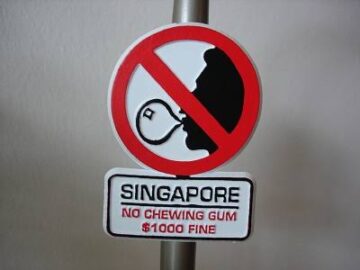
When I tell someone I lived in Singapore, the most common response is some variation of, “Singapore – isn’t that where it’s illegal to chew gum?”
I know a Greek couple who refuses to visit Singapore because they feel the rules are too strict and inhumane. I don’t think they know what all the rules are – but in a country that still has strong opposition to helmet laws, I suppose restrictions on chewing gum and urinating in public seem fascist.
So, no – it’s not illegal to chew gum in Singapore. It was from 1992 to 2004. Although you do have to show identification and be entered into a log at any store in which you buy gum – and the gum has to be certified to have dental value. So, it’s not exactly a chew-as-you-please policy either.
British journalist Peter Day interviewed Singapore’s founding Prime Minister Lee Kuan Yew in 2000 and tackled the chewing gum issue:
Day suggested that chewing gum stuck to the pavements might be a sign that the desired new spirit of creativity Lee sought for his country had arrived.
“Putting chewing gum on our subway train doors so they don’t open, I don’t call that creativity. I call that mischief-making,” Lee replied. “If you can’t think because you can’t chew, try a banana.”
The S$150,000 a year the Housing and Development Board was spending cleaning used gum off the walkways and facilities of some of Singapore’s largest condo developments was also often cited as a reason for the gum ban.
While chewing gum caught the eye of the foreign press and the whim of the world, Singapore’s “Nanny State” laws forbidding and fining things that might seem ridiculous to Westerners are an integral part of the country’s development.
One can get fined for urinating in an elevator, not flushing a public toilet, not washing hands in a public restroom, spitting on the sidewalk, feeding pigeons in public places, kite flying, connecting to someone else’s WiFi without permission, littering and carrying durian on a public train or bus – among other things. To most Americans I know, laws like this feel strict – impediments to enjoying freedom and the serendipity of life (at least minus the elevator urinating rule – I’d like to think we’re all comfortable with that).
While understandable, context is critical to understanding most things. When Singapore became independent in 1965 it was a nation of migrants from the Malay Peninsula and immigrants mostly from China and Tamilnadu, India – three very different cultures that had come to coexist within a British open-port city. But co-existence and integration are two different things and the need to convert everyone into Singaporeans meant closer cooperation was needed. The problem was each culture had habits that bothered the others – including spitting and public urination.
Moreover, Singapore’s nascent leadership was also concerned about public health. Living one degree north of the equator comes with significant vulnerability to disease. Simple actions like flushing toilets, washing hands and again – not spitting – could help reduce disease transmission in a place where typhoid, yellow fever and hepatitis once ran rampant – not to mention insect-borne diseases like malaria and dengue.
Singaporean leaders quickly learned fines and enforcement got stronger results than public service announcements. Plain-clothes officers would walk around giving citations requiring fines – and often steep ones. During the chewing gum ban, a first offense could cost S$2,000 and after three citations, each offense could cost S$10,000.
Of course, we can all appreciate clean sidewalks and pleasant public restrooms. But what does this kind of enforcing do to a culture?
Singapore’s Lee Kuan Yew and interestingly Malaysian Prime Minister Dr Mahathir Mohamad began talking about “Asian Values” in the late 1970’s. There is much debate about the idea of “Asian Values” because of the array of Asian cultures and their sometimes very different origins, histories and religious beliefs (such as atheist Lee from a Chinese Confucian background and Muslim Mahathir). However, the thrust of what these and several other leaders of their time seemed to be getting at was Collectivism. Most Asian countries have much higher degrees of Collectivism than the nations of North America and Europe.
In a 1994 interview with Foreign Policy, Lee elaborated on Singapore’s collectivist bent:
Let me be frank; if we did not have the good points of the West to guide us, we wouldn’t have got out of our backwardness. We would have been a backward economy with a backward society. But we do not want all of the West.
Let me give you an example that encapsulates the whole difference between America and Singapore. America has a vicious drug problem. How does it solve it? It goes around the world helping other anti-narcotic agencies to try and stop the suppliers… Singapore does not have that option.
What we can do is to pass a law which says that any customs officer or policeman who sees anybody in Singapore behaving suspiciously… can require that man to have his urine tested. If the sample is found to contain drugs, the man immediately goes for treatment. In America if you did that it would be an invasion of the individual’s rights, and you would be sued.
In other words, Singapore sees virtue in putting the whole before the individual. The welfare of the majority relies on individuals reasonably curbing their behaviors to create a better environment. Naturally, that means a loss of some degree of personal freedom. But if the trade-off is that shoppers can’t bring home their incredibly pungent (to me nauseating) durian fruit on the public subway, but thousands of riders don’t suffer for the needs of a few fruit enthusiasts – is that a loss? In my home state of California, you can’t smoke a cigarette on a public bus. Is that so different?
According to the World Health Organization, in 2022, Singapore reported 237 cases of non-respiratory communicable and parasitic diseases. In 1965, Singaporeans experienced 1,079 cases of non-respiratory communicable and parasitic diseases and 166 cases of nutritional deficiencies. That year 649 people died of tuberculosis and 187 due to diarrheal diseases. In 2022, 20 people died of tuberculosis and 33 of diarrheal diseases (although it should be noted COVID was still in more acute stages in 2022 and in 2019 there were only 22 such deaths).
The health statistics suggest toilet flushing and handwashing may well have contributed to substantial public health outcomes. Moreover, it’s unusual to see anyone fined today – officers issuing such fines are rare. A decade of serious enforcement during Singapore’s earlier days changed the populace’s habits.
During a speech on Singapore’s National Day in 1986, while still Prime Minister, Lee Kuan Yew said:
I am often accused of interfering in the private lives of citizens. Yet, if I did not, had I not done that, we wouldn’t be here today.
And I say without the slightest remorse, that we wouldn’t be here, we would not have made economic progress, if we had not intervened on very personal matters – who your neighbor is, how you live, the noise you make, how you spit, or what language you use. We decide what is right.
This quote is a favorite among Lee’s critics. It certainly has an authoritarian ring to it. That said, some context may be valuable. Singapore mandates no condo block can have more than 70 percent of any one ethnicity and English was chosen as Singapore’s working language in no small part to make sure no ethnicity dominated another. And the spitting speaks for itself. If one consides the goals were to create equality, fairness and respect for neighbors – is Lee’s quote as bad as it sounds at first blush? I’m sure it will be debated for years to come.
In the West we still debate the Right To Smoke vs The Right To Breathe. California says Right To Breathe. Much of liberal Europe supports the Right To Smoke. Do the homeless have the right to find a place to camp in our cities or do communities have the right to keep their sidewalks, parks and parking lots free of vagrants? We debate these issues here in the United States. Singaporeans may not be able to chew any brand of gum, anytime, without impunity – but they don’t breathe cigarette smoke, and their sidewalks, parks and communities are safe and clean.
***
Enjoying the content on 3QD? Help keep us going by donating now.