Redeeming Pleasure: Women Lead A Second Sexual Revolution

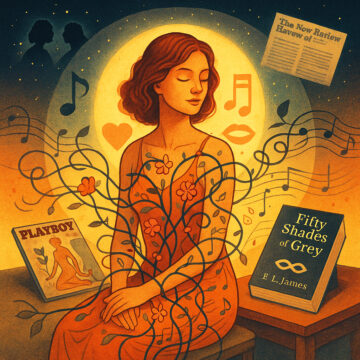
by William Benzon Justly is shame very specially connected with this lust; justly, too, these members themselves, being moved and restrained not at our will, but by a certain independent autocracy, so to speak, are called “shameful.” Their condition was different before sin. For as it is written, “They were naked and were not ashamed,”—not…

Trapped in Work Mode: The Real Challenge of AI is not Technical, It’s Conceptual, Mythic, and Institutional

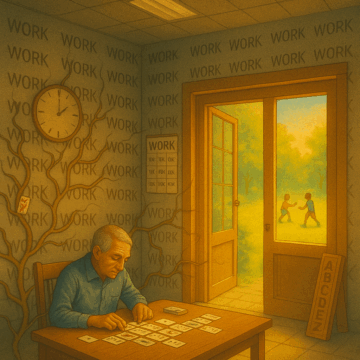
by William Benzon I have been thinking about artificial intelligence and its implications for most of my adult life. In the mid-1970s I conducted research in computational semantics which I used in analyzing Shakespeare’s famous Sonnet 129, “Th’ Expense of Spirit.” In the summer of 1981 I participated in a NASA study investigating ways to…

Why I am a Patriot: Vietnam, the Draft, Mennonites, and Project Apollo

by William Benzon “Loyalty to the country always, loyalty to the government when it deserves it.” –Mark Twain Sometime in the past two weeks I found myself feeling patriotic in a way I don’t remember ever having felt before. I accounted for this feeling by invoking that old adage, “you don’t recognize what you have…

Melancholy and Growth: Toward a Mindcraft for an Emerging World

by William Benzon If Harold Bloom is correct in asserting that, in some sense, Shakespeare invented the human, not in the sense that Eli Whitney invented the cotton gin, Alexander Graham Bell the telephone, Thomas Edison the light bulb, Hedy Lamar got a patent for frequency-hopping spread spectrum technology, not to mention Yahweh’s work on…

Georgia on My Mind

by William Benzon “Georgia on My Mind” was composed and recorded by Hoagy Carmichael (lyrics by Stuart Gorrell) in 1930. Born in 1899 and dying in 1981, Carmichael composed several hundred songs, many of which became hits, including “Stardust,” “The Nearness of You,” “Heart and Soul,” “Skylark,” and “In the Cool, Cool, Cool of the…

Affective Technology, Part 3: Coherence in the Self

by William Benzon In the first part of this series on Affective Technology, I talked about Poems and Stories, using Coleridge’s “This Lime-Tree Bower My Prison” as one example and a passage from Mark Twain’s Tom Sawyer as the other. Coleridge’s poem talks about an injured poet having to spend the afternoon alone while his…

Affective Technology, Part 2: Emotion recollected in tranquility

by William Benzon Here’s the previous article: Affective Technology, Part 1: Poems and Stories In his 1997 best-seller, How the Mind Works, Steven Pinker suggested that, however important art may be to humans, it is not part of our specifically biological nature: We enjoy strawberry cheesecake, but not because we evolved a taste for it.…

Affective Technology, Part 1: Poems and Stories

by William Benzon This is the first in a series of three articles on literature consider as affective technology, affective because it can transform how we feel, technology because it is an art (tekhnē) and, as such, has a logos. In this first article I present the problem, followed by some informal examples, a poem…

Pop-Tarts Re-frosted: An allegory about creativity in a corporatized world?

by Bill Benzon From beginning to end, Unfrosted is constructed with the intricacy of Seinfeld’s stand-up bits. Taken as a sequence of five-minute segments it’s wonderful, and there are resonances among and mid- and long-range connections among those segments. But you can’t carry an hour and 20-minute film on watch-making intricacy alone. There’s got to be…

The Irises Are Blooming Early This Year

by William Benzon I live in Hoboken, New Jersey, across the Hudson River from Midtown Manhattan. I have been photographing the irises in the Eleventh Street flower beds since 2011. So far I have uploaded 558 of those photos to Flickr. I took most of those photos in May or June. But there is one…