
by Malcolm Murray
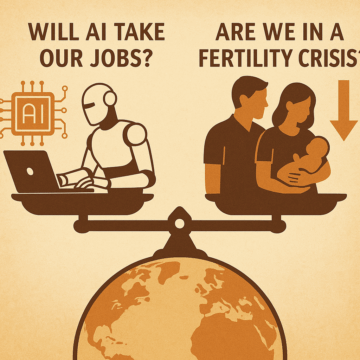 The question of the day on everyone’s minds is whether AI is a boom or a bust. But if we lift our eyes ever so slightly from the question of the day and look at the bigger picture, two bigger questions come into view.
One: Will AI take our jobs? This debate seems to happen for all new technologies, but has been especially salient for AI. This makes sense. (Putting aside questions of per-unit economics and market distorting preferences), if you define AGI as something that can do anything humans can do, then by definition, you have also defined yourself out of any jobs remaining.
Two: Is dropping fertility a crisis? Fertility has been dropping precipitously in developed countries for years, first in East Asia, then Western Europe, and now in practically all countries. Immigration has been the solution, but sometime in this century, the global population as a whole will peak and start shrinking. Many economists, such as Robin Hanson, are deeply worried about this. This again makes sense. Innovation is closely linked to the number of people around to come up with innovations and shifting demographics will turn existing social security systems upside down.
However, a positive, bigger picture reading would be that these two effects might cancel each other out, or at least partly offset each other. The effects of both are of course highly uncertain, but from what we can best tell, these will largely overlap in timing, and could potentially have counteracting effects. By the middle of the century, one potential world is certainly one where AI has replaced humans in many jobs, but the number of working-age humans has gone down, so there are fewer humans that need employment. Or a world where a machine-to-machine economy fills government coffers with more than enough revenue to support the costs of the larger number of non-working age humans in need of pension and healthcare. It seems almost too good to be true that these two massive macro-level trends would coincide in time during the same century. Why is it that, just as the groundwork is laid for creating artificial intelligences that might be able to replace humans for many tasks, improvements in healthcare and economic pressures mean that families start having fewer children in most of the world? Read more »
 In Arabic, the word
  Sughra Raza. Self-portrait in Temple, Jogjakarta, Indonesia, October 2025.



 There can have been very few musicians who played such key roles, in so many different bands in so many different genres, as Danny Thompson. When he died at 86 in September, music lost one of its great connectors.
 Language: Ooh, a talkie!
 There are contradicting views and explanations of what dopamine is and does and how much we can intentionally affect it. However, the commonly heard notions of scrolling for dopamine hits, detoxing from dopamine, dopamine drains, and

 When you walk through the gates to enter the B-52 Victory Museum in Hanoi, you immediately find the wreckage of what has been one of the most terrifying machines ever built: an American Boeing B-52 Stratofortress. Apparently, this wreckage largely came from Nixon and Kissinger’s “Christmas Bombings” of 1972.

 Throughout most of the UK (Northern Ireland is
 In June 1932, half a year before Adolf Hitler was sworn in as German Chancellor, Victor Klemperer watched Nazis on a newsreel marching through the Brandenburg Gate in Berlin. A professor of Romance languages at the Technical University of Dresden, whose area of specialization was the 18th century and the French Enlightenment, Klemperer (1881-1960) was unpleasantly gripped by this first encounter with what he termed “fanaticism in its specifically National Socialist form,” and by the “expression of religious ecstasy” he discerned in the eyes of a young spectator as the drum major passed by, balanced precariously on goose-stepping legs while he robotically beat time.
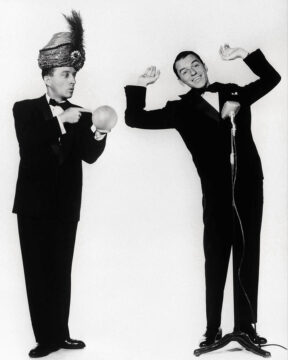 When my mother was a teenager in the early 1940s, a NY-area radio station ran a weekly contest, asking listeners to vote for their favorite singer among two: Crosby or Sinatra? How people made this preference known remains unclear to me: did you need a phone in your house to make a call to the station or was sending a postcard enough? Whatever the method, the winner would be announced each Sunday afternoon. While Sinatra often took the prize, Crosby occasionally outpaced the Jersey boy who grew up two towns south of Cliffside Park, my mother’s hometown. On those occasions, she told me, she’d stamp around my grandparents’ railroad apartment, enraged at the abject stupidity of her fellow listeners. When she’d tell this story, my mother would marvel at her parents’ forbearance, the way they’d accept these outbursts without comment, though they were highly disciplined, gloomy people for whom the idea of having an “idol,” or caring about his fate on a weekly radio show was surely alien. I like this insight into them, a softer side that I myself had only witnessed a few times.