
by Daniel Gauss
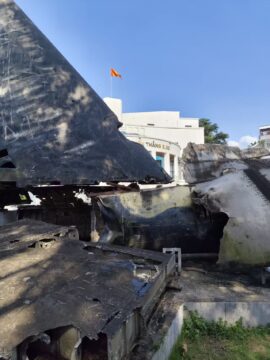 When you walk through the gates to enter the B-52 Victory Museum in Hanoi, you immediately find the wreckage of what has been one of the most terrifying machines ever built: an American Boeing B-52 Stratofortress. Apparently, this wreckage largely came from Nixon and Kissinger’s “Christmas Bombings” of 1972.
The museum has the wreckage laid out to show the rough outline of a B-52, to give visitors some idea of how massive the plane was. It looks like a slain dragon lying there with gaping wounds. My friend Trang, a professor in Vietnam, marveled at the twisted gargantuan structure, wondering out loud what kind of country had the resources and will to make so many airplanes that were so large and destructive.
I witnessed visiting groups of Vietnamese who silently gathered around areas of the wreckage as there was an odd tranquility surrounding the dead beast. It had been dead for over 50 years and folks realized it would never rise again. Yet what lay mangled before us had once represented the apex of American power, when America unquestioningly thought it could win wars through sheer force and technological domination. This was the embodiment of what Theodore Roosevelt once called the “big stick” that we might sometimes use in our foreign policy.
The B-52 was never simply an airplane. It was a political instrument and a psychological weapon. Its very existence, capable of carrying nuclear weapons halfway across the world while being refueled in the air, gave the United States a terrifying aura during the Cold War.
Indeed, from 1961 to 1968, the U.S. Strategic Air Command (SAC) kept nuclear-armed B-52 bombers continuously airborne as part of Operation Chrome Dome. The B-52s flew routes over the Arctic, Atlantic and Mediterranean, staying within striking distance of Soviet targets. Crews flew 24-hour missions, with new crews taking over as others landed. Read more »
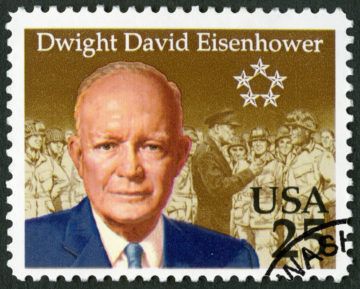 A Republican used to be someone like Dwight Eisenhower, a moderate who worked well with the opposing party, even meeting weekly with their leadership in the Senate and House. Eisenhower expanded social security benefits and, against the more right-wing elements of his party, appointed Earl Warren to be the Chief Justice of the Supreme Court. Warren, you’ll remember, wrote the majority opinion of Brown v Board of Education, Miranda v Arizona, and Loving v Virginia. If Dwight Eisenhower were alive today, he would be branded a RINO and a communist by his own party. I suspect he would become registered as unaffiliated.