
by Daniel Gauss
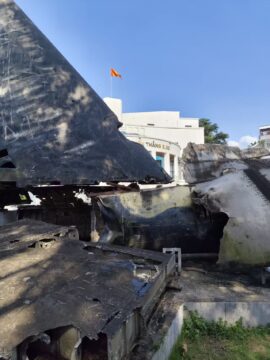 When you walk through the gates to enter the B-52 Victory Museum in Hanoi, you immediately find the wreckage of what has been one of the most terrifying machines ever built: an American Boeing B-52 Stratofortress. Apparently, this wreckage largely came from Nixon and Kissinger’s “Christmas Bombings” of 1972.
The museum has the wreckage laid out to show the rough outline of a B-52, to give visitors some idea of how massive the plane was. It looks like a slain dragon lying there with gaping wounds. My friend Trang, a professor in Vietnam, marveled at the twisted gargantuan structure, wondering out loud what kind of country had the resources and will to make so many airplanes that were so large and destructive.
I witnessed visiting groups of Vietnamese who silently gathered around areas of the wreckage as there was an odd tranquility surrounding the dead beast. It had been dead for over 50 years and folks realized it would never rise again. Yet what lay mangled before us had once represented the apex of American power, when America unquestioningly thought it could win wars through sheer force and technological domination. This was the embodiment of what Theodore Roosevelt once called the “big stick” that we might sometimes use in our foreign policy.
The B-52 was never simply an airplane. It was a political instrument and a psychological weapon. Its very existence, capable of carrying nuclear weapons halfway across the world while being refueled in the air, gave the United States a terrifying aura during the Cold War.
Indeed, from 1961 to 1968, the U.S. Strategic Air Command (SAC) kept nuclear-armed B-52 bombers continuously airborne as part of Operation Chrome Dome. The B-52s flew routes over the Arctic, Atlantic and Mediterranean, staying within striking distance of Soviet targets. Crews flew 24-hour missions, with new crews taking over as others landed.
At its peak, SAC launched up to 75 B-52 sorties per day, supported by 133 KC-135 tanker flights for mid-air refueling, to strike into the heart of the Soviet Union should the “Russkies” ever push things too far. The B-52 was the airplane designed to destroy the world, if the USA ever decided it needed to.
Designed in the early 1950s, the Stratofortress was built to deliver atomic bombs on the Soviet Union from altitudes too high for interception. In time, it became something more abstract: a flying doctrine of never-ending deterrence. The “I dare you…” nobody ever took. It was a major prop in the psychological theater beneath deterrence: it was not rational calculation but, instead, ego, bravado and other playground instincts scaled up to nuclear stakes.
The Birth of the Big Stick in the Sky
To understand the B-52’s more symbolic meaning, let’s recall its origins. The aircraft entered service in 1955, amid a postwar obsession with airpower as destiny. General Curtis LeMay, the architect of the U.S. firebombing of Japan, became the B-52’s chief evangelist. To him, strategic bombing wasn’t just a military tactic but a way of life: terrorize your enemy into submission through overwhelming destruction. The B-52, vast and sleek and powerful with eight engines, became the perfect vessel for this mission.
Ho Chi Minh wanted a unified Vietnam and was none too happy his nation was still split even after the US, under Eisenhower, had promised to help hold elections for a unified government. So, Ho Chi Minh began launching attacks in the South, classic guerrilla warfare to put pressure on an army of occupation. LeMay’s reaction was simple.
In 1965, he told U.S. News & World Report: “My solution to the problem would be to tell them frankly that they’ve got to draw in their horns and stop their aggression or we’re going to bomb them back into the Stone Age.” You could do that to a nation of Buddhist farmers with a bunch of B-52s and a guy like LeMay.
LeMay’s mindset, and, by extension, America’s, combined technological hubris with moral certainty. “If you kill enough of them, they stop fighting,” LeMay once said. But LeMay was wrong. Possibly over 3 million Vietnamese were killed in the “American War,” and they never stopped fighting, until they didn’t have to fight any more. The Yankees largely went home in 1973.
If you go to Ho Chi Minh City (no longer Saigon) you can see the Pittman Apartments’ roof (not the embassy roof) where the last US helicopter officially took off in April 1975. I took a look at it myself last year. Not a lot of American tourists seem to go there, and it has not been established as a tourist site.
When Vietnam emerged as a battle ground for Cold War ideology, the B-52 was repurposed for conventional bombing. In Southeast Asia, it ceased to be a symbol of deterrence and became an instrument of coercion and punishment. Its sole purpose was to demonstrate that might makes right and that the mighty still wanted a divided country regardless of what that country’s people wanted.
Vietnam: The “Arc Light” of Terror
Beginning in 1965, under Operation Arc Light, B-52 bombers began regular missions over Vietnam, later extending into Laos and Cambodia. Flying at altitudes above 30,000 feet, they dropped up to 30 tons of bombs in a single sortie, devastating areas up to two square miles. Survivors described the raids as if “the sky itself exploded.”
In strategic terms, however, the bombings rarely achieved their stated goals. They did not break the morale of the North Vietnamese nor destroy their supply lines. Instead, they devastated civilian areas and rural communities, outraging, radicalizing and emboldening more people than they subdued. Even the U.S. Air Force’s own postwar assessments admitted that the B-52 campaign had limited tactical value.
But even though they were ineffective, they were used anyway, as Lyndon Johnson could violently vent his uncontrollable anger and frustration over people who would not do what he wanted them to do. The attitude seemed to be, “Well, we can’t beat them with the B-52, but at least we can kill lots of them and make them regret asserting their right to independence, even if they wind up winning it.”
It’s horrifying to consider that the devastating B-52 strikes might have offered Johnson, Nixon and Kissinger some type of emotional satisfaction during a war they must have known could not be won.
When Nixon ordered the “Christmas Bombings” in December 1972, he and Henry Kissinger hoped to force Hanoi into signing the Paris Peace Accords on American terms. For eleven nights (the crews got a day off for Christmas), the B-52s unleashed 20,000 tons of bombs on Hanoi and Haiphong.
After negotiations had broken down, the North Vietnamese anticipated that Nixon would throw some kind of tantrum and began evacuating civilians and reinforcing Hanoi’s defenses, thus holding down the numbers to 1,600 Vietnamese civilians killed. Yet the final agreement was nearly identical to what Hanoi had already offered months before the bombings began. Kissinger would win a Nobel Peace Prize. I doubt Kissinger ever learned that technology cannot substitute for wisdom and terror cannot substitute for humane diplomacy.
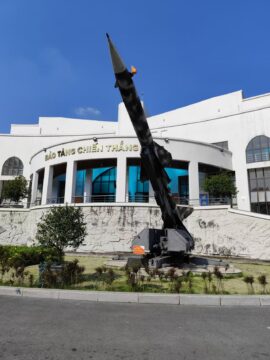 Now, the Russians knew a thing or two about technology as well and began giving North Vietnam Surface to Air Missiles (SAMs) which could now reach the B52s. They were, basically, B-52 killers. These missiles were part of a sophisticated air-defense network that the North Vietnamese built around Hanoi and Haiphong.
The December 1972 “Christmas Bombings” (Operation Linebacker II)
The U.S. sent waves of B-52s to strike Hanoi and Haiphong for 11 nights. The bombers flew in large formations, following predictable routes, altitudes and timing. The North Vietnamese took advantage of this predictability. They massed their radar-guided SAM sites around the city and fired in coordinated volleys.
The sky over Hanoi was filled with missile trails, flak bursts and falling wreckage. 15 B-52s were shot down during those 11 nights. 33 American crewmen were killed and 33 captured and taken to the “Hanoi Hilton” (which you can visit in Hanoi if you ever drop by – although the part that held American POWs was torn down to make way for condos and shopping malls).
So, if you could not outrun or out-climb radar-guided missiles, US engineers started thinking: maybe you could avoid being seen at all? After Vietnam, and as a significant result of the B-52 snafu over Hanoi, American engineers began an accelerated effort into exploring how to reduce an aircraft’s radar cross-section, essentially how big it appears on enemy radar. The idea was to scatter or absorb radar waves so the aircraft would blend into background noise. Although stealth technology had earlier roots, the problematic aspects of bombing Vietnam with B-52s accelerated its development.
The B-52 is now a symbol of excessiveness, not deterrence. When the U.S. faces small or poorly defended countries, stealth is not necessary. That is why the B-52 keeps being used in wars against countries or insurgent groups that lack real air power. Vietnam’s successors in this sense have been Iraq, Afghanistan, Serbia, Libya and Syria.
The B-52 functions less as a tactical tool and more as a psychological and political instrument. So while stealth aircraft are reserved for high-end conflicts, the B-52 remains the hammer for smaller nails.
The B-52’s Afterlife
So, the B-52 never died. It outlived the Cold War, the Soviet Union and several generations of U.S. presidents. The Air Force now plans to keep it flying into the 2050s, meaning the B-52 may serve for a full century. The B-52 has been America’s preferred symbol of “shock and awe.” Each modernization program involving new radar, new weapons, new avionics, is an effort to prolong an idea: that power displayed from the air can enforce order on the ground.
Was It Ever Really Successful?
The B-52’s record is ambiguous. It never really won a war. It never secured a lasting peace. Its missions often turned public opinion against the United States in Vietnam, Laos and Cambodia, and later in the Middle East.
In Iraq, Afghanistan and Syria, B-52s were used for shock and saturation bombing, but none of these conflicts ended with clear, lasting peace. The bomber’s presence often reinforced perceptions of American arrogance, brutality and overreach. One could argue that the B-52 has been a tool of projection, but not resolution. It has not provided decisive victories in asymmetric wars. Frankly, it was a way to express disapproval and frustration on a vast and bloody scale.
But what about its deterrence value? Didn’t it keep us out of nuclear war? It might be argued that the B-52 never won a war, but it may have helped prevent the ultimate one. As a flying embodiment of mutual assured destruction, it ensured the Soviets would never launch a first strike. Yet, declassified Soviet documents and memoirs show that Soviet leadership, especially after Khrushchev, was deeply committed to its own deterrence and not at all eager for a first strike.
In one of the most absurdly comic aspects of human history, both sides in the Cold War built massive arsenals of nuclear weapons, not to use them in a first strike, but to prevent the other from using theirs, while neither side ever really had that intention. The Soviets seemed as keen on deterrence, and averse to a first strike, as the Americans.
The Fear that Sustains
Reinhold Niebuhr once warned that nations are also tempted by the “pride of power”…that they can impose their sense of moral order through force. Every president who has used the B-52, from Johnson to Obama, has claimed moral necessity. They all assumed that power can accomplish virtue. Trump has not used B-52s for bombing, but he had some flying off the coast of Venezuela recently as a message to Maduro.
The B-52 still flies partly because fear sustains empires as much as ideology does. The fear of vulnerability, of being surpassed, humiliated or attacked, drives nations to cling to their biggest weapons. The B-52 is the embodiment of that insecurity: too outdated to be a true superweapon, yet too iconic in reputation to retire.
To the rest of the world, especially in places like Vietnam, the B-52 means something else entirely. It is not a symbol of deterrence, but of swagger, a distant empire trying to assert moral authority through firepower and not compassion, discourse or economic cooperation.
Standing Before the Ruins
I realized that the B-52’s legacy depends on where you stand. In Washington, it may still represent deterrence, the alleged logic of realpolitik. In Hanoi, it represents victory and survival, proof that even the largest empire can be resisted.
The B-52 was meant to make the world fear America. Instead, it aided America in fearing the world, fearing weakness, failure, the loss of control. It taught the United States to confuse might with meaning and technology with truth. It taught the rest of the world that even the most powerful machine can fall from the sky and become a broken slaughtered relic of a beast for kind and peaceful professors to gape at in wonder and shake their heads.
Epilogue: The Weight of Air
When Teddy Roosevelt coined the phrase “speak softly and carry a big stick,” he meant that diplomacy should be backed by believable force. The B-52 became a part of a misunderstanding of that expression, as the US began speaking loudly without conversation, doling out outrageous punishment without persuasion or change.
History can speak softly, too, through revisited memory. The very machine that once symbolized American omnipotence now sits as a monument to human endurance, and hopefully forgiveness. May we begin acting in a way that warrants forgiveness. Maybe that’s the real lesson of the B-52: that every empire may eventually have a museum of its own hubris. The question is whether we or someone else curates it.
Enjoying the content on 3QD? Help keep us going by donating now.