
by Charles Siegel
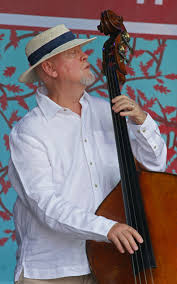 There can have been very few musicians who played such key roles, in so many different bands in so many different genres, as Danny Thompson. When he died at 86 in September, music lost one of its great connectors.
I first learned of Thompson as a freshman in college, when my roommate introduced me to Pentangle. There had never been a band like Pentangle, and there really hasn’t been one quite like them since either. They were an utterly unique melding of folk and jazz. The band’s guitarists, Bert Jansch and John Renbourn, were two of the leading English folk guitarists of the day when Pentangle was founded in 1967. Terry Cox was an established jazz drummer, and Jacqui McShee was an up-and-coming folk singer.
At the center of it all was Danny Thompson on bass. By 1967 he’d already had a wide variety of musical experience, not to mention a turbulent life.
Born in Devon, he never knew his father, a miner who joined the Royal Navy at the start of World War II and was killed in a U-boat attack. His sister died not long after, and he and his mother moved to Battersea, then a rough area of London yet to be gentrified.
He was a good soccer player — good enough to play for Chelsea’s youth teams. And he was a good boxer, winning 22 of 23 fights. But already, music was becoming his consuming passion. By the time he was a young teenager he had tried guitar, mandolin, trumpet and trombone. He told an interviewer that one reason he gave up trombone was his boxing, “because a smack in the chops is not very good for that.”
After all of those instruments, he settled on the double bass. Like pretty much every young musician in England in the 1950s, he started out playing in skiffle bands, and like everyone from Paul McCartney to Jimmy Page, he was inspired by Lonnie Donegan.
From there, he played in strip clubs in Soho and on American military bases. In keeping with his already ornery personality, in 1957 he was arrested for failure to report for national service. Three days before he was sent to prison, he married his girlfriend, and then was posted to Malaysia for two years, where he took up the trombone again in an army band.
When he came back, he joined Alexis Korner’s Blues Incorporated, sort of an incubator for future English superstars (e.g., Ginger Baker, Charlie Watts, Jack Bruce). He also began playing with jazzers.
Take, for example, another veteran of Blues Incorporated: John McLaughlin. At this point, in the mid-1960s, McLaughlin had yet to make the move to the U.S. that led to his playing with Tony Williams and Miles Davis. Playing with him, Thompson moved effortlessly from blues to jazz. While that doesn’t sound like such a great shift — blues, after all, is the atavistic root of jazz — McLaughlin was already beginning to think in a new direction, that eventually made him one of the pioneers of fusion, and Thompson adapted. He also played with many, many other leading jazz figures such as Joe Williams, Ronnie Scott, and Jon Hendricks.
In 1967, he started Pentangle with the others. This was, again, something entirely new: highly stylized versions of deep English folk songs, along with innovative jazz numbers. Here they are on the folk classic “Once I had a Sweetheart”:
https://www.youtube.com/watch?v=TRXPslHDVI0
Jacqui McShee’s crystalline voice, Terry Cox’s rolling drums and glockenspiel accents, a long sitar solo, and Thompson’s brooding bass all make for a haunting rendition.
On “A Maid That’s Deep in Love,” Thompson is in the foreground. Listen to how his bass propels the song along. Together with Renbourn’s exquisite electric guitar filigree over Jansch’s acoustic rhythm, it’s magical: https://www.youtube.com/watch?v=4pGDi7OCxA0
As groundbreaking as they were with folk tunes, they were equally comfortable with jazz. Thompson takes a solo on “I’ve Got a Feeling,” their treatment of Miles Davis’ “All Blues”: https://www.youtube.com/watch?v=1cMoetAG_1Q In “Light Flight,” which was later used by the BBC as the theme for the TV series “Take Three Girls,” Thompson announces the song’s groove at :18, and they return to it at 2:34: https://www.youtube.com/watch?v=OsMm0wxpaRc
The group called it quits in 1972. (There was a brief reunion tour in 2011, and the band still exists today, in name only though, with McShee, the only living original member, performing and recording sporadically with some very capable musicians.) Thompson still had nearly 50 years of music left to play.
The list of people and bands he played with goes on forever: Sandy Denny, Richard Thompson, Donovan, Rod Stewart, London Wainwright III, Kate Bush, Ralph McTell, Paul Weller, Joe Strummer, Talk Talk, The The, Everything But the Girl to name just a few. And scores more. It’s impossible to do justice to that kind of career, but here are four idiosyncratic favorite clips:
Thompson was a close friend of John Martyn. They were also fellow alcoholics, known for combustible behavior onstage and off. Eventually, after this reputation took its toll and he began to get less work, Thompson sobered up in the late 1970s and his career rebounded. Here are the two of them in a moody take of Martyn’s song “Solid Air,” which he wrote for his friend Nick Drake (whom Thompson had also played with and who died of an overdose of antidepressants 18 months later). At 3:17, Thompson takes a lovely, plaintive solo. https://www.youtube.com/watch?v=ohmSPv-rtSQ
The song Martyn is probably best known for is “May You Never,” and it’s much happier. Here, Kathy Mattea joins him and Thompson in a sinuous version, with a nice solo on the dobro from Jerry Douglas: https://www.youtube.com/watch?v=VRLj2GdCYcU
In a previous column, https://3quarksdaily.com/3quarksdaily/2025/06/dead-company-paint-their-masterpiece-at-the-sphere.html, I mentioned “Morning Dew,” an old folk tune from the early 1960s covered by many, most famously by the Grateful Dead. It was originally written by a 21-year old Canadian woman, Bonnie Dobson. Here she sings it at a Bert Jansch tribute concert, with Robert Plant and Bernard Butler. Thompson provides tasteful grounding: https://www.youtube.com/watch?v=zZXuuKwhVvI&list=RDzZXuuKwhVvI&start_radio=1
Finally, here he is in New York, playing with the mighty gospel icons, the Blind Boys of Alabama. He starts the song, “Run On for a Long Time,” and keeps it chugging. The lead singer introduces him at the beginning, and calls him out at the end during his short outro:
https://www.youtube.com/watch?v=OkLdmayneGM
The fatherless boy from Devon really did run on for a long time, and to many musical places. It’s virtually impossible, now, for a musician to have this kind of career. The reasons are many and varied, from short attention spans to the disappearance of session work and the fragmentation of genres and listening habits. There probably won’t ever be another musician like Danny Thompson, which is a shame.