by David Kordahl
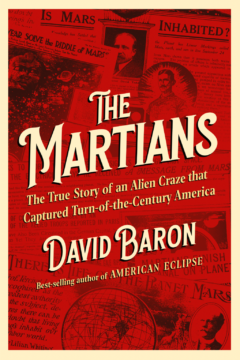
This article is a lightly edited transcript of a conversation with David Baron about his new book, The Martians: The True Story of an Alien Craze that Captured Turn-of-the-Century America. A video of this conversation is embedded below.
Intro and Percival Lowell Background (0:00)
Origins of the Canal Craze (6:39)
Gathering Evidence for the Canals (10:41)
Scientific Debate with Astronomers (14:02)
Thinking about “Outsider Scientists” (23:35)
Influence of Canals on Culture (27:45)
Reflections on Mars and the Future (32:33)
Intro and Percival Lowell Background
Today I’m speaking with David Baron, a seasoned science writer who has contributed to many major American journalism outlets, including the New York Times, the Washington Post, and the Wall Street Journal. He was a longtime science correspondent for NPR, and his TED Talk on the experience of solar eclipses has been viewed millions of times. His last book, American Eclipse, won the American Institute of Physics Science Writing Award in 2018. Today we’ll be discussing his new book, The Martians: The True Story of an Alien Craze that Captured Turn-of-the-Century America.
The “alien craze” in the subtitle of your book is the story of how, for about a decade at the beginning of the twentieth century, many people came to believe that the planet Mars held not only life, but a complex civilization. The person most responsible for popularizing this view as an established scientific fact was Percival Lowell. Lowell functions as a main character in your book.
I want to thank you for joining me today. At what point in your reporting for this book did it become clear that Lowell would function as a central figure in your story?
Oh, pretty much I knew that from the start. I first learned about the so-called “canals on Mars” from Carl Sagan, when I was in high school and watched the Cosmos series on PBS. On an episode about Mars, Sagan talked about this astronomer, Percival Lowell, who at the turn of the last century saw these weird lines on Mars that he believed were irrigation canals. It’s remembered as one of the great blunders in science, because it was an idea that really took off.
What actually surprised me was not that Lowell was my main character, but just how many other people got swept up in this craze—some of them quite prominent, famous scientists and inventors who totally believed that in fact there was the civilization on Mars. It was not just Percival Lowell. It was quite a collection of interesting characters. Read more »