
by Malcolm Murray
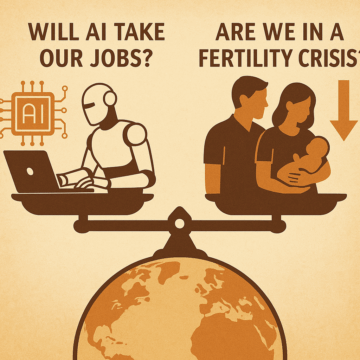 The question of the day on everyone’s minds is whether AI is a boom or a bust. But if we lift our eyes ever so slightly from the question of the day and look at the bigger picture, two bigger questions come into view.
One: Will AI take our jobs? This debate seems to happen for all new technologies, but has been especially salient for AI. This makes sense. (Putting aside questions of per-unit economics and market distorting preferences), if you define AGI as something that can do anything humans can do, then by definition, you have also defined yourself out of any jobs remaining.
Two: Is dropping fertility a crisis? Fertility has been dropping precipitously in developed countries for years, first in East Asia, then Western Europe, and now in practically all countries. Immigration has been the solution, but sometime in this century, the global population as a whole will peak and start shrinking. Many economists, such as Robin Hanson, are deeply worried about this. This again makes sense. Innovation is closely linked to the number of people around to come up with innovations and shifting demographics will turn existing social security systems upside down.
However, a positive, bigger picture reading would be that these two effects might cancel each other out, or at least partly offset each other. The effects of both are of course highly uncertain, but from what we can best tell, these will largely overlap in timing, and could potentially have counteracting effects. By the middle of the century, one potential world is certainly one where AI has replaced humans in many jobs, but the number of working-age humans has gone down, so there are fewer humans that need employment. Or a world where a machine-to-machine economy fills government coffers with more than enough revenue to support the costs of the larger number of non-working age humans in need of pension and healthcare. It seems almost too good to be true that these two massive macro-level trends would coincide in time during the same century. Why is it that, just as the groundwork is laid for creating artificial intelligences that might be able to replace humans for many tasks, improvements in healthcare and economic pressures mean that families start having fewer children in most of the world?
Some might see this as evidence for technological determinism – that technology has its own force of nature and the evolution of new technologies is practically pre-determined. Kevin Kelly famously wrote about the Technium, with almost a mind of its own. More recently, the founders of Epoch AI left to start Mechanize, arguing that AI automation is inevitable. Luke Drago called this technocalvinism.
However, this coincidence seems to potentially go beyond technology. It almost suggest a notion of history as a self-healing mechanism. Perhaps at a large enough scale, balancing forces tip the scale back toward an equilibrium whenever it gets too askew. Looking throughout history (albeit with a very broad brush and a lot of cherries picked, since I am not a historian) we can see myriad examples of this. When populations became too large in medieval cities, plagues came as corrections. As the world reeled from the horrors of the two world wars, the UN was founded and the pendulum swung towards increased freedoms at all levels for 80 years. This goes back to the Greeks and Polybius’ concept of anacyclosis where societies cycle through monarchy, tyranny, aristocracy, oligarchy, democracy, and ochlocracy. Going up on level, James Lovelock’s Gaia hypothesis talks about how the Earth itself self-regulates as a broad system.
Another current example of this dynamic at play is for the other big risk of the 21st century, climate change. Political will is sapped in most countries, people have given up on vegetarianism, and COP30 looks set to be a failure, but at the same time, this is all dwarfed by the inexorably dropping price of solar energy. What does it matter if the stock price of Beyond Meat drops by 90% if the price of a solar panel also drops by 90% so that an African farmer can afford one? This has led people like Noah Smith, Bill Gates and Ted Nordhaus to look much more optimistically at future climate projections. Yet another example is the new “epidemic” talked about in the media – the “loneliness epidemic” (loneliness is worse than smoking!) This is now coinciding with the development of AI companions that seem for many people to be just as meaningful as the real thing.
As a Buddhist, I have learned that our free will is much more limited than what we typically think and, what’s further, that we can take comfort in this notion of no control. For the many people who look at the future with more concern than hope these days, the notion of history as a self-healing mechanism could perhaps be a similarly comforting notion. It might not mean that there is a God that has determined our final destination, nor that there will not be individual sorrows and struggles on a granular level, but zooming out to a big enough picture, individual errors might be corrected as history continues its balancing act.
***
Enjoying the content on 3QD? Help keep us going by donating now.