by Barbara Fischkin
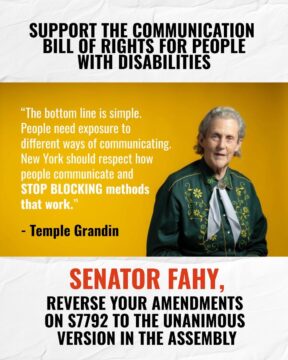
I am writing this in honor of my late mother Ida Fischkin who, as a child, saved her own life in the midst an anti-Semitic pogrom in Eastern Europe. She taught me to fight for the seemingly powerless—to consider they might not be weak or stupid. Her lessons came in handy as I raised our elder son, who has nonspeaking autism. For 33 of his 38 years, he has typed to communicate his own thoughts with sensory support from me and from some of his more enlightened and well-trained therapists and teachers. These days, at the keyboard, he approaches independence and often demonstrates it.
There are hundreds, perhaps thousands, of non-speakers who use this same technique.
Some need the same sensory support as my son—a touch on the hand can fade to the arm or shoulder. Then they move on to independence. Others need support for longer. The training is intense and complicated. One must learn to merely touch non-speakers, not move them to the keys. This communication has been validated as real and original by doctoral level professors, expert educators and scholars and by the typers themselves who communicate information their sensory supporters do not know.
I have a long list of “validations,” which were typed by my son Daniel Mulvaney and span the years. I write about him and offer two examples of these validations, with his permission. As a child he told his teachers that he had seen a dead bird while on a walk with me. Indeed, he had. More recently he bemoaned the loss of a romantic opportunity with a nonspeaking woman because “she found a boyfriend who drives.” She did.
But now the chair of a committee in the New York State Senate, the legislature’s upper house—wants to officially denigrate this method. She wants to demolish its use. Read more »





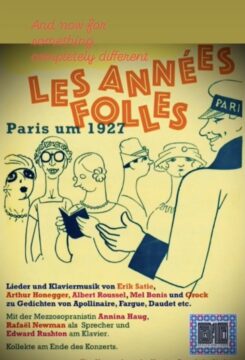
 On Thursday this week I will join two of my colleagues—the mezzo Annina Haug and the pianist Edward Rushton—to present a program of poems by French authors to a private audience. We are staging our concert in Zurich, at the home of a descendant of one of those authors, the renowned Swiss-French clown and musician





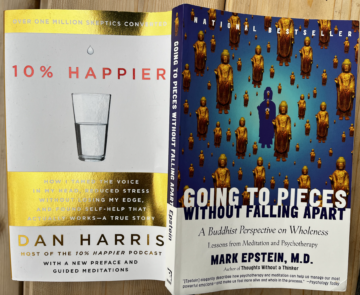 I’m curious about the intersection of psychology, philosophy, and spirituality, and the more I read, the more closely they all appear to intertwine until they’re sometimes indistinguishable. Buddhism overlaps with Stoicism, which influenced Albert Ellis’s REBT (then CBT and all its variations). They dig down to acknowledge and question mistaken core beliefs. Plato inspired some of Freud’s work, which mixed with Sartre and Camus to become the existential psychotherapy of Irvin Yalom and Otto Rank. They have a focus on the acceptance of death, which comes back around to the Buddhist prescription to meditate on our bones turning to dust. Yet, despite a general theme being repeated, it’s striking how hard it is to get out from the minutia of daily life to attend to it.
 Sughra Raza. Microforest, March 2022.