
by Leanne Ogasawara
1.
Every morning, the mathematician wakes up not knowing who he is.
Or rather, he knows exactly who he is. He knows his theorems, his love of prime numbers, the way a perfect equation can feel like something close to grace. What he cannot recall, however, is who slept in his house last night, who cooked his breakfast, whose child left muddy shoes by the door. His memory, damaged by a long-ago accident, resets every eighty minutes.
And yet it seems that no one who encounters him — not the housekeeper who tends to him, not her young son whom he names Root for the shape of his head, not even his sister-in-law who knew him before — would say he is not himself. He is achingly, luminously present in every moment. He simply cannot remember things happening before.
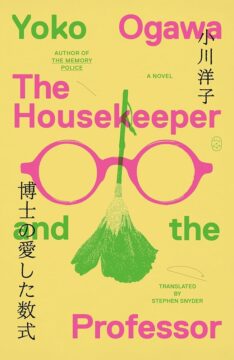
Yoko Ogawa’s novel The Housekeeper and the Professor has haunted me since I first read it, but it returned with new insistence when I recently opened Michael Pollan’s new book, A World Appears: A Journey into Consciousness.
Before reading Pollan’s book, I struggled to think of Ogawa’s Professor as truly conscious, in the same way I am truly conscious, mainly I had always assumed that consciousness was inseparable from something called the continuous self. When I tried to imagine, for example: what I myself am beyond the sum total of my life experiences and my story of being “me,” I struggled. We have all heard families of Alzheimer’s sufferers describe how a light went out in the sufferer’s mind or how “mom was gone.”
If I put myself in the fictional professor’s shoes, for example, while I can imagine my love of reading and writing still being there even after a catastrophic loss of memory, I wonder what “me” would I be if I couldn’t recognize my son or my husband? How much can I lose and keep “feeling myself?”
Or more interesting, how much can I really lose and keep being myself?
Philosophers sometimes invoke the concept of a “philosophical zombie,” which is a being that imitates consciousness perfectly but has no inner subjective experience, no sense of what it is like to be itself. The Professor is the uncanny reverse: a being whose inner life is unmistakably rich, whose subjective experience of each eighty minutes is vivid and complete, but who cannot stitch those moments into a continuous story. Read more »