
by Charles Siegel
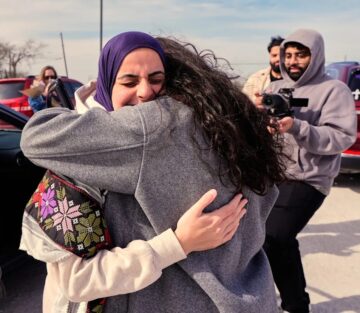
In one of my first columns for 3 Quarks Daily, I began by noting that my law firm had just filed, along with other firms, a petition for habeas corpus relief in federal court in Dallas. Our client was Leqaa Kordia, a Palestinian woman living in New Jersey, who was imprisoned in a detention center in Alvarado, 40 miles away. Last week, almost exactly one year after she was detained, Ms. Kordia was freed. We are, of course, relieved and beyond happy that she has been released from detention. But her case was an utterly grotesque abuse of the American immigration justice system.
Leqaa grew up in the West Bank. Her parents divorced when she was young and her mother moved to Gaza, and eventually to the United States where she remarried and had other children. In 2016 Leqaa joined her mother in New Jersey, obtained a student visa, attended classes and worked as a waitress and at other jobs. At home, she took care of her mother, who is severely asthmatic, and her autistic half-brother.
Her mother, who is a U.S. citizen, filed a “family-based” petition for Leqaa to begin the process of obtaining permanent residency. This petition was approved, but this also created a tripwire that ultimately seriously disadvantaged her: a teacher told her, mistakenly, that with the family-based process underway, she did not need to maintain her student-visa status.
On October 7, 2023, Hamas attacked Israel from Gaza, killing approximately 1200 people, mostly civilians, and taking 250 hostages. Israel responded with unrestrained fury, bombing Gaza into ruins for two years and destroying the basic infrastructure of life there. Nearly 30 months into the war, conservative estimates are that at least 75,000 deaths have occurred in Gaza. The Israeli army itself has accepted a figure of 70,000 deaths. These numbers may well be undercounts, but even if they aren’t, they indicate that for every single Israeli killed by Hamas on or after October 7, 2023 (including hostages who were later killed or who died in captivity), nearly 50 Gazans have died.
Among those tens of thousands of victims are close to 200 of Leqaa’s extended family. She told the New Yorker six months ago that she was ‘heartbroken; my mind was all about Gaza, nothing else…. To feel helpless – this is one of the most awful feelings in the world…. There is no safe place in Gaza.”
As the war ground on, the presidential campaign got going. Trump repeatedly said he would use immigration enforcement measures against students speaking out in support of Palestinians. At a rally in Las Vegas, he promised to “terminate the visas of all of those Hamas sympathizers, and we’ll get them off our college campuses, out of our cities, and get them the hell out of our country.” In spring 2024, he vowed to campaign donors that “any student that protests, I throw them out of the country.” He also said that “if you get me reelected, we’re going to set that movement [for Palestinian rights] back 25 or 30 years.” Marco Rubio said that the government should “cancel the visa of every foreign national out there supporting Hamas and get them out of America.”
Relying on these statements, and the odious executive orders that followed, organizations opposed to Palestinian rights began publicizing names of individuals they thought should be deported, and submitted “tips” to ICE’s tip line. For example, Betar USA, an openly Islamophobic group, has published lists of names and urged ICE to deport them. Betar has bragged that it has “submitted names of hundreds of terror supporters to the Trump Administration.” Canary Mission, a similar group, has similarly proclaimed it has identified “suspected foreign nationals” to be deported.
Leqaa would occasionally take the train from her home in Paterson, New Jersey to New York City. On one such visit, on April 30, 2024, she joined a rally for Gaza at Columbia University. At one point, she began to feel lightheaded, and sat down on the sidewalk. At the same time, police began to clear the crowd and make mass arrests. She was arrested, but the charges were very soon dropped, as were the charges for virtually every other person arrested at Columbia that day.
Nearly a year later, DHS agents visited her home; her mother called her, and the agents told her they just needed to speak with her. So she went to the Newark DHS office, with her lawyer, thinking it was a routine check-in. In one of the many little sick, devious changes that the government has made to immigration procedure, she was arrested there. How hollow, how insecure must a regime be, when it abducts people by deceiving them into showing up for routine administrative appointments?
And in another of the truly despicable maneuvers that has characterized this regime, ICE immediately flew Leqaa 1300 miles away to Texas. ICE has done this to thousands of detainees because it wishes to have their cases evaluated by federal courts in the Fifth Circuit, the most conservative court of appeals in the country (the court covers Texas, Louisiana, and Mississippi).
Thus began Leqaa’s year at the Prairieland Detention Facility in Alvarado. On ICE’s website, our government tells us that one of ICE’s missions is to “protect the homeland through the arrest and removal of those aliens who undermine the safety of our nation’s communities and the integrity of U.S. immigration laws.” Leaving aside the blood-and-soil overtones of “homeland,” the agency goes on to say that detention centers “house aliens to secure their presence for immigration proceedings or removal from the U.S.” It further states that “ICE detains aliens who are subject to mandatory detention or those that ICE determines are a public safety or flights risk….”
You will not find, on the ICE website, much information about the fact that Prairieland is operated by LaSalle Corrections, a private prison company. The subject of the private prison industry in this country is itself worth a dozen more columns. (And perhaps an additional column about the lawsuit pending against LaSalle for pervasive racial discrimination in employment at Prairieland. Just this month, an extremely conservative federal judge, appointed by Trump, denied LaSalle’s motion for summary judgment in the case, and so it will proceed to trial.)
When Leqaa arrived, the facility was so overcrowded that no beds were available. Instead, she and approximately 55 other women were housed in a room intended for 20. She slept on the concrete floor with a thin mattress and blanket; as a result, she developed a severe rash, which bled anytime she touched it. It only stopped bleeding when she bought a long-sleeve shirt from the commissary. A nurse said she would give her medicine but only provided Vaseline, which gave no relief.
Eventually a bed became available in her holding area, but it was located a few inches below an air-conditioning unit that blew frigid air almost constantly. She could not sleep restfully, and experienced a sore throat and a headache every day. She made three requests to change beds, but never received a response, and so she asked to move back to the floor. She preferred the rash to constant sore throats, migraines, and weakness.
Leqaa submitted several requests for medical care, but was rarely offered anything besides ibuprofen. Even a cough drop was sometimes out of the question; once a nurse told her they were out of cough drops because the facility was overwhelmed by the number of inmates.
The place is squalid. Leqaa frequently saw roaches near her on the floor. Many of the plumbing fixtures do not work; in the bathroom she shared with dozens of other people, only one of four sinks worked. The showers have little temperature control, and so are either freezing cold or scalding hot. Because of the bugs, broken sinks, and uncontrolled showers, Leqaa struggled to stay clean. Once, while doing her laundry, Leqaa saw a snake on the floor of the laundry room. When she called repeatedly for a guard, no one came. When a guard finally turned up, she told Leqaa to pick the snake up herself.
Food ranged from impermissible to inedible. From the beginning, she requested halal meals, which is her constitutional right, but was refused them. After some weeks, guards began to give her cellophane-wrapped kosher meals. When she pointed out that kosher and halal are not the same, the guards simply ignored her. What little food Leqaa could eat was atrocious. Moldy and smelly “meals” were common. As a result of all of these problems, Leqaa at one point had lost approximately 35 pounds.
Lights went out only late at night, and came on again at 4:00 a.m. An inmate is not allowed to have her phone or other devices. Despite all this, and despite the loneliness and endless slowness of time, Leqaa tried hard to be hopeful, even resolute. When I visited her with other members of the legal team a few months ago, she was in relatively good spirits. When my law partner visited her again with other team members a few weeks ago, they were short one chair in the spare conference room; while one of the lawyers went to ask about finding another chair, Leqaa told him not to worry. “This is my home now,” she said. “In my home you are guests, so I will stand while you sit. Please make yourself comfortable.”
Meanwhile, legal efforts to end Leqaa’s detention proceeded. Broadly speaking, these efforts went forward on two tracks: in immigration court, and in federal court. These are distinct systems: immigration courts are administrative courts within the Department of Justice, and as such are in the executive branch. Trump can thus summarily fire immigration judges, and in fact has fired more than 100 of them, all while massively increasing the system’s caseload. Federal courts, conversely, are within the judicial branch, and so are theoretically free from pressure by the executive, although Trump viciously pressures judges constantly. Once nominated by the president and confirmed by the Senate, a federal judge can serve as long as he or she wishes.
The United States seeks to deport Leqaa and has instituted “removal” proceedings against her. (The issue of where it could or would send her is itself a fraught one.) Normally, or at least before Trump 2.0, people are not typically detained during the pendency of such proceedings. That has changed drastically, which is why ICE is scrambling to construct or lease dozens of new detention facilities, some of which will hold thousands of people.
A person may petition for release from detention during the pendency of removal proceedings, and often release is conditioned on the posting of a bond. In order to grant release on bond, an immigration judge must determine that an individual is neither a danger to the community nor a flight risk.
In support of her request for bond, Leqaa submitted letters from friends and family. DHS argued that she was both a danger and a flight risk, stressing that she had sent money to a family member living in Palestine, and suggesting that this amounted to “support for Hamas.” Ultimately, the immigration judge disagreed, noting that the government had no information about the recipient of this single transaction.
But ICE did not release her. ICE now keeps individuals confined for at least 24 hours after a bond hearing, even where the person posts a bond, so that DHS attorneys may seek an automatic stay from the Board of Immigration Appeals of any decision granting bond. Under past practice, ICE virtually never confined an individual legally admitted to the country with no criminal history, particularly where that person has a viable defense to removal or an approved family-based petition for a green card, and usually would not invoke an automatic stay of the decision.
Under the relevant regulations, DHS’s filing of an appeal automatically prevents the bond order from going into effect. This means the person will necessarily remain in custody until either the BIA decides the bond appeal, or 90 days pass. Since DHS has ten days to file the appeal before the 90-day clock starts, this stay provision creates a 100-day, due-process-free zone where there is no ability to be heard at a meaningful time.
At the end of the automatic stay period, the immigration judge’s order to release a noncitizen on bond remains stayed for up to 30 days while the BIA considers any discretionary stay request. Thus, the regulations in effect permit a 130-day period of confinement without any procedures to contest or challenge that confinement.
In Leqaa’s case, the immigration court actually ordered her released twice, conditioned on the payment of a $20,000 bond, in April and August of 2025. DHS twice appealed, and twice invoked the automatic stay provision, preventing her release during the pendency of DHS’s bond appeal. DHS also twice sought a discretionary stay of the bond order, which the BIA twice granted, without providing any reasoning or giving Leqaa an opportunity to respond.
Finally, three weeks ago, the BIA issued an order remanding the immigration judge’s August 28, 2025 bond decision. The BIA panel acknowledged that “DHS [did] not challenge the determination that the respondent does not present a danger,” but it found the $20,000 bond set by the immigration judge insufficient, and remanded the case for her to set “a significant bond.”
Leqaa’s immigration counsel submitted over 100 pages of additional evidence attesting to her ties to the community, financial support from her family, and increasingly severe medical condition (she had recently suffered a seizure, and had been taken to a hospital where she had been chained to a bed for 72 hours). Two weeks ago, the immigration judge ordered her released yet again. She again stated that she did not view Leqaa as a serious flight risk, but acknowledged that the BIA’s remand order required her to raise the bond amount. This she set at $100,000, and stated her hope this would be high enough to avoid another remand. A nonprofit fund immediately posted the bond. After a few more days’ delay, the government finally announced that it would not appeal this third decision.
While all of this played out in immigration court, the habeas corpus litigation proceeded in federal court. The federal magistrate ruled in Leqaa’s favor, recommending that she be released, but that ruling was never finally adopted by the district judge (federal magistrates do not have lifetime tenure, and typically issue “recommendations” to district judges, who can accept, reject or modify them). But eventually the immigration court freed Leqaa anyway, and so now the habeas corpus petition is moot.
I said at the start of this column that this entire case has been a grotesque abuse of the immigration justice system. In my next column, I will explain why I think that. The important thing for now, of course, is that Leqaa is free. The day I submitted this column, she flew home to New Jersey.