
by Rafaël Newman
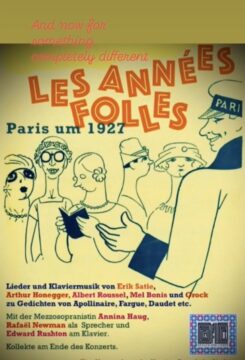
 On Thursday this week I will join two of my colleagues—the mezzo Annina Haug and the pianist Edward Rushton—to present a program of poems by French authors to a private audience. We are staging our concert in Zurich, at the home of a descendant of one of those authors, the renowned Swiss-French clown and musician Grock. In fact, Edward, the founder of Besuch der Lieder, our home-concert association, will be playing on Grock’s own piano, accompanying Annina as she sings individual chansons and song cycles by Erik Satie, Arthur Honegger, Darius Milhaud, and Albert Roussel, as well as “La femme est un jardin d’amour,” a jaunty number penned by Grock himself. Edward will also perform short instrumental works by Mel Bonis, Satie, and Honegger, all on the poet-clown’s vintage Gaveau, and I will recite poems by various authors, written in France and Germany during the interwar period.
The poets whose works, both declaimed and set to music, we will be showcasing all worked for the most part in the first half of the 20th century, and the texts we are featuring come mainly from the 1920s, as do the musical works we will be playing, to a mostly Germanophone audience—hence the (bilingual) title of our program: “Les années folles: Paris um 1927.” These poets include such renowned and lesser-known literary lights as Léon-Paul Fargue, Lucien Daudet, Mimi Godebska, René Chalupt, and Guillaume Apollinaire—the last of whom, however, had already succumbed to injury and illness in 1918, although his influence on contemporary literary developments was to continue for some time.
As it happens, April 23—the date of our concert—is also World Book Day. The commemorative day, alternatively known as “World Book and Copyright Day” or “International Day of the Book,” was organized by UNESCO and first celebrated in 1995; but its roots are older, in early 20th-century Spain. The date was initially chosen to honor Cervantes, who was believed to have died on April 23, 1616—the very same day on which Shakespeare was also believed to have died, a coincidence that subsequently reinforced the significance of that date. In fact, though, since Spain and England were still using two different calendars in the 17th century, this is not really true—instead, according to UNESCO, April 23 is a “symbolic date of world literature” which “coincides with that of the disappearance of the writers William Shakespeare [and] Miguel de Cervantes.”
World Book Day, in other words, is actually Dead Poets Day.
Now, at first blush, there’s something odd about choosing any author’s death date for the annual commemoration of their books, along with those of other writers. Because—shouldn’t we be remembering their birth instead, the beginning of the period in which they created the works we revere? But I suppose that would be tantamount to a cult of personality, to a form of the “ethical criticism” that espouses only literature featuring “likeable” or (yikes) “relatable” characters, and whose creators can thus be held up as virtuous role models. And then of course, the fact that a writer’s work continues to be read after their demise is undoubtedly the surest proof of their enduring value as a writer, if not as a moral paradigm: count no author happy, to paraphrase Sophocles, until they are dead. Because after all, Ars longa, vita brevis. Biological life certainly ends at some point; but what an artist creates may, if they are very good at what they do and with a certain amount of luck, persist after they are gone.
World Book Day 2026 has a special resonance for me: at any rate, more resonance than usual. The day has been importantly marked in past years, not only by me but also by the members of Besuch der Lieder. We spent April 23, 2022, for example, filming a promotional clip about our association, now available on our website, with bookshelves clearly visible behind us as we perform. The year before we had spent several weeks in spring preparing and staging a sample soirée musicale, broadcast in April, to entice potential hosts back to our offering of in-home concerts following the drought of Covid-19. That performance, still up on YouTube, features Annina singing, among other offerings, Schumann’s setting of texts by Mary, Queen of Scots, a royal poet whose wider renown is owed largely to the grisly nature of her death.
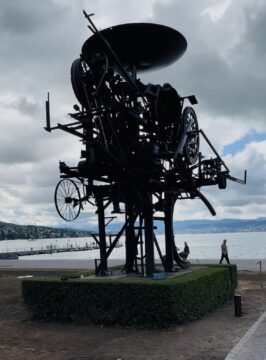
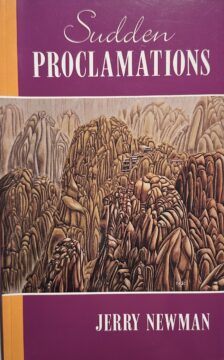 But this year’s World Book Day takes place in the week in which I stage my own private commemoration of a very particular dead poet. My father, C.J. “Jerry” Newman, died in the summer of 2024, and in August 2025 we marked his Yahrzeit—the first anniversary of his death— in his native city of Montreal, at the cemetery where his parents and younger brother are buried. We held a second event later that year, with my family here in Zurich, with readings from Sudden Proclamations, his 1992 poetry collection, at the Jewish graveyard which contains the stones of two other poets important to me, Mascha Kaléko and Margarete Susman; and this week, with the seasonal reinauguration of “Heureka,” Jean Tinguely’s marvelous kinetic sculpture, we are celebrating my Papa’s memory for a third time, on a promontory on Lake Zurich.
“Heureka” (1964), installed on the Zürihorn as a public artwork in 1967 and stirred automatically into action thrice daily for eight minutes at a time between April and October, suggested itself as an appropriate site for a couple of reasons: My father had enjoyed the Rube-Goldberg-like assemblage on visits to Zurich years ago, the absurdist poetry of its industrial machinery cranked up into a Chaplinesque ballet sequence; and a local artist friend of mine stages a musico-mystical event there every year on the anniversary of the sculptor’s death in 1991, which occurred in the month of August, like my Papa’s. So “Heureka” had already been marked for me as a site of remembrance.
My father was raised, in mid-20th-century Canada, by immigrant parents whose experience of economic uncertainty and murderous racism in Eastern Europe had left them eager for security. My grandfather, who had once dreamt of becoming a Talmudic scholar, was obliged to commence work for a furrier when he was barely adolescent, and he continued in the garment industry, founding a dress-making workshop in Montreal, until his death in the late 1990s; while my grandmother’s naturally cheery disposition was clouded by her husband’s business difficulties and her own post-partum depression. Their eldest son, thanks to the opportunities afforded by the family’s eventual, hard-won middle-class prosperity in the New World, was able to pursue his own version of his father’s fantasy life of letters, against the more sober wishes of his parents, earning a university degree in English and becoming a professor of creative writing—and a poet. So when he noticed my own interest in verse, Papa was keen to encourage it—or at least not to discourage my “unpractical” bent, writing to me once, when I was quite young, with his characteristically tender irony: “You can be anything you want to be: even a poet.”
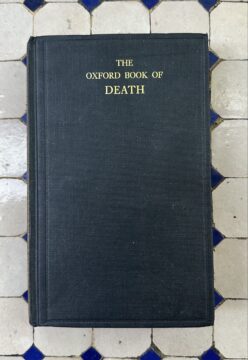
I’ve followed his advice—or rather, taken advantage of his humorous waiver—and managed a book of poetry of my own; and books have certainly played as important a role in my life as they played in his. Indeed, when I returned to Switzerland from Canada last year, sad that airline regulations forbade me to transport “human remains” with me on the plane, and thus had deprived of an urn of my own, my brother sent me some of our father’s ashes for safekeeping at my home abroad—in a copy of The Oxford Book of Death, specially hollowed-out, secret-agent/treasure-map style. As if my deceased father, a fan of Eric Ambler, Ian Fleming, and Graham Greene, were still recommending racy reading material from beyond the tomb.
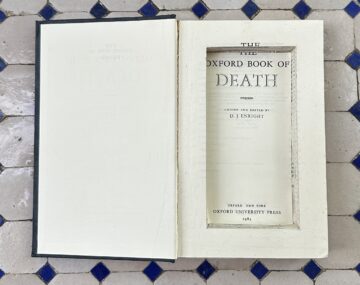
It is in this spirit, and in an effort to mitigate somewhat the funereal solemnity, both of our Besuch der Lieder event on World Book Day and of the family performance planned for the Zürihorn later this week, that I will be reciting not only original works by the dead poets to whom the day is consecrated, both those whose texts were set to music by Satie et al., and which Annina will be singing, as well as selected others from the same period, such as Marie Luise Kaschnitz and Joachim Ringelnatz—but also my own verse translations of some of the French texts, in particular those of Apollinaire and Léon-Paul Fargue. And it is with a poem by this latter, one of five of Fargue’s set by Satie in his cycle Ludions (1923), that I close here:
Air du Poète
Au pays de Papouasie
J’ai caressé la Pouasie …
La grâce que je vous souhaite
C’est de n’être pas Papouète.Dichterlied
Im papuanischen Fernost
Hab’ ich Papoesie liebkost…
O gönn’ mir was, falls das noch geht:
Werd’ bitte sehr kein Papoet.A Poet’s Air
In Papua I flirted with
Papoetry; and my fond wish
Is, if you truly care for me,
A Papoet you shall not be.
The German and English translations above are by me: very much not yet dead and still producing Papoetry of a kind, albeit helping to bear Fargue’s slightly downbeat message as regards that craft. But perhaps there is in the French author’s plea (or at least in my rendering of it)—that his reader not become a “Papouète”—an echo of the tender irony my late Papa deployed in his long-ago career advice to me: that I could even become a poet.
In memory of Jerry Newman, and of other Papoets, both dead and alive