
by Leanne Ogasawara
1.
Every morning, the mathematician wakes up not knowing who he is.
Or rather, he knows exactly who he is. He knows his theorems, his love of prime numbers, the way a perfect equation can feel like something close to grace. What he cannot recall, however, is who slept in his house last night, who cooked his breakfast, whose child left muddy shoes by the door. His memory, damaged by a long-ago accident, resets every eighty minutes.
And yet it seems that no one who encounters him — not the housekeeper who tends to him, not her young son whom he names Root for the shape of his head, not even his sister-in-law who knew him before — would say he is not himself. He is achingly, luminously present in every moment. He simply cannot remember things happening before.
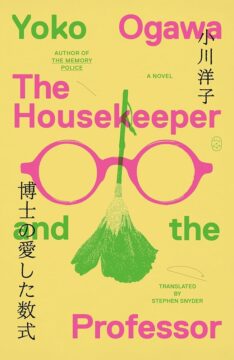
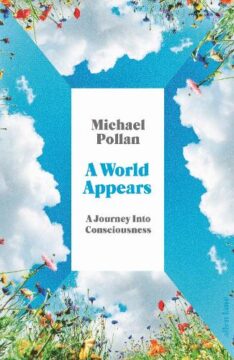
Yoko Ogawa’s novel The Housekeeper and the Professor has haunted me since I first read it, but it returned with new insistence when I recently opened Michael Pollan’s new book, A World Appears: A Journey into Consciousness.
Before reading Pollan’s book, I struggled to think of Ogawa’s Professor as truly conscious, in the same way I am truly conscious, mainly I had always assumed that consciousness was inseparable from something called the continuous self. When I tried to imagine, for example: what I myself am beyond the sum total of my life experiences and my story of being “me,” I struggled. We have all heard families of Alzheimer’s sufferers describe how a light went out in the sufferer’s mind or how “mom was gone.”
If I put myself in the fictional professor’s shoes, for example, while I can imagine my love of reading and writing still being there even after a catastrophic loss of memory, I wonder what “me” would I be if I couldn’t recognize my son or my husband? How much can I lose and keep “feeling myself?”
Or more interesting, how much can I really lose and keep being myself?
Philosophers sometimes invoke the concept of a “philosophical zombie,” which is a being that imitates consciousness perfectly but has no inner subjective experience, no sense of what it is like to be itself. The Professor is the uncanny reverse: a being whose inner life is unmistakably rich, whose subjective experience of each eighty minutes is vivid and complete, but who cannot stitch those moments into a continuous story.
 2.
2.
For his new book, Michael Pollan spent five years interviewing neuroscientists, philosophers, Buddhist teachers and plant biologists, trying to understand what consciousness actually is — how three pounds of tissue between our ears (“the tofu,” as he calls it) generates the irreducible felt fact of being alive, of there being something it is like to be us.
He surveys the field’s most ambitious theories, including Giulio Tononi and Christof Koch’s Integrated Information Theory and Mark Solms’ argument that consciousness originates not in the cortex but in the ancient, feeling brainstem. He visits laboratories and meditation retreats, takes psychedelics in his garden and sits in silence in a cave in the Sangre de Cristo mountains. He returns, finally, not with an answer but with something more honest — a deepened sense of the mystery, and a suspicion that Western science may be hunting consciousness with the wrong instruments entirely.
Which is precisely where Ogawa’s Professor comes in.
The Professor is not a case study or a thought experiment. He is a literary character of extraordinary warmth and specificity. But he functions, whether Ogawa intended it or not, as a perfect counter-example to almost every dominant theory of consciousness that Pollan examines — and as a quiet argument for something that neither Koch’s mathematics nor Solms’s neuroscience quite reaches.
Central to much of both Western philosophy and modern neuroscience is the assumption of the continuous self — the idea that consciousness is not merely a series of present moments but a thread connecting them, a narrative the mind tells about itself across time.
We are conscious, on this account, precisely because we remember having been conscious: yesterday’s self reaches forward to claim today’s. This is something that has been denied to most animals (those that fail the mirror test, for example) and infants. It’s hard to fathom how surgeons as late as the early 1980s, operated on infants, particularly newborns, without analgesics or anesthetics, believing they were not fully conscious or capable of feeling pain.
Ditto for animals. It boggles the mind how anyone could not see dogs have a continuous sense of self.
The Professor in Ogawa’s book dismantles this assumption simply by existing. He has no continuous self in the conventional sense — no thread connecting this morning to last Tuesday, no accumulating autobiography. And yet his selfhood is unmistakable. His personality, his mathematical passion, his particular tenderness toward Root — all of it persists, morning after morning, without any narrative to sustain it.
Ogawa’s novel asks, with characteristic Japanese quietness, whether the continuous self we take to be the foundation of consciousness might be something closer to its furniture — useful, perhaps, but not load-bearing.
 3.
3.
I should confess that I have been thinking about Koch’s work for some time. Six years ago, writing in these very pages about octopuses and animal consciousness, I found Koch’s journey deeply moving — his rejection of his Catholic upbringing’s insistence that dogs have no souls, his commitment to extending moral consideration across species, his vision of consciousness as existing on a spectrum rather than as a binary human privilege. The Integrated Information Theory he developed with Giulio Tononi seemed to offer exactly what we needed: a scientific framework generous enough to include octopuses, trees, perhaps even fungi networks, in the vast web of sentient life. I was persuaded, or close to it anyway.
Reading A World Appears, I find myself less certain.
Not about Koch’s moral impulse, which remains admirable, but about the theoretical architecture.
IIT assigns consciousness a mathematical value — phi — as though awareness were a property a system possesses, as measurable as temperature or electrical charge. And it was precisely this framework that Koch and David Chalmers wagered on in 1998: Koch betting that the neural correlates of consciousness would be identified within twenty-five years, Chalmers that they would not. In 2023, Koch conceded. The experiments designed to adjudicate between IIT and its rival Global Neuronal Workspace Theory produced no decisive verdict. The mystery of the hard problem held.
What strikes me now, reading Ogawa’s novel alongside Pollan’s account of this failure, is that both Koch and his rival theorists may be asking consciousness to be the wrong kind of thing. They are looking for a substance, a property, something a brain has.
But the Professor — losing and regaining himself every eighty minutes, conscious beyond any reasonable doubt and yet possessing nothing resembling the continuous neural integration IIT requires — suggests that consciousness may be less like a property and more like a weather: something that arises between things, in the space of encounter, irreducible to any single system’s internal state.
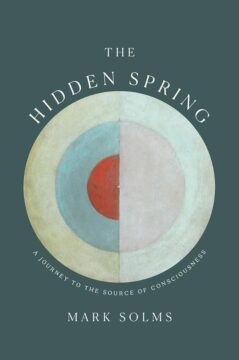
Mark Solms was another thinker I’d encountered before. Reading The Hidden Spring some years ago, I was moved above all by its origin story: a childhood memory of watching his younger brother fall from a roof and survive, but changed, his personality subtly altered along with his cognition, prompting the young Solms to ask a question he would spend his career pursuing: if my brain were damaged, would I still be me?
I think that is my question as well, and something that haunted me as I re-read Ogawa’s book last week.
Solms’ answer, developed over decades of working with neurological patients and training as a Freudian psychoanalyst, is that consciousness originates not in the cortex — not in the sophisticated, language-processing, reasoning brain we tend to think of as the seat of our selfhood — but far deeper, in the ancient brainstem we share with all vertebrates. Feelings, on this account, come first. Thought is downstream. The hidden spring is not cognition but affect, connected to emotion and feeling—. It is also something explainable by Natural Selection since beings who trust their gut when danger is at hand will be more apt to survive, in the same way that having a sense of self would help a creature succeed.
Pollan seems to find Solms the more sympathetic of his two main interlocutors, and I understand why. There is something in Solms’s insistence on the primacy of feeling — on consciousness as fundamentally affective rather than computational — that feels closer to lived experience than Koch’s mathematical phi.
And yet again, reading Ogawa’s Professor, I find myself wondering whether even Solms’s generous, feeling-centered model captures what the novel quietly insists upon. The Professor’s brainstem is presumably intact. His feelings are exquisite: mathematical beauty moves him almost to tears, Root’s head in his hands is the most perfect thing in the world. And yet his self, in any conventional neurological sense, is radically discontinuous.
 4.
4.
This leads me to what I find most distinctive — and most challenging — about Ogawa’s novel as a contribution to the consciousness debate: its profound Japaneseness.
While Japanese thought is far from monolithic, the traditions that have most deeply shaped its aesthetic and ethical life — from ancient Shinto through Buddhism to the Kyoto School philosophers of the twentieth century — share a tendency to approach reality not as a collection of discrete substances possessing properties, but as a field of relations, a web of interdependencies, a dynamic of encounters and entanglements.
Even the term for human being bears this out on some level in Japanese:
人 (hito) — person, an individual
間 (ma or aida) — space, interval, betweenness, the space between things
人間 (ningen) — human being, literally “person-between” or “the space between people”
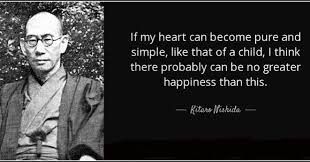
One of the oft-cited examples is from philosopher Kitaro Nishida, who remarked that while Westerners routinely make subject-based utterances, such as “I hear the bell,” that in natural Japanese a person would say, “the sound of the bell is heard.” Does this point to anything deeper than a linguistic difference? Nishida suggested it pointed to an understanding of pure experience as something that precedes the division of self and world: a moment before the “I” claims the hearing as its own..
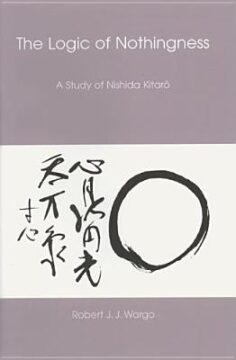
Nishida is best known for his concept of basho. This is usually translated as “place” or “field.” He made use of this term to counter what he saw as Western philosophy’s insistence on the primacy of the individual subject, and by extension objects, which perhaps is what led to Western philosophers wanting to find a material object called “consciousness.”
For Nishida, consciousness is not a property that a self possesses; rather it is the field within which both self and world arise together; that moment of the bell being heard.
 The Professor lives in basho. Every eighty minutes, his accumulated self dissolves back into that clearing of basho, and what remains — what persists through every reset — is not a narrative self but something more fundamental: a capacity for encounter, for feeling, for the particular quality of attention he brings to a prime number or a child’s head. His consciousness, Ogawa seems to suggest with great beauty, was never something he owned. It was always something that happened in the space between him and the world.
Pollan, in his book, is drawn toward something like this. His encounters with meditation and psychedelics repeatedly bring him to the edge of the individual self’s dissolution, and he finds these moments not terrifying but revelatory.
There is a related concept in Zen Buddhism that goes even further: 自他不二 — jita funi — literally “self and other, undivided.” Where Nishida’s basho describes the field in which self and world arise together, jita funi insists that the boundary between them is not merely porous but ultimately illusory. The self does not encounter the other across a distance — the encounter itself is what both self and other are made of. The Professor, who cannot accumulate a self between encounters, lives this not as a philosophy but as a fact of his daily existence. Every eighty minutes, the boundary dissolves. Every eighty minutes, what remains is pure relation.
Pollan is fascinated by what researchers call “lantern consciousness”: drawing on the developmental psychologist Alison Gopnik’s work: the wide, diffuse, peripherally aware state found in young children, meditating monks, and people in psychedelic states. It stands in contrast to what Gopnik calls “spotlight consciousness”: the narrow, self-referential awareness of ordinary adult cognition, in which the prefrontal cortex has developed enough to focus the beam but in doing so has dimmed the periphery. Adulthood, on this account, is in some sense a narrowing: we gain executive function and lose wonder. The Professor, whose default mode network can no longer sustain its usual narrative function, lives permanently in the lantern state: not by spiritual practice or pharmacology, but by neurological circumstance. His eighty-minute window does not constrain him; it liberates him into a perpetual present, undimmed by yesterday’s accumulations.
The relational model of consciousness may also have unexpected relevance to current debates about artificial intelligence. If consciousness arises in a field of relation rather than within an individual system, the question of machine consciousness becomes harder to dismiss and harder to measure. It may be, as Nishida’s logic suggests, that the right question is not whether an AI possesses consciousness, but whether genuine encounter is possible — and what happens in the generative space between (in Japanese “Ma.”)
 5.
5.
Pollan, to his credit, senses all of this. A World Appears is not a book that arrives at triumphant answers — it is a book that learns, slowly and honestly, to sit with the mystery. And in that humility, it comes closer to Ogawa than its scientific apparatus might suggest. What both writers share, finally, is a conviction that consciousness is not a problem to be solved but a fact to be inhabited — something that exceeds every instrument brought to bear on it, including language itself.
Ogawa’s novel ends quietly, as it must. The Professor’s eighty minutes shrink to almost nothing. He moves to a care facility. And yet the housekeeper and Root keep coming — once a month, packing a lunch, sitting with him in the sun when the weather allows, playing catch. Root grows up to become a mathematics teacher, carrying the Professor’s love of numbers into the lives of children who will never know where that love came from. The Professor does not remember any of it. He cannot. And none of it, for that reason, is lost.
At the same time, bringing it back to evolutionary explanations for subjective awareness, it is not at all clear whether the Professor in the novel could ever survive on his own in his current state. He is cared for on a daily basis by others and ends his days in a facility.
But Ogawa’s story depicts something that neither Koch’s phi nor Solms’s hidden spring quite captures, being concerned about not where consciousness lives, but what it leaves behind. And more, what it calls forth in others, unbidden, across the space between. The seventeenth-century Japanese poet Mizuta Masahide, in a poem so admired that Bashō himself praised it, wrote:
蔵焼けて 障るものなき 月見哉
kura yakete sawaru mono naki tsukimi kana
The storehouse burns down —
nothing now obstructs
the view of the moon.
The Professor loses everything, eighty minutes at a time. And each morning, unobstructed, the moon is still there.
NOTES
- Every so often in class crafts on writing, you will hear about the consciousness of the point-of-view character. Not just for first person protagonists but even for close-third, the novelist is evoking another “person’s” consciousness. That is, the novelist is describing what it is like to be that person, to walk around in that character’s skin…through interiority and descriptions of physical sensation, etc. For more on this, please see my Substack post here.
- I thought the Professor’s condition in Ogawa’s book was impossible, but learned that it is a real condition that maybe Oliver Sack’s described in his book, The Man Who Mistook His Wife for a Hat
- For those interested in “ma,”— the pregnant interval, the space between things — is the work of philosopher Watsuji Tetsurō’s concept of aidagara (間柄, betweenness).
- Readers interested in ma as a living concept across Japanese art, music, garden design, and daily life will find much to delight in Ma: The Japanese Secret to Contemplation and Calm, edited by Ken Rogers and John Einarsen and published by Tuttle Publishing (2025). The volume grew out of Kyoto Journal issue 98, also devoted to ma, which included my own essay “The Heart of the Matter: Translating the Heart Sutra,” subsequently republished at this publication. That the editors of Kyoto Journal felt an entire issue — and now an entire book — warranted by a single Japanese concept speaks to just how inexhaustible ma proves to be.
- Readers interested in the question of octopus consciousness and its relationship to the hard problem of mind will also find much to think about in Ray Nayler’s remarkable debut novel The Mountain in the Sea (Farrar, Straus and Giroux, 2022), a near-future thriller set on a Vietnamese archipelago where a species of octopus appears to have developed its own language and culture. It is one of the most philosophically serious works of speculative fiction in recent memory — and proof that novelists sometimes reach where scientists cannot yet follow.