
If I had been born as an Australian Aborigine, or an American Indian, I’d probably have been a shaman. If I’d been born in ancient India, Greece, Israel, or medieval Europe, I might well have been a priest. If I’d been born in colonial America, I might have been a clergyman; Harvard, Yale and Princeton were started to train clergymen.
As it is I was born in 1947 in a hospital in Pittsburgh, Pennsylvania, steel country. I spent the first four years of my life in coal country, Ellsworth, Pa. The family then moved to Johnstown, Pa., as much coal as steel country. Though she had been raised as an Episcopalian, my mother took me and my sister to Sunday school in a nearby Lutheran church. My father stayed home. But he did attend services on Christmas Eve.
I couldn’t have been more than six or seven years old when I had my first cosmological idea. By that time I was attending Sunday school at a Lutheran Church in the neighborhood where we lived. The teachers told us marvelous stories from books with colorful illustrations. I figured out that the world was a movie God created for the entertainment and enjoyment of the Baby Jesus. One thing puzzled me, though. Movies are flat, but our world is round. I never figured that one out. Perhaps I’m still working on it.
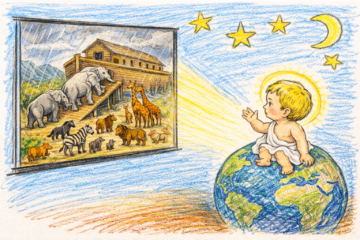
My sister is four years younger than I am. I don’t know what she thought about the Baby Jesus. Early in the 21st century she would convert to Shinnyo-en Buddhism, an esoteric sect founded in Japan in the first half of the 20th century. Back in 2013 she invited me to attend a lovely interfaith Celebration of the Equinox Shinnyo-en held in St. Bartholomew’s Episcopal Church in Manhattan.
Bertrand Russell and Madeline Murray
Sometime during my early teens I was rummaging in boxes of paperback books my father kept in the basement. I found, and read, George Orwell’s 1984, which had a lurid pulp-style cover depicting a shapely woman in tight blue overalls wearing a button for the “Women’s Anti-Sex League.” I forget what the cover of Aldous Huxley’s Brave New World looked like, but I read it too. Theodore Reik’s Listening with the Third Ear introduced me to psychoanalysis. And then there was Bertrand Russell’s collection of essays, Why I Am Not a Christian, devastating and witty.
It was time for me to move on from Sunday school classes to catechism classes as preparation for becoming confirmed as a member of the church. I balked. My parents didn’t force me. I forget what I did about regular church services from that point on, but I still attended services of Christmas Eve with the family.
It was about this time that Madeline Murray was kicking up a fuss about compulsory prayer in the schools. She took it to the Supreme Court and won. On April 8, 1966, the cover of Time Magazine asked, “Is God Dead?” Bertrand Russell was interviewed in Playboy Magazine, where he talked about nuclear disarmament, among other things. Several years later Playboy would publish a letter of mine.
I entered Johns Hopkins University as a freshman in the fall of 1965. The war in Vietnam was cranking up, as was opposition to it. I joined the Students for a Democratic Society (SDS) and so became part of the anti-war movement.
I read Aldous Huxley’s The Doors of Perception, which was about his experience taking mescaline, though not in connection with any course I was taking. Timothey Leary was making news with his advocacy of LSD. “Light my Fire,” became a psychedelic rock hit by The Doors, who took their name from Huxley’s book. I took a course in developmental psychology with Prof. Mary Ainsworth, one of the founders of attachment theory, where I read Piaget’s The Child’s Construction of Reality. I spent a great deal of time trying to imagine how the world would appear to a creature with those cognitive and perceptual capacities and wondered if that’s what happened when adults took mescaline or LSD. It would be a while before I found out.
But I read a great deal about psychedelic experiences, and mystical experience as well. I became interested in Eastern religion, so did the Beatles and who knows whom else. It was in the air. I read books by Mircea Eliade, Alan Watts, Thomas Merton, and D. T. Suzuki, but also St. John of the Cross. Big question: Is drug-induced mystical experience as real as spontaneous mystical experience or experience brought about through meditative practice?
I became friends with Peter Barnett, Henry Shapiro and Fred Portnoy. There was only one Jewish family in the neighborhood where I grew up in Western Pennsylvania. Peter would become a life-long friend. He took me to Yom Kippur services at a local conservative shul. They had yarmulkas and shawls for those who didn’t have their own. Peter was embarrassed that the Rabbi was so vigorous in exhorting for money. Some years later Peter would marry a Presbyterian woman, Sandy. They had an interfaith ceremony. I played Mendelssohn’s “Wedding March” on my trumpet. Their adopted Chinese daughter would attend services of both faiths.
In 1969 young men of draft age where assigned numbers by lottery. I got 12. I was certain to be drafted. I decided to become a Conscientious Objector. In order to qualify, though, my objection to war had to be grounded in religious belief. Since I had no conventional religious belief at that time – it had been a decade and a half since I was entranced by the Baby Jesus – that might have been a problem. I solved the problem by declaring myself to be a mystic, one “who believes in the spiritual apprehension of truths that are beyond the intellect” (New Oxford American Dictionary). I consulted with Dr. Chester Wickwire, the University Chaplain at Johns Hopkins, and with a draft counselor affiliated with the American Friends Service Committee, and prepared a statement that convinced my draft board.
Now, where would I perform the required alternative service? If I’d gone into the military, I would have had to serve two years. Since that wasn’t going to happen, though I could have elected to become a medical corpsman, I had to serve in some civilian capacity for two years. Hospital orderly was a common choice. I argued that I should become an assistant in the Chaplain’s Office at Johns Hopkins. Wickwire was agreeable and so, it turned out, was my draft board. It probably didn’t hurt that Wickwire arranged for two Maryland congressmen, Parren Mitchell (one of the founders of the Congressional Black Caucus) and Paul Sarbanes, to write letters of support.
The nature of Dr. Wickwire’s religious belief was not obvious to me. He once told me that, in his youth, he’d been “the” (he used the definite article) tenor with a traveling evangelist; but these days his energies went into the Social Gospel (a movement dating back to the 19th century), making life better for people. He’d been active in the civil rights movement since the late 1950s, when he’d organized the first integrated concert in Baltimore. He was active in the anti-war movement as well, which sometimes put him at odds with campus authorities. He established a program that brought inner city children to the Johns Hopkins campus where students tutored them. When he brought Bayard Rustin to campus in the spring of 1966 the Ku Klux Klan burned a cross on campus.
He had something called “The Sunday Experience,” but it was not a conventional religious service. No scripture, no sermon, no choir. Though I attended many of those programs, I remember very few. One Sunday an avant-garde jazz group from Boston (Mark Harvey?) raised the roof. Congressman Parren Mitchell spoke on another occasion, which brought the church ladies out. I introduced him with “Swing Low, Sweet Chariot” on the flugelhorn; the church ladies clapped along with me. Another speaker talked about the Holocaust. We had “Sounds Incorporated,” a soul review from a local prison, some other Sunday. We might have had peace activist Father Philip Berrigan speak one Sunday; after all, Wickwire had been assigned to Berrigan as his parole officer.
I forget whether or not an offering plate was passed around. Probably not physically, but virtually, Wickwire was always looking for money. Years later I contacted him to deliver the eulogy at my father’s funeral service.
At the same time I was working on a master’s thesis about Coleridge’s “Kubla Khan.” I’d become entranced with the poem in the spring of 1969, my senior year. It’s one of the best known poems in the English language. Whether or not it came to Coleridge in an opium-inspired vision, it was obviously a visionary poem. While that did interest me, I was more interested in its structure and was eventually able to figure out that it was like a pair of matryoshka dolls, each nested three-deep.
Now I was stuck. For I hadn’t been looking for that. I’d been looking for something else in the poem. What I’d stumbled on was more interesting. But was it real? I think so, but I’m not sure.
While figuring that out I took LSD for the first time in my life (there was one other occasion a bit later). I didn’t have any of the visions I’d been led to expect, but I spent two weeks saying strange things to my friends. I also decided to drop the thesis and become a musician. Louis Armstrong had died a couple of months previously and (I decided that) he’d become reincarnated in me. I signed up for trumpet lessons at the Peabody Conservatory. My teacher was Harold Rehrig, who’d spent most of his career with the Philadelphia Symphony; he also appreciated Dizzy Gillespie, one of my musical heroes.
My trumpet playing improved; the acid trip faded into the past; and I decided to finish my thesis on “Kubla Khan.” I made “Kubla Khan” the touchstone by which I judged further intellectual work. I’m still working on it.
While all that other stuff was going on – my draft board, “Kubla Khan,” the Sunday Experience – I joined a rock and roll band, The St. Matthew Passion. Just why that name, I don’t really know. I believe Mal Henoch, one of the group’s founders came up with the name. It was, after all, the 60s, even into the 1970s. You had the Beatles, the Rolling Stones, The Doors, The Grateful Dead, Moby Grape, A Beautiful Day, Cream, Jefferson Airplane, Quicksilver Messenger Service, Vanilla Fudge, Buffalo Springfield, The Paul Butterfield Blues Band, Traffic, Chicago Transit Authority, Ars Nova, Procol Harum, Blood, Sweat and Tears. Why not The St. Matthew Passion?
Our first gig was joyous, for us and for the dancers. A Hopkins polysci professor, Rick Pfeffer, threw a party and hired us; I believe one of that guys in the band took a class of his. Our last gig? That opened with one of the defining experiences of my life. Our first tune was “She’s Not There.” The sax player and I opened with a wacked-out avant-garde freak-out. No sooner had we gotten rolling when WHAM!! the world went white and I disappeared. Gone. Nothing. It was bliss. It was over. We finished the freak-out and the keyboardist, and leader of the band, cued the band in on the first bar of the written arrangement.
“It’s all true,” I said to myself, probably the next day after I’d slept on it, “what the mystics said, it’s all true.” Now, the mystics said a lot of things, some had visions of one sort or another, some seemed able sustain an altered state, as they came to be called, but other experiences, like mine, were just a glimpse. It’s not as though mystical experience is some well-specified definite thing. It’s not, they’re not. But that one glimpse was enough to tell me that these accounts weren’t the ravings of confused people, oh, maybe some of them were, but not all.
That experience followed me for quite a while. “Haunted” is the first word that comes to mind, but it has spooky associations which get in the way. I kept thinking about it. What was it, really? Would it happen again? I both wanted it to and feared that it would. It didn’t. And that’s OK.
When asked why, if he believed that LSD induced a real mystical experience, Alan Watts is said to have replied, “When you’ve gotten the message, you hang up the phone.” Seems right.
I’d gone to graduate school to figure out what was going on in “Kubla Khan.” I went to the English Department at the State University of New York at Buffalo, aka UB. That’s where I met David Porush, who would become a life-long friend. He was a secular Jew when I met him; but he later fell in love with a gentile woman in Virginia; she converted, they got married, had a family, and he became devout. He’s retired now, studies the Torah, blogs about it too, and plays poker on Fridays with his buddies.
That’s also where I met David Hays, but not in the English Department. Hays taught computational linguistics in the Linguistics Department. That’s where I got my real education. I’d come to Hays to study computational semantics and to see what we could figure out about “Kubla Khan.” I joined his research group, which met once a week at his house on the eastern shore of Lake Erie.
There I met Bill Doyle, an undergraduate at the time. Years later he’d let me pilot his yacht – a 55 foot Freedom – in New York harbor on the 4th of July. I moved from upstate New York to New Jersey to join a company he founded (and which died in the dot-com bust of 2001).
Rich Fritzson was an undergraduate as well. He moved in with me after he’d broken up with his girlfriend. In subsequent years I’d visit him and his family when I drove to Philadelphia to see my sister during the Christmas holidays. He spent most of his career working in computing. When it got old and stale, he left to become the executive director of the Unitarian congregation he and his family had attended for decades. I’ll bet the Baby Jesus was bemused as we watched that. Rich is a Jewish atheist.
But I digress.
“Kubla Khan” kept its own counsel, but Shakespeare’s Sonnet 129, “The Expense of Spirit,” proved more tractable. The day I finally figured it out I did an Archimedes. I’m sure you’ve heard the story.
As he was stepping into the bath, Archimedes noticed that his body displaced water, leading to an important scientific principle. He leapt out of the bath and ran naked through the streets shouting, “Eureka! Eureka!” (meaning “I have found it”). I wasn’t stepping into the bath, nor was I naked, and I didn’t shout anything, but I did jump around a bit and remembered that story. Just how a very abstract intellectual discovery can have such a dramatic physical effect beats me, but such things do happen.
I published that, well “discovery” is too grand a word. But I published my analysis of that sonnet in a good journal and went on to finish my dissertation, “Cognitive Science and Literary Theory.” Somewhat later I published my 1972 work on “Kubla Khan.”
About a decade after those events I was on the faculty at the Rensselaer Polytechnic Institute (RPI) in upstate New York. There I met Eddie “Ade” Knowles, who as Assistant Dean for Minority Affairs. But prior to that he had toured with Gil Scott-Heron as a percussionist, congas, djembes, bells, shekere, and so forth. At the time we met he was playing for African dance classes taught by his finance, Druis Beasley. They asked me to join them and before you knew it we’d formed a musical group, the New African Music Collective.
We played a variety of mostly local gigs, including opening for Dizzy Gillespie, but the high point of our association came in a rehearsal, where we had been joined by Druis’s sister, Fonda. Druis, Fonda, and I were each playing simple interlocking rhythmic patterns on bells. Ade would then improvise a more elaborate pattern over our background texture. Once we’d become relaxed, locked into the groove, and rocking, something remarkable would happen: high-pitched twittering sounds appeared, but no one was playing them. They were just there somehow emerging from the sounds we were creating. Ade referred to those sounds as “the magic of the bell,” as though he’d heard them on other occasions with other musicians. Uncanny.
A decade or so later, while he was Vice President for Student Life at RPI, Ade became a priest of Shango, the Yoruba Orisha (deity) of fire, thunder, lightning, virility, dance, drumming, strength and justice.
NASA, Kennedy Space Flight Center
In 1956 I saw Forbidden Planet, a classic science fiction film. I was drawing pictures of robots and flying saucers for days and weeks afterward. In October of 1957 my father took me outside late in October to see Sputnik crossing the night sky. Sputnik was the first man-made satellite to orbit the earth. The launching of Sputnik was the first world-historical event that was also personally important to me. I became obsessed with space, drawing space-themed pictures and assembling plastic kits well into my middle teens.
The Apollo moon-landing in 1969 didn’t move me. My attention was on the fact that I had drawn 12 in the draft lottery. Stanley Kubrick’s 1968 film, 2001: A Space Odyssey, impressed me more, especially the psychedelic imagery leading of the Jupiter fly-by.
Years later, in the mid-1990s, I was in Orlando, Florida, as an exhibiter at a trade show. I cut the last day of the trade show and drove across Florida to Kennedy Space Flight Center, which had launched all the Apollo missions. To enter one building you had to walk between rows of massive rocket engines resting on either side of the entrance. Another building housed a full-sized Saturn V rocked suspended from the ceiling. The Apollo capsule seemed tiny.
I stood on sacred ground. This dirt on which I was standing was connected to lunar regolith, 240,000 miles away, by the footsteps astronauts had taken almost three decades ago. A small step, a giant leap. That’s all.
My father died on November 21, 1998. He’d gone into the hospital two weeks before to have a cancerous tumor removed from his bladder. The surgery was successful, but he became septic during recovery. The infection got worse and he had to go into the ICU, but the infection wasn’t clearing. His lower intestine became so inflamed and swollen that he couldn’t eat and breathing became difficult. His surgeon thought he would be able to remove the colon successfully, but the recovery would be long and arduous. Father wasn’t interested.
He had filed a DNR (do not resuscitate) giving my sister and me the power to invoke the order. By that time Mother’s Alzheimer’s was so bad that she couldn’t make the decision. When a young pastoral intern came by to talk he asked her to “pray for my family” – he was clearly thinking of my mother, for he was not himself a religious man. When I asked, with very practical and mundane considerations on my mind, whether there was anyone he wanted to handle the liquidation of his stamp collection he was able to tell me “William Weiss, he’s in the phone book.” That’s all he was able to say. There was no possibility of extended discussion about why he preferred to die.
My sister and I told the doctor not to proceed. They took him off all medication except for morphine, which made him more comfortable. One time when I asked him how he felt he just shrugged his shoulders and looked at me as if to say, “How should I know how I feel, I’ve never done this before.” One thing he did, and it was quite striking, was to clasp his hands together and move them together over his right shoulder and then down to his waist. He seemed to be practicing his golf swing.
Mother died two and a half years later, on May 16, 2001. After Father had died my sister and I had to make arrangements for her since she couldn’t live alone and neither of us were in a position to house her. We hired a full-time live-in aid, but that didn’t work out. Eventually my sister located a very good assisted-living facility on the Main Line in Philadelphia. By the time we moved her in she recognized us only sporadically. Her condition got worse until she fell into a coma and didn’t wake up.
My sister and I were with her in her room at the hospital when she died. At one point I left the room to take a nap in a waiting room down the hall. When I woke up and went back to Mother’s room, it was empty. The sheets had been stripped from the bed.
I walked out of the hospital, got into my car in the parking lot, backed into a lamp post, and drove to my sister’s apartment.
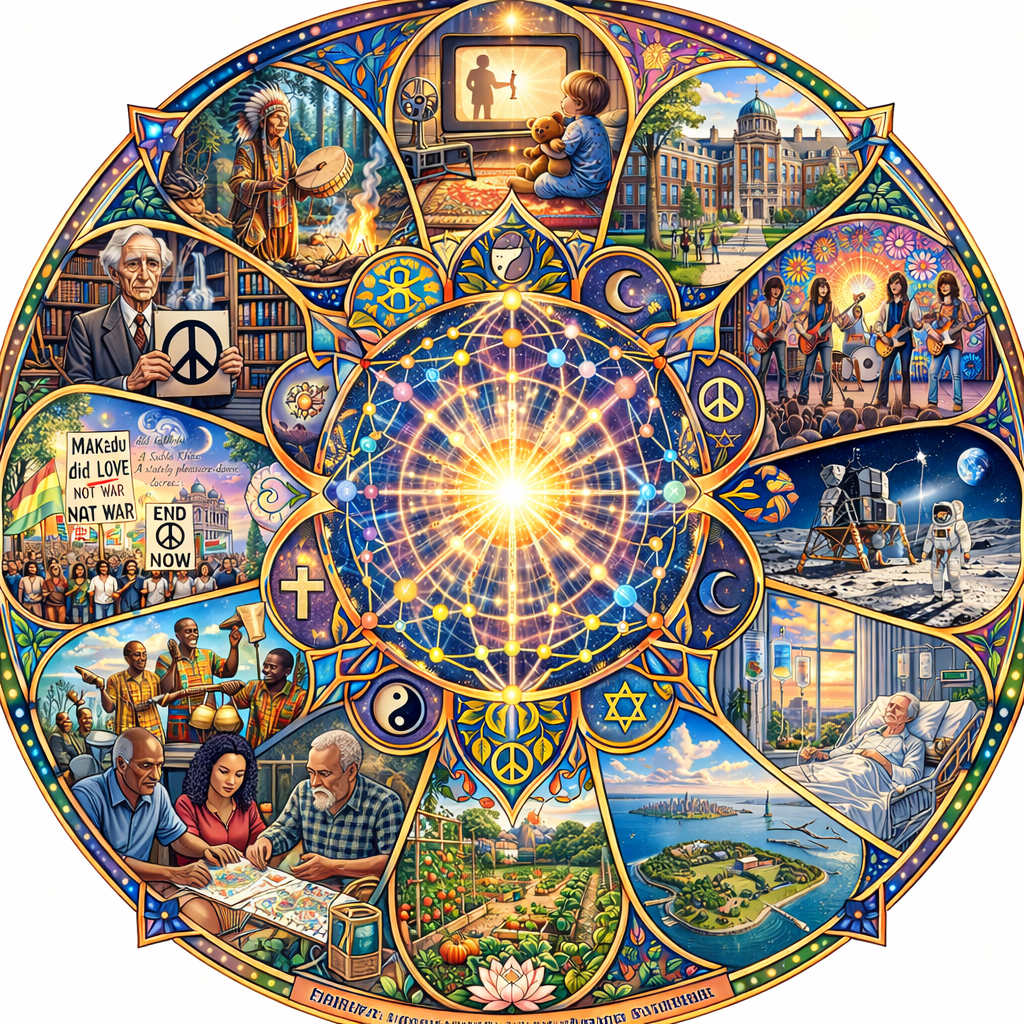
Three or four years after that I met Jerry Greenberg, who was pursuing a remarkable project that he called World Island, a “permanent world’s fair for a world that’s permanently fair”. Think of it as a combination of the best features of the United Nations, Disney World, a kid’s rumpus room, the trading floor at the Chicago Board of Trade, the Bibliothèque nationale de France, and the Japanese exhibit at the 1893 World’s Fair in Chicago. It would cost $25 billion or so and be planted with orchids. Why orchids? Beauty aside, they’re an early warning system for climate change, when the orchids go, we’re not going to be far behind. It was to be built on Governors Island, a 172 acre former Coast Guard base in New York Harbor.
Governors Island had been a Coast Guard base until the end of the century. New York Senator Patrick Moynihan had convinced the government to sell the island to GIPEC (Governors Island Preservation and Education Corporation), jointly owned by New York State and New York City. GIPEC took possession for a couple dollars rather than a price at market rate. GIPEC was holding a competition for ideas on how to develop the island. The winner of the competition got to build their project. World Island was Jerry’s concept.
I was looking for consulting money at the time and this project was too sweet to be true. I met with Jerry, saw the plans – interesting, impressive – and he asked me to join up. When I asked about my pay – anyone preparing to take on a project of that magnitude must have money, if not to burn, at least to pay consultants – he replied, “Deferred compensation.” Whoops! Jerry – who changed his name to Zeal a year or three later – didn’t know where the money was coming from. That makes the materials he showed me, including renderings and a 100-page briefing book, even more impressive. I saw six figures worth of New York design and marketing talent on the table. That’s what it was worth. But Zeal had gotten it donated. The idea was so sweet and Zeal so charismatic that talent flowed to the project. I signed up for deferred compensation and got a glorious ride.
We met with people: bankers, insurance guys, artists, musicians, real estate brokers, developers, accountants, graphic designers, dancers, engineers, educators, scholars, architects, teenagers and old folks – Zeal talked of “wisdom keepers and wisdom seekers” – anyone and everyone who could help, or who would listen. I made I don’t know how many PowerPoint presentations, revised the briefing book half a dozen times. There was a mad dash down the West Side highway on May 10, 2006; we had to deliver our finished proposal by noon. We made it, just barely. Our proposal was rejected. All of them were. We weren’t given any reason, but I’d guess the financials killed it for everyone.
GIPEC took things in a different direction. So did Zeal. I took what I’d learned from him and schemed up a two-mile linear park for Jersey City.
In 2012 I moved to the Lafayette neighborhood of Jersey City, perhaps the oldest in the city. It was a neighborhood in transition, black, brown, and gentrifying, but the rents were still affordable. I somehow found my way to June Jones and the Morris Canal Community Development Corporation. (CDC) She had decided to start a community garden, The Lafayette Community Learning Garden. It was time to get my hands dirty.
A local developer gave Morris Canal CDC temporary access to an empty lot on Pacific Ave. I helped clear rocks and brush from the lot and fill the beds with topsoil provided by the city. June got some local graffiti writers to paint a mural beside the garden, “A Garden State of Mind.” She also got the city to provide a cherry picker to lift the writers up the wall. I don’t remember doing any planting myself, but I remember weeding and harvesting the veggies.
Above all, I remember photographing the whole thing, from start to finish. Thousands of photos over the two-year life of the garden. I uploaded photos to my Flickr page and my blog, New Savanna. Cabbages, especially ornamental red cabbage, bell peppers, jalapeños, cherry tomatoes, heirloom tomatoes, tomatillos, chives, cucumbers, rosemary, thyme, squash, basil, fennel, rhubarb, corn, sunflowers, pumpkins, kohlrabi, even a strawberry or three. For two years, then the developer needed the block back, time to build.
In the process I met Masaddiq Amhad who, when he found out about my interest in graffiti, introduced me to Greg Edgel, aka the Green Villain, a graffiti curator and DJ. We became friends. He’d curate a spot and I’d photograph it. The big one was the Demolition Exhibition in the summer of 2015 – a vacated Pep Boys covered in graffiti inside and out. Thousands of people came by opening weekend, from both sides of the Hudson River. We dreamed of the World-Wide Wall, all of the world’s graffiti considered as a single object, linked together through photos on the web. In time Greg moved on from graffiti to brokering commercial real estate. Now he’s married, studies the Torah, and has two daughters.
Remember that linear park I dreamed up for Jersey City? It was to be built around a park for skate boarding. That SK8park was completed in the late summer of 2017. June Jones did some of the heavy political lifting; Greg reached out to skate boarders and graffiti writers; and I kept the idea alive.
For the last decade I’ve been living in Hoboken in subsidized housing for single men. The building used to be the YMCA, and it’s still called that. But there’s no longer any affiliation with the Young Men’s Christian Association, just the rooms, and the gym, which is currently derelict. Some men end up here because, like me, they’ve just run out of money. But others have physical and mental disabilities, sometimes fairly severe.
A few years ago the management made a deal with a local hospital to have a full-time social worker on site. Rita is the current one. Her parents immigrated from Sri Lanka. Her father was a Roman Catholic priest and a scholar; her mother is Hindu and is trained in Indian classical dance. Rita grew up speaking Tamil at home, only learning English at school. She teaches Indian classical dance on the weekend.
During the week she does whatever it is that social workers do, helps guys with paper work, navigate bureaucracy and secure services, provides counseling; and she runs Art Club. What is Art Club? Guys gather around a table and color pictures, as does Rita. Strange, no? That’s what I thought. Then I decided, why not?
I’d taken art lessons for nine years when I was young, painted in oils and acrylics; later on I became a photographer. Now I’m sitting with other adult men, around a table, coloring between the lines. And the guys – one had been a semi-pro football player, another packs a quarter of a ton on a five-nine frame, a third runs an e-bike repair business out of his room, one has the mind of a ten-year-old, there are others. Under ordinary circumstances we’d never have met. But these aren’t ordinary circumstances.
We’d gather in a room twice a week, color between the lines, and sometimes talk, sometimes talk trash. Somehow it clicked. I decided that, if I’m going to do this at all, I’m going to do it well. I figured out that you didn’t really have to color between the lines all the time, and you could color like Matisse, or a drunken monkey. As long as you colored, Rita liked it.
She began posting pictures on a board outside her office, then two boards. Over the course of the year the pictures got better and better. They upped the vibe on the floor. Wouldn’t you know? Semi-Pro Footballer likes to play chess, so he taught the Big Guy. They began playing chess regularly. One of the custodians joined in every now and then. Before you knew it: Chess Club! What’s next?
Call it Sri Lanka’s gift to Hoboken, NJ.
Of course I have. That’s what I am, a thinker, and explorer. Yes. I’m also a musician, a painter, and a photographer, but the thinking comes first. That’s what pulls me into the world. That’s what teaches me that the world is forever beyond us. We’ll always have room to move, to explore, to grow.
Let’s say it began with that first cosmological idea, that the world was a movie God created to entertain the Baby Jesus. Over the course of a decade and a half that morphed into an interest in “Kubla Khan,” which I put at the center of my intellectual life. Then came computational semantics and Shakespeare’s Sonnet 129. I kept on going, a coffee-table book about computer graphics, Visualization: The Second Computer Revolution, David Hays and I worked out an account of cultural evolution, then another book, this one about music, Beethoven’s Anvil: Music in Mind and Culture. That brings us to the 21st century. I began blogging late in 2006, published working papers on various topics, including the digital humanities, during the 2010s. ChatGPT hit late in 2022, so I began working with it. At the moment I’m working on a book, Play: How to Stay Human in the A.I. Revolution, and collaborating with an expert in computer vision, Ramesh Viswanathan (you guessed it, Hindu), to figure out what makes these chatbots tick inside. At the moment that’s a mystery.
As I see it I’ve got more work ahead of me than I have hours in which to do it. Nor do I intend to spend all my time on these intellectual projects. There’s music, there’s art, there’s life.
As you might imagine, these are things I think about from time to time. And, while I drafted this essay between February 26 and April 12, 2026, you might want to imagine me sitting in a church on a Sunday morning and thinking, perhaps these thoughts, perhaps others, while I drift in and out of the events around me, the words spoken by various participants in the ritual, including the pastor, readers, the congregation as well, and the singing, by choir and congregation, the standing and sitting, the offering plate (to which I contribute), the eucharist, which I sit out. For that is what occasioned these words.
Last fall I joined a senior (i.e. old people) choir in Hoboken, NJ, where I’ve been living for over a decade. We gave a concert in All Saints Episcopal Church last December. I liked the vibe. So I started attending services on February 1 and chatting with people afterward. What can I contribute to this congregation? That’s one of the things I think about while sitting there. I lost/gave-up belief in God in my early teens. Since then…I’ve lived a life. There is a difference between what I (have come to) know, and what I can/will say.
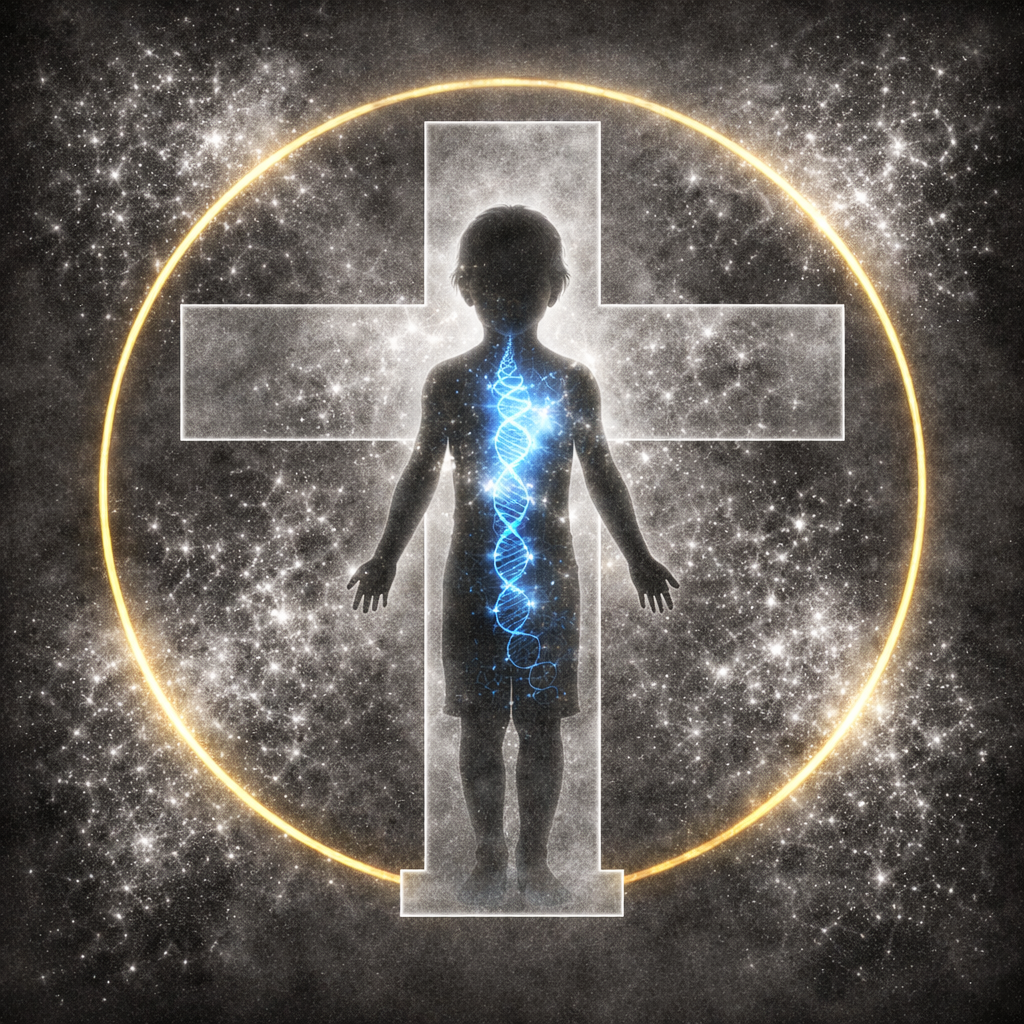
Neil deGrasse Tyson, the astronomer and director of New York City’s Hayden planetarian liked to explain how we are in the universe and the universe is in us. Hydrogen, oxygen, carbon, and nitrogen are the most chemically active elements in the universe. They are, as well, the most common elements that constitute us.
This is reminiscent of Jesus Christ as He is presented in Colossians 1:17: “And He Himself existed and is before all things, and in Him all things hold together.” Later: “Christ in you, the hope of glory” (Colossians 1:27) and Paul’s “I live, yet not I, but Christ liveth in me” (Galatians 2:20).
Christ is the ground of all things – hydrogen, oxygen, carbon, nitrogen, and the other elements – and, like hydrogen, oxygen, carbon, nitrogen, and other elements, Christ is in each of us.
QED
* * * * *
I’ve made a number of posts at my personal blog, New Savanna, that are related to this article. They’ve been tagged “WLB-religion.”
AI Declaration: I wrote all the prose, but I consulted with Claude on a few relatively minor things, including the proper formulation of Neil de Grasse Tyson’s idea; Claude also gave me the Biblical references. ChatGPT did the pictures under my supervision. We produced 57 different images; roughly a half-dozen or so variants for the first image; 30 or so variants for the second one; 15 plus-or-minus for the last; and a half-dozen of a different kind all-together.
As for those shorts on the child, I know, they spoil the lines. I didn’t ask for them. There were no shorts on an earlier version of the image where the figure was an adult man. My guess is that ChatGPT’s idiosyncratic and unpredictable sense of modesty dictated those shorts. Rather than attempt to change it I decided to take the Navajo weaver option and think of it as a deliberate mistake made so as not to offend the presiding spirits.
Enjoying the content on 3QD? Help keep us going by donating now.