
by Eric Feigenbaum
When I lived in Singapore during the mid-aughts, it seemed like the only thing you needed to do Hot Yoga was to turn off the air conditioning or go outside.
In recent years, I have made hot yoga a part of my daily routine and am used to doing a variation of the Bikram set sequence at roughly 104 degrees and 50 percent humidity. On my last visit to Singapore, I decided to see if I could continue staying true to form.
There are a surprising number of yoga and hot yoga studios in Singapore today, so I sampled a few. The one whose format and facilities most resembled what I’m sued to at home was Hom Yoga in the Orchard Center Mall.
A very friendly American-Singaporean couple owns and runs it. Hom Yoga had all the elements one would expect of a nice corporate yoga studio – spacious, light, well appointed locker rooms with showers and hair dryers, towels, fancy water – the whole nine yards. They went the extra mile – providing mats and have them all laid out like parking spaces, which felt very Singaporean.
Hom Yoga provided exactly what I sought – the classic Bikram 26 and 2 sequence pervasive in American Hot Yoga.
Of course, the command, “Change!” between asanas was a bit jarring. No gentle, “rock forward into plank” or “let’s all meet in downward-facing dog.” While it felt shocking un-yogic, maybe you get used to it with time.
One very noticeable difference was the vibe. Maybe I’m just spoiled, but the studios I have attended in the US are very community oriented. People know each other. There are hugs and catching up between classes or while waiting for one to start. One teacher calls the ten minutes leading up to his class, “The Muppet Show” because of the quiet din of everyone chatting.
No one at Hom Yoga was talking. Maybe they were waiting for the “change!”
When I first came to Singapore on my first visits in late 2003-early 2004, I would be shocked if there were even half as many yoga studios as there are today. In 2005, when my friend Alex came to join me to recruit nurses for US hospitals, he was taken aback by how disconnected Singapore was from clean living, healthy food, self-care – all the things Alex experienced in abundance in the Bay Area for several years prior.
Alex noticed Singapore lacked its own art. He felt the amazingly strong and tight systems design that led to a successful Singapore in just one generation and was catapulting itself to higher heights in the next – didn’t leave its citizens the pathos that comes from suffering that when combined with creativity, often leads to great art.
While I never liked that assertion, the proof seemed to be in the pudding – Singapore had one modest art museum and a handful of small galleries. If there was any thriving art in Singapore, it was architecture – not the fine arts.
Once you plant a seed, you can’t really know what will happen. The tree or plant could develop in any number or ways with variances in shape or even a mutation producing a new crop or color. Of course, a terrible frost, blight or man with an axe or scythe can come along too.
One of the most common conversations I used to have with both Singaporeans and non-Singaporeans about the small nation’s future is what would happen in another generation? What would happen once Lee Kuan Yew – the force of nature who throughout his life claimed titles such as founding Prime Minister, Senior Minister, Minister Mentor, and for all intents and purposes Mastermind and Father of Singapore – died? Would the incredible system prove unsustainable and break down when the maker was gone the way it did when Portugal’s Salazar died? Would young Singaporeans want something different? Would a generation that knew only prosperity and never the fear and suffering of their grandparents continue on the path LKY meant for them?
It has been almost 12 years since the Minister Mentor passed and Singapore has not changed much. But maybe change won’t come radical bursts, but evolutions of organic growth? Maybe the tree will take on some of its own direction and shape?
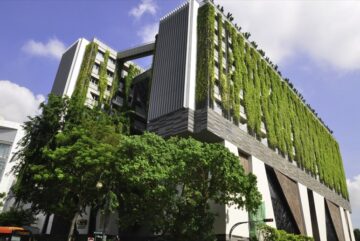
After my enjoyable hot yoga class, I walked along Orchard Rd toward Bras Basah – one of my favorite areas. As I rounded a very familiar curve in the road, there in front of me was a massive building I didn’t recognize at all – interesting, artistic and covered with live plants. School Of The Arts Singapore. My heart smiled. Apparently, the pathos was just waiting for expression. The time had finally come. The tree was growing toward the light.
A major barrier to clean eating in Singapore is the produce itself. Early in Singapore’s nationhood, LKY and his group of leaders made the difficult decision to end all agriculture in Singapore because there wasn’t enough land and resource to ever make the country self-sufficient. Instead, they reasoned, it was better to develop better housing and industry with Singapore’s precious and limited land – using its comparative strengths to its advantage. Food can be bought from other countries – and so it has been ever since. The supermarket produce section offers a selection of onions from Australia, the USA, China and Malaysia. Pricing corresponds to cost of import and freshness (generally Malaysian agriculture is the freshest). Produce is sprayed and treated to have longer shelf life because it has already come such a long way before reaching the supermarket display.
Alex made the point about how dull the produce was in Singapore. I used to spend a lot of time in Bali in those days and his comment opened my eyes. Balinese product is incredibly vibrant and flavorful – fresh off the farm and the trees. When returning to Singapore, the contrast was glaring. All the tastes and smells were muted.
Today, Singapore is a pioneer in low-resource hydroponic farming and is beginning to once again produce its own food. The times have changed and it turns out that Singaporeans are happy to have the freshest, healthiest produce if they can get it. Through their investments in science and research, Singapore may well be agriculturally independent again and even organic.
Many critics of the paternalistic flavor of Singaporean governance believed that younger generations would rise and change Singapore radically after LKY was gone. It could still happen. But I don’t think it will.
My Singaporean ex-girlfriend was smart, educated and spent significant time in Australia and the United States. When it was election time, I asked her who she would vote for – assuming she would support an opposition party because she would want change.
“The answer is obvious,” she told me, “I would only vote for the PAP (the party that has always held the majority in Singapore). You can’t trust someone else can successfully govern Singapore – the whole thing could unravel!”
And there it was. Even a younger generation thought of LKY like Roger Moore – Nobody Does It Better…. And sometimes they probably wish someone would.
Maybe the Singaporean way isn’t to revolt or want drastic change. Maybe there’s too much to lose that way. Trees seem unmoving and very stable. However, if you took a photo of a tree every week for 50 years and made a flip book of the photos, you would discover trees move a lot. I believe the Singaporean tree is moving and changing. You see it in the architecture, art walks, yoga studios, increasing farm-to-table restaurants and through charity work, civic planning, education, and exposure through travel.
Perhaps it is as Lee Kuan Yew predicted in 2004, “Friends tell me many young Singaporeans believe Singapore’s best years are behind us…They are pessimists and wrong. Singapore is like an aircraft flying at 30,000 ft. We have another 6,000 ft to rise to 36,000 ft, the height top US and EU airlines are flying. Furthermore, we have not reached First World standards in the finer things in life, music, culture and the arts, the graces of a civilized society. The generation now in their 30s to 50s can take Singapore there in the next 15 to 20 years. The best is yet to be.”
***
Enjoying the content on 3QD? Help keep us going by donating now.