
by Herbert Harris
Why should we care about each other? Is it disguised self-interest? Is altruism a “selfish gene” that gives the species a survival advantage? Is responsibility an illusion?
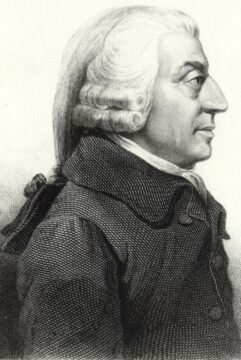
Economist Adam Smith took on these questions at the dawn of the Industrial Revolution. Better known for his foundational economic theories, Smith is remembered as one of the patron saints of the modern free market. Milton Friedman famously idolized him by wearing neckties featuring Smith’s image. But it is very hard to imagine Smith being pleased with today’s “utility monster” economy. This is because Smith’s other foundational contribution was a moral philosophy that placed sympathy at the center of our moral lives.
Smith’s approach drew from David Hume, who argued that we can’t derive moral truths from simple statements of fact. There is always a leap from talking about what is to saying what ought to be. Moral statements were seen as matters of feeling rather than facts. Smith used this starting point to construct a theory of moral sentiment grounded in the natural sympathy we feel for our fellow human beings. Could mere feelings ground a sturdy, compelling moral system? Philosophers have long sought alternative foundations, but the barrier between is and ought is formidable.
A strong contender having a recent resurgence is virtue ethics. Traditionally associated with Aristotle, it views moral life as a product of virtuous character. What is a virtuous character, and how do you get one? For centuries, there were no solid answers. The recent resurgence of interest had a number of champions, including Philippa Foot, who argued that the virtues can be grounded in the biology of what it means for a human being to flourish. A naturalistic foundation for moral philosophy seemed a promising new approach, but psychology and neuroscience have been generally indifferent to concepts like normativity or flourishing, which are essentially “oughts.” However, recent developments in computational neuroscience may offer points of alignment between the brain’s predictive architecture and the language of moral philosophy. Read more »