
by Herbert Harris
Why should we care about each other? Is it disguised self-interest? Is altruism a “selfish gene” that gives the species a survival advantage? Is responsibility an illusion?
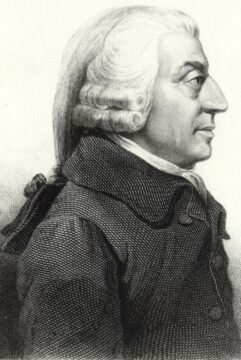
Economist Adam Smith took on these questions at the dawn of the Industrial Revolution. Better known for his foundational economic theories, Smith is remembered as one of the patron saints of the modern free market. Milton Friedman famously idolized him by wearing neckties featuring Smith’s image. But it is very hard to imagine Smith being pleased with today’s “utility monster” economy. This is because Smith’s other foundational contribution was a moral philosophy that placed sympathy at the center of our moral lives.
Smith’s approach drew from David Hume, who argued that we can’t derive moral truths from simple statements of fact. There is always a leap from talking about what is to saying what ought to be. Moral statements were seen as matters of feeling rather than facts. Smith used this starting point to construct a theory of moral sentiment grounded in the natural sympathy we feel for our fellow human beings. Could mere feelings ground a sturdy, compelling moral system? Philosophers have long sought alternative foundations, but the barrier between is and ought is formidable.
A strong contender having a recent resurgence is virtue ethics. Traditionally associated with Aristotle, it views moral life as a product of virtuous character. What is a virtuous character, and how do you get one? For centuries, there were no solid answers. The recent resurgence of interest had a number of champions, including Philippa Foot, who argued that the virtues can be grounded in the biology of what it means for a human being to flourish. A naturalistic foundation for moral philosophy seemed a promising new approach, but psychology and neuroscience have been generally indifferent to concepts like normativity or flourishing, which are essentially “oughts.” However, recent developments in computational neuroscience may offer points of alignment between the brain’s predictive architecture and the language of moral philosophy.
Brains are often described as prediction machines. Rather than passively receiving sensory information and then deciding what to do with it, the brain continuously generates predictions about what it will experience and updates those predictions when they turn out to be wrong. Perception and action are two sides of a single process, minimizing the gap between what we expect and what we get.
This predictive architecture explains agency through the paradigm of self-regulation. Organisms maintain their temperature, blood pressure, and other parameters by predicting an optimal state and acting to align the world with those predictions. This may require complex, coordinated motor and sensory actions. Catching a baseball can be understood as a sequence of actions that realize the predicted state, holding the ball.
The brain can predictively model parts of itself as subsystems, but how can it model itself as a whole, independent entity? This would seem impossible unless it could access external sources of information about itself. Humans have a natural way of accomplishing this as social beings participating in social systems. From infancy, we are surrounded by other people who form predictive models of us and provide constant feedback about who we are and how we appear to them. Naturally, we construct predictive models from this data. These are models of models, giving them the “recursive” structure that we call self-consciousness.
As infants, we cry when hungry. This behavior changes how our caregivers model us that results in feeding. This is similar to the baseball example, where actions produce changes to realize a predicted state, but there is an important feature to note. Both the self that performs the action and the self that is the desired outcome of the action are modeled through self-consciousness. Self-conscious agency has a recursive structure (the self constructing itself) that we experience as the inescapable feeling of authorship and responsibility. These actions seem self-caused, putting them outside our usual understanding of natural causality. Responsibility, on this account, is not about blame or punishment. It is the feeling that our choices are constitutive of who we are. They matter to us in a sense analogous to what Heidegger called “Care.”
Self-consciousness has a very important limitation. It is always incomplete, never a unique, fixed entity. It is a multiplicity derived from interactions with many people, characterized by a recursive, reciprocal interdependence. We are partially anchored in the body and in relatively stable physical objects, but our psychological sense of continuity and uniqueness primarily depends on personal narratives and episodic memories. Inevitable gaps in memory and storyline mean that our identities are always underdetermined.
We experience this most intensely in early childhood, when the identities of self and other are most fluid. This fluidity persists into adulthood, and we constantly catch ourselves projecting our feelings onto others or internalizing their fears and anger. The compassion we feel for others arises from this essentially underdetermined nature of personal identity. The capacity to identify with others is not an optional achievement that requires justification; it is a structural feature of human selfhood.
Compassion and responsibility arise from the same architecture, but they do not point in the same direction. Compassion reflects the openness of an underdetermined identity, the capacity to recognize oneself in others. Responsibility reflects the closure of authorship, the sense in which one’s actions are one’s own. These orientations can reinforce each other, but they can also pull apart. That tension is not a defect in the system; it is what makes moral deliberation possible.
The relationship between indeterminate identity and compassion is vividly illustrated by John Rawls and his famous thought experiment. Rawls asked us to imagine choosing principles of justice from behind a “veil of ignorance,” not knowing our economic status, race, gender, religion, or age. From this position, rational agents would always choose principles of fairness.
The veil of ignorance is not just a thought experiment about hypothetical rational choice. It is an idealization of something self-consciousness already provides: a perspective constitutively informed by the perspectives of others. Fairness, in this sense, becomes a way of operationalizing compassion. Behind the veil of identity, everybody behaves like a Rawlsian.
The recursive structure of self-consciousness may hold the solution to the gap between is and ought. For Adam Smith to say, “I didn’t buy shares in East India Company,” would be a factual statement living in the world of is. For Adam Smith to say, ‘I shouldn’t buy shares in East India Company,” involves reasoning about possible actions of possible selves in possible worlds. To arrive at “shouldn’t,” Smith would have to model himself as an agent with options, model the consequences of those options, and evaluate them from a perspective that stands outside any single action. This is a job for self-consciousness.
An understanding of the structure of self-consciousness as a socially embedded active inference process may do more than bridge the gap between the empirical “is” and the moral “ought.” It suggests that the gap was never as absolute as it appeared. The same architecture that allows us to represent the world, when applied to itself, also places us within a field of concern, where others already matter, and our actions already count as our own. Moral life is not something added to a neutral cognitive system. It is what it is like for that system to understand itself.
***
Enjoying the content on 3QD? Help keep us going by donating now.