Nine Reasons To Read The Classics

by Eric Schenck

One of my New Year’s resolutions was to read one of the “classics of fiction” each month this year. I’m happy to report that I’m on pace to succeed. 

While I won’t tell you which books I’ve read so far (no spoilers here!) this year of reading has taught me a few things.

I used to think it was a waste of time reading old novels. But now?

I realize it can actually teach you quite a lot – even if it’s not what you expected. In honor of the nine classics I’ve read so far in 2025-

Here are nine reasons you should read them in the first place.

1) You can get off the self-help train.

I used to read self-help books almost constantly. Whether it was about optimizing your time, optimizing your health, or optimizing your optimization (sadly, not a joke), I was trying to get to the ideal level of everything.

But if you really want to improve your life – the classics will help.

Stories like this teach you lessons on love, death, success, and what it means to be human.

What more do you need?

2) You can hate on the classics you don’t like.

I said there wouldn’t be any spoilers here, but I can’t help myself. Don’t hate me for what I’m about to say…

But I read “Beloved” by Toni Morrison and I couldn’t stand it. Too poetic. Plus, you’re telling me a ghost came back to live with her and everybody was cool about it?

Pssssssh.

There’s a special kind of club (even if you’re the only member) where you hate a book everybody else seems to love.

And with the classics?

That club is all the cooler. Read more »

Wednesday, September 17, 2025

Sweetening the Bitter Lesson: An Argument for a More Natural AI

by Ali Minai

As AI insinuates itself into our world and our lives with unprecedented speed, it’s important to ask: What sort of thing are we creating, and is this the best way to create it? What we are trying to create, for the first time in human history, is nothing less than a new entity that is a peer – and, some fear, a replacement – for our species. But that is still in the future. What we have today are computational systems that can do many things that were, until very recently, the sole prerogative of the human mind. As these systems acquire more agency and begin to play a much more active role in our lives, it will be critically important that there is mutual comprehension and trust between humans and AI. I have argued elsewhere that the dominant AI paradigm is likely to create powerful intelligences that are quite alien, and therefore potentially hazardous. Here, I critique an influential principle implicit in this paradigm, and make the case that incorporating insights from biological intelligence could lead to a more natural AI that is safer and more well-adjusted to the human world.

General Critique:

In 2019, Richard Sutton, one of the pioneers of computational reinforcement learning and winner of the Turing award, wrote an extremely influential essay titled “The Bitter Lesson”. His main argument was that trying to reach artificial intelligence by emulating biology, neuroscience, and psychology was futile, and that the focus should be on general purpose meta-methods that can scale with computation – notably search and learning. The following quote from the essay captures the essential insight:

We have to learn the bitter lesson that building in how we think we think does not work in the long run. The bitter lesson is based on the historical observations that 1) AI researchers have often tried to build knowledge into their agents, 2) this always helps in the short term, and is personally satisfying to the researcher, but 3) in the long run it plateaus and even inhibits further progress, and 4) breakthrough progress eventually arrives by an opposing approach based on scaling computation by search and learning. The eventual success is tinged with bitterness, and often incompletely digested, because it is success over a favored, human-centric approach.

This is a truly profound point that deserves some unpacking. The implication in Sutton’s argument is that the “intelligence” that AI seeks to implement is something similar to the intelligence exhibited by humans, or possibly by some other animals. In other words, biological, natural intelligence. This is reasonable, since all existing examples of general intelligence are biological, and it’s hard to imagine some radically different form of intelligence. Given this goal of building AI similar to natural intelligence, it seems reasonable to assume that insights from biology would be very useful. Read more »

The Ecosystems of W.S. Merwin

by Laurie Sheck

1.
In the garden of the Maui home where the poet W.S. Merwin lived for the last forty years of his life, writing and translating poems, and restoring deforested land into a flourishing palm forest, there is a black stone marker engraved with his name and that of his wife, along with the four simple words “Here we were happy.” It is a remarkable story. Merwin first came to the island in 1975 to study with the Buddhist teacher Robert Aitken. Drawn to the land, he found at first three acres of a disused pineapple plantation where, with the help of friends, he built a house. Later, he purchased and tended fifteen acres more. Over the years, seedling by seedling, he planted his palm forest. At first, he wanted to plant only trees native to the island but found through experience the ecosystem had been so degraded they could no longer survive. The first 800 trees he planted died. After that, he focused on planting various endangered species of plants and trees. He planted one tree almost daily; by the time of his death, he had planted approximately 14,000 palm trees.

The history of the island is one of natural beauty severely harmed by human intervention. When the earliest settlers arrived, many of its trees were cut down to provide wood for the construction of whaling ships. Soon the land was further cleared for grazing cattle. Rats, mosquitoes and other life-forms foreign to the island were introduced. In 1876, the Hamakua Ditch Company began building a network of ditches and tunnels that diverted the rainwater from the central valley to newly cultivated sugar cane fields. The valley was starved of water. By 1917 nearly 130,000 acres of Maui had come under the ownership of sugar plantations and factories. Large numbers of the native population had died from infectious diseases brought to the island by Americans and Europeans. When the pineapple industry arrived, it further destroyed what was left of the native ecosystem.

2.
These are some of the life-forms that were lost: Acacia palm trees, sandalwood trees, many kinds of native land snails, damselflies, honeycreepers.

By the time of Merwin’s death, his plantings included 128 genera and 486 species. One ecosystem had been destroyed but another had begun to flourish.

3.
I first came upon Merwin’s poems in my early twenties. It interested me that he had turned from the lapidary early poems that drew notice from W.H. Auden, who picked Merwin’s first book for the Yale Series of Younger Poets, to something much starker, stripped down, alert to and pained by human hubris and error. By his 6th volume, The Lice, he had dropped punctuation. The poems were concerned with war, destruction, power, and the counterforces that make us of value as a species, and that make our planet a wondrous place. Read more »

Tuesday, September 16, 2025

Basic Consequences: On Information And Agency

by Jochen Szangolies

Anxiety is the dizziness of freedom: Should you want to be free, knowing that your decisions could yield catastrophic results?

The principal argument of the previous column was that without the possibility of making genuine choices, no AI will ever be capable of originating anything truly novel (a line of reasoning first proposed by science fiction author Ted Chiang). As algorithmic systems, they can transform information they’re given, but any supposed ‘creation’ is directly reducible to this initial data. Humans, in contrast, are capable of originating information—their artistic output is not just a function of the input. We make genuine choices: in writing this sentence, I have multiple options for how to complete it, and make manifest one while every other remains in the shadow of mere possibility.

This is of course a controversial proposition: just witness this recent video of physicist Sabine Hossenfelder making the case for free will being an illusion. In particular, she holds that “the uncomfortable truth that science gives us is that human behavior is predetermined, except for the occasional quantum random jump”. I think this significantly overstates the case, in a way that ultimately rests on a deep, but widespread misunderstanding of what science can ‘give us’—and more importantly, what it can’t.

Before I make my argument, however, I feel the need to address an issue peculiar to the debate on free will, namely, that typically those on the ‘illusionist’ side of the debate consider those taking a different stance to do so coming from a place of romantic idealization. The charge seems to be that there is a deep-seated need to feel special, to be in control, to have authorship over one’s own fate, and that hence every argument in favor of the possibility of free will is inherently suspect. I think this is a bad move. First of all, it poisons the well: any opposing stance is tainted by emotional need—just a comforting story its proponents tell themselves to prop up their fragile selves. (Hossenfelder herself describes struggling with the realization of having no free will.)

But more than that, I just don’t think it’s true—disbelief in free will can certainly be as comforting, if not more so. After all, if I couldn’t have done otherwise, I couldn’t have done better—I did, literally, my best, with everything and always. No point beating myself up about it afterwards. Read more »

At what age are you officially “old” and why? Or, I got eye blooows. Do you?

by Bonnie McCune

When my grandson was about two, I heard him stirring from his nap and went to his bedroom to get him up. He saw me at the door and clambered to his feet, clinging to the rail of his crib. “I got eye blooows,” he announced with pride, indicating with a pointed finger the yellow fuzz framing one eye.

I can imagine his curiosity as he first felt the ridge frequently called the brow ridge, the bony prominence above the eyes, known also as the supraorbital ridge. Touching the hairs and wondering what in the heck they are. Asking his parents why his face sprouted these strange growths. Checking faces of people around him for similar protrusions.

A momentous discovery, probably more for me than for him. It’s difficult for adults to get any view, even a squinty-eyed one, into the mind of a child just learning about himself and life. I was lucky. This particular child, at that precise time, paired verbal skills with a questioning mind and was able to say what he was thinking. I’d never caught a glimpse of the process before although I’d wondered how a kid learns.

I’ll give you an answer. It’s the same way a kid learns about a roly-poly bug and how it faces danger. They poke at it. Go nudge something and get excited about it, learn about it. This is actually how we continue to learn about life in all its fascinating variations. We witness some phenomenon, wonder about it, and learn and think.

We don’t claim we’re always right. Aging is a particularly delicate topic. Some of us don’t want to admit we’re not as charming or beautiful or strong or healthy as we once were. So we cover up with white lies and smiles.

But how does each of us determine, and ADMIT, we’re old? Read more »

Monday, September 15, 2025

If Everyone Reads it, Everyone Doesn’t Die?

by Malcolm Murray

“A clearly written and compelling account of the existential risks that highly advanced AI could pose to humanity.” — Ben Bernanke


“Humans are lucky to have Yudkowsky and Soares in our corner, reminding us not to waste the brief window that we have to make decisions about our future.”— Grimes

Probably the first book with blurbs from both Ben Bernanke and Grimes, a breadth befitting of the book’s topic – existential risk (x-risk) from AI, which is a concern for all of humanity, whether you are an economist or an artist. As is clear from its in-your-face title, with If Anyone Builds It, Everyone Dies (IABIED), Eliezer Yudkowsky and Nate Soares have set out to write the AI x-risk (AIXR) book to end all AIXR books. In that, they have largely succeeded. It is well-structured and legible; concise, yet comprehensive (given Yudkowsky’s typically more scientific writing, his co-author Soares must have done a tremendous job!) It breezily but thoroughly progresses through the why, the how and the what of the AIXR argument. It is the best and most airtight outline of the argument that artificial superintelligence (ASI) could portend the end of humanity.

Although its roots can be traced back millennia as a fear of the other, of Homo sapiens being superseded by a superior the way we superseded the Neanderthals, the current form of this argument is younger. I.J. Good posited in 1965 that artificial general intelligence (AGI) would be the last invention we would need to make and in the decades after, thinkers realized that it might in fact also be the last invention we would make in any case, since we would not be around to make any more. Yudkowsky himself has been one of the most prominent and earliest thinkers behind this argument, writing about the dangers of artificial intelligence from the early 2000s. He is therefore perfectly placed to deliver this book. He has heard every question, every counterargument, a thousand times (“Why would the AI be evil?”, “Why don’t we just pull the plug?”, etc.) This book closes all those potential loopholes and delivers the strong version of the argument. If ASI is built, it very plausibly leads to human extinction. End of story. No buts. So far, so good. As a book, it is very strong. Read more »

Little Cousin Bernie Swears He Can Fly Like Buck Rogers — The Memoir of a Free-Range Professor Continues

by Barbara Fischkin

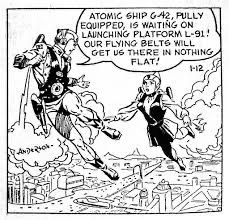
Buck Rogers wearing his flying belt. Vintage comic strip panel.

Eight weeks have passed since I wrote about my Cousin Bernie—and how, posthumously, he adds to my own memories of him. As readers may remember from my last offering, Cousin Bernie’s widow, Joan Hamilton Morris, sent me the pages of an incomplete memoir her late husband pecked out on a vintage typewriter in an adult education class he took after retiring as a university professor of psychology and mathematics.

If Cousin Bernie were alive today he would be 102. Those pages of memoir chapters, some more worn than others, remain in a place of honor, tucked into a corner of my own writing table. I feel that “Cousin Joanie,” as I call his widow, sent them to me for safekeeping—and for presentation to the world. Originally I thought I could do this in one or two chapters. A deeper read has revealed a surprising amount of insight. Here is my fourth take on my cousin, who fascinates me despite his evergreen persona as a nerdy, chubby, lost boy from Brooklyn. There will be a fifth offering and probably a sixth. If it seems Bernie is taking over my memoir, I am fine with this. I have written a lot about my mother’s side of the family. Now it is my father’s family’s turn.  And what better way to bring them into the light, than through Cousin Bernie?

What follows is Cousin Bernie, Part Four. I’ve only edited it slightly, less so I think than his Adult Education teacher. So far, my minor editing has provoked no lightning bolts from the heavens. I have discovered another Bernie, a child who believed he could fly like his comic strip hero.

“I was eight years old, and my sister, Gertie, six. We had just been transplanted to Bridgeport, Connecticut from Brooklyn, New York. My father, a home painter and decorator, felt that he could do better in terms of finding work in a smaller city.

“Here, a whole new set of stimuli presented itself: A Benjamin Franklin stove in the kitchen, a gas water heater in the bathroom, which had to be lighted so we could bathe, and a coal bin on the back porch. There was a scuttle for bringing in coal for the stove. The Saturday Sabbath meal preparations—gefilte fish, stewed chicken and beef, challahs, cookies and pies—began as early as Wednesday night. The stove was banked and allowed to go out on Saturday night.

“We slept as the stove died down and, on Sunday mornings, my sister and I would climb into my parents’ big bed. Pop got up wearing his union suit, put on a robe, removed the ashes, kindled a new fire in the stove and came back to bed with us for my reading of the Sunday comics. My sister, Gertie, pointed to each speech bubble, as I read them. It seemed to me that Andy Gump’s nose or chin was strange looking. I disliked it when the bubbles were long. But it was here in the Sunday comics that I encountered the adventures of ‘Buck Rodgers in the Twenty-Fifth Century.’  Read more »

Poem by Jim Culleny

Conversation

Boat:
……… —Your slope is russet and graceful; seems soft.

Land:
……… —It is. I see it echoes the grace of your gunnels, stem to stern.

Boat:
……… —We approach your still grace, having been upon water all day.

Land:
……… —Who is that with you, the who with articulating sticks?

Boat:
……… —He rows, he brings me to you to lie in your shade.
…………. He imagines the sky is worth gazing into
…………. with you beneath his back; the painter has
…………. rendered us true and sure & his clouds
…………. follow the breath of wind as they must

Land:
……… —But I’m confused, what painter,
………… I am real and true and so is sky?

Boat:
……… —Yes, and so the painter is, and so am I.

Jim Culleny, 11/16/22
Painting by Jack Braudis

Enjoying the content on 3QD? Help keep us going by donating now.

Sunday, September 14, 2025

A Conversation with Natalie Bakopoulos

by Philip Graham

Archipelago, the third novel by Natalie Bakopoulos, ranges among the Cycladic Islands of Greece, the coast of Croatia, and crosses the borders of various Balkan states until finally—temporarily?—settling in a small town in the Peloponesian peninsula. All this traveling echoes (and is echoed by) the inner journey of the unnamed (and yet named) narrator of Archipelago, a translator who, as the novel progresses, seems to allow her own self to be written, to be translated.

Archipelago is a heady read, deceptively quiet and yet rife with private risk-taking and minute transgressions. It’s a novel that sets its own pace and sets its own rules as the narrator, in the process of discovering herself, must also learn how to remember herself.

*

Philip Graham: I have so much to say and ask about this beautifully-written house of mirrors that is Archipelago, your latest novel, that I don’t know where best to start. Perhaps the novel’s own beginning? The narrator, a translator of Greek literature on her way to a literary conference, has a brief but disturbing encounter with an aggressive man. A case of mistaken identity? She has no recollection of this man, but somehow she has become a character in his angry imagination. The possibility of being a “someone else,” seems to cling to her in different ways as the novel progresses.

Meanwhile, she decides to forego reading a novel—titled Occupation—before beginning to translate it, a new professional process for her. “I wanted to try translating something as I was coming to know it,” she says, in order to “tell a story before I knew its ending.” Her translating “blind” sets the stage for another thread in the novel, an acceptance of “unknowing” how her own story will move forward.

As she notes near the end of Archipelago, “the beginning is often many places at once.”

Natalie Bakopoulos: Thank you so much, Philip, for starting this conversation, and for these wonderful observations and connections. You’re absolutely right, I was indeed playing with the idea of “beginnings.” “Here in Greece,” the narrator says, “the rivers rarely have a single source: They spring from the mountains at several places.” I also wanted to think about the arbitrariness of origin and a way of thinking about belonging that wasn’t necessarily about “roots”—but instead rhizomes, as Edouard Glissant, and others, might say.


Joan Silber, in The Art of Time in Fiction, writes: “A story is already over before we hear it. That is how the teller knows what it means.” I really appreciate this sentiment, and I even echo it in the book, but I also think the actual telling of the story helps the teller to understand it, and that each telling, or translation, might privilege different things. I fact, I might say that in Archipelago, her narration is as much the story as any other elements of the work. Read more »

The War Room Is Still a Playground: The Politics of Fragile Egos and Mishandled Emotion

by Daniel Gauss 

Two school children pass replicas of US 500lbs bombs from WW2. From the Osaka Peace Museum, Dan Gauss photographer.

There are more than 50 armed conflicts going on in the world right now. In fact, depending on how you define “armed conflict,” the number from the most trustworthy sources ranges from around 60 (using a strict, high-intensity definition) to over 150 (using a broader, low-intensity definition). We wake up, take a look at the news and often see that it’s war again. Again. An airstrike, retaliation, another round of funerals and recriminations.

A recent, well-publicized armed conflict was in South-East Asia between a government run by a father/son dictatorship duo and a government still dominated by its military establishment, where generals retain substantial power to influence and often overrule civilian politics at will. Both of these governments demanded and marshalled the patriotic fervor of their respective populations to square off over who “owned” a largely inaccessible 1,000-year-old temple in the middle of a forest, which does not even generate much tourism money. People died.

All these wars, clashes and skirmishes…if you listen closely, really closely, past the rattle of gunfire, the buzz of drones, missiles smashing into concrete buildings, the somber gravitas of the news anchor, you’ll hear it…the soft whimper of a bruised ego.

There is the assumption that war is often rationally motivated. Somewhere in a quiet, high-tech, air-conditioned war room, serious, highly educated and seasoned adults in formal attire or uniforms decorated with medals did the math, weighed strategic interests and analyzed existential threats. We then read that they had no choice but to take action, and, of course, according to the “humanitarian” rules of war, they tried to minimize civilian casualties.

But I sense that beneath all the theatrics is something simpler. Read more »

Lessons From Singapore: Incubating Excellence

by Eric Feigenbaum

In 2016, my then-wife and I took our one and three-year-old children from Los Angeles to Bali, Indonesia. It took 21 hours of flight time with one stop in Tokyo to refuel and another in Singapore to change planes – making for a roughly 26-hour journey with two kids in diapers. It is not the easiest way to begin a vacation.

My wife and I were seasoned travelers – both of us having lived abroad before meeting. Asia was no stranger to either of us, and in fact I had lived in both Bali and Singapore in my 20’s. There was a time in both our lives when the best flight was the cheapest one. When flying from Bangkok to Kathmandu for the first time with two buddies aboard Royal Nepal Airlines, we laughed about the used TV cart the flight attendants pushed through the aisle instead of the Boeing-issued ones – purposely included with the plane both for functionality and safety.

One British friend used to take Biman Airlines of Bangladesh back to London from Bangkok, sleeping on the floor of the Dhaka Airport in order to save the most money. Once on a budget flight from Bangkok to Udon Thani, there was so little leg room, I couldn’t sit forward and had to pivot to fit into the row.

It didn’t matter – it was part of the adventure and made for great stories.

Traveling with a one and three-year old across the world was an adventure in and of itself – and suddenly inconveniences were enemies and comforts our best friends. We needed any and every advantage we could get. It became clear to my wife and I that we had reached the age where reducing friction was worth a premium. We needed to rely on everything we couldn’t control going right.

After all, when something goes right, we often don’t notice or comment – but when it goes wrong, it becomes clear that “nothing” is really the hallmark of incredible accomplishment.

This is the bedrock success of Singapore Airlines. Read more »

Friday, September 12, 2025

Captain Head

by Rafaël Newman

Marie Cosindas, “Ted Newman” (1965)

At the University of Toronto one winter term in the mid-1980s I took an undergraduate course on classical philology. The instructor was Hugh Mason, a British-born Marxist who once reproved me for wearing a white dress shirt to give a presentation, something he maintained “only a fascist” would have done in his day. (My own politico-sartorial instructions, meanwhile, were issued by The Clash, who cautioned strongly against a wardrobe featuring the colors blue and brown unless one were already “working for the clampdown”). The course was spent for the most part learning about celebrated pioneers of the study of Greek and Latin—among them Ulrich von Wilamowitz-Moellendorff, better known beyond the world of classical antiquity for his dispute with Nietzsche—; but there was also a unit on something called Proto-Indo-European.

PIE, as it is commonly abbreviated, is the hypothetical “mother” of the large, widespread family of tongues comprising Greek, Latin, English, French, and German, but also Russian, Farsi, Lithuanian, Albanian, and Hindi, among many others. Their linguistic ancestor can only be theorized, following the discoveries of British colonial philologists in 18th-century India who compared Sanskrit with Ancient Greek: because there are no written records of languages spoken longer ago than a few millennia.

A putative PIE vocabulary, we learned from Professor Mason, must thus be reconstructed by surveying the modern languages identified as cognate descendants of the earlier idiom for similarly sounding words with related meanings—such as, famously, μήτηρ/mater/mère/Mutter/mother—and using established laws of phonetic evolution to reverse-engineer as their forebear *méh₂tēr (the subscript stands for a particular quality of aspirate, while the asterisk indicates that the word is hypothetical). The PIE reconstruction I recall best from the course, however, and which had no doubt been chosen (or perhaps invented) to reflect the climatic conditions in which we were gathering, in Toronto in February, was *sneghweti: “It is snowing”.

The study of Proto-Indo-European has developed considerably over the past 40 years, since I was first introduced to the idea that winter day in Toronto, its evolution driven by significant technological advances, particularly in the fields of archeology and genetics. In Proto: How One Ancient Language Went Global, Laura Spinney gives an absorbing account of the latest attempts to identify and trace the speakers of Proto-Indo-European. Spinney, a science journalist, surveys archaeologists, geneticists, and linguists who are reconstructing not only the way those prehistoric peoples spoke, but also how they lived. Read more »

Captive of the Narrative

by Akim Reinhardt

Story Time Tuesday Fun - DC Public LibraryThe wealthy and powerful have always used the narrative to their advantage. The narrative defines them as superior in some way, and thus deserving of their power and wealth. In ancient times, they might be descended from the Gods, or at least favored by them or otherwise connected to them, perhaps through special communicative powers that granted them insights into the will of the Gods or God. In modern capitalist societies, that narrative promotes a fantasy of merit. You are rich and/or powerful because you are better. You are more civilized, better educated, more intelligent, or blessed with an exceptional work ethic. These narratives cast wealth and/or power as not only justifiable, but deserved.

The poor and exploited have always had the narrative used against them. The narrative defines them as inferior in some way, and thus deserving of their poverty and exploitation. In ancient times, they were conscripted by the Gods to serve the will of the Gods’ descendant, favored, and prophets. The poor serving the wealthy and/or powerful was the will of the Gods or God, and could extend into the afterlife. In modern capitalist societies, the narrative promotes a fantasy of the non-meritorious. You are poor and/or exploited because you are inferior. You are uncivilized, uneducated, stupid, or lazy. These narratives cast poverty and/or exploitation as not only justifiable, but deserved.

The middle class cannot use the narrative to their advantage to the degree that the wealthy and powerful do. The middle class can only use the narrative to modestly justify its modest advantages. The narrative does not demonize the middle class the way it does the poor and exploited. It does not cast them as savages, morons, or parasites. Instead, it frames the middle class as the laudable backbone of the nation, casting a moral sheen over them. This is consolation for the narrative subjecting the middle class to a volatile message of fear and hope. If you work really hard, and get a little lucky, maybe you’ll become wealthy. But never forget: while things are good enough for now, they are not great, and if you fuck up, you will be punished. For the middle class, the narrative is not just carrots and not just sticks. It is both, carrots and sticks. With a demon authoring half the pages, and an angel authoring the rest, the narrative is a see-saw that repeatedly raises them with promises of a bright future and drops them down to the edge of the precipice, while slathering them with a thin coating of goodness. Read more »

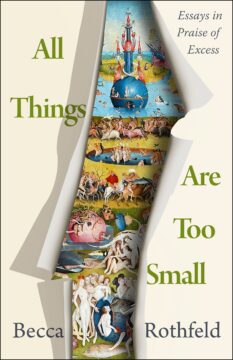
Garden of Earthly Delights: And Becca Rothfeld’s All Things Are Too Small: Essays in Praise of Excess

by Leanne Ogasawara

1.

Standing before Bosch’s Garden of Earthly Delights in the Prado is an act of surrender. Eyes are consumed by details: naked bodies cavorting in crystalline ponds, human-sized strawberries and a multitude of dripping cherries. There are birds devouring humans, whilst cities are collapsing into flames at the far edge of vision. Each figure is rendered with miniature precision, yet together they overwhelm, producing an excess that resists containment.

Bosch offers no single story; the painting’s power lies in its refusal to be reduced. It is “too much”—and therein lies its meaning. I was not surprised, therefore, to find details from the painting on the cover of Becca Rothfeld’s 2024 book All Things Are Too Small: Essays in Praise of Excess. I had heard so much about this book before finally picking up a copy. Offering a strong critique of our contemporary aesthetics of minimalism, I thought it was a perfect book to pack for my summer of writing. First, working on a novel manuscript at two writers’ residencies, one in Vermont and the next in Virginia, I then made my way to the Sewanee Writers’ Conference and then to Bread Loaf. It was two-and-a-half months living out of a small suitcase with that one book along for the ride– in hardcover, of course.

From Marie Kondo’s call for us to “take out the trash” –where trash is defined as anything we are not currently using and enjoying– to the multi-million-dollar mindfulness industry, which similarly sells ways for us to de-clutter, Rothfeld’s book asks us to consider that less is not always more.

Sure, sometimes it is.

Especially for Americans whose lives do so often seem to be spinning out of control, not least of all because of all the stuff we endlessly buy and throw away, by all the choices we have, and how these endless choices seem to define who we are. Maybe for people constantly loading up at Costco and traveling overseas several times a year, with households with so many moving parts, a car per person, Kondo’s style of clean consumerism can feel like a relief, of sorts. I get it. Read more »

Some Hybrid Remarks on Man-Machine Collaboration

by William Benzon

When ChatGPT was released late in November of 2022 my immediate response was, “meh.” But then I decided that I needed to check it out, if only out of curiosity. Within an hour or so my reaction went from “meh” to “hot damn!” I put it through its paces in various small ways before deciding to give it a whirl on a task I understood well, interpreting a text. In this case I chose a film, Steven Spielberg’s Jaws. I published the result here in 3QD: Conversing with ChatGPT about Jaws, Mimetic Desire, and Sacrifice (Dec. 5, 2022).

I then dove in with both feet. For about a year or so I was mostly interested in observing ChatGPT’s behavior. In time I began using it as an assistant in my own work, even as a collaborator. I started working with Anthropic’s Claude in November of 2024. Starting in December I did a series of posts in which I had Claude discuss photos I uploaded. At the same time integrating it into my general intellectual workflow along with ChaGPT.

In March of this year I began working on a somewhat speculative book on the long-term prospects of AI. Current working title: Play: How to Stay Human in the AI Revolution. I have been making extensive use of both Claude and ChatGPT in developing the book. I’ve used them for general research, for summarizing some of my scholarly research and evaluating it for use in the book, for working on the overall structure of the book, and more generally for things and stuff. The purpose of this article is to give you a glimpse into that work.

First comes three sections of preliminary materials. The fourth section is a short essay that ChatGPT wrote: Beyond the Human/AI Divide. I conclude with some questions about just who or what wrote that essay.

Read more »

Thursday, September 11, 2025

Between An Artist And GPT

by Mark R. DeLong

Avital Meshi, a performance artist who uses AI in her work, stands with herright arm raised to show an electronic device strapped on her right forearm. She has her head slightly cocked, her long blonde hair falling over her right shoulder. She is not smiling as she looks straight into the camera. The background is black, so her upper body is clearly outlined.
Avital Meshi wearing the small computer and phone device that she uses to communicate with “GPT.” Photo courtesy of Avital Meshi.

Avital Meshi says, “I don’t want to use it, I want to be it” “It” is generative AI, and Meshi is a performance artist and a PhD student at the University of California, Davis. In today’s fraught and conflicted world of artificial intelligence with its loud corporate hype and much anxious skepticism among onlookers, she’s a sojourner whose dived deeply and personally into the mess of generative AI. She’s attached ChatGPT to her arm and lets it speak through the Airpod in her left ear. She admits that she’s a “cyborg.”

Meshi visited Duke University in early September to perform “GPT-Me.” I took part in one of her performances and had dinner with her and a handful of faculty members from departments in art and engineering. Two performances made very long days for her—the one I attended was scheduled from noon to 8:00 pm. Participants came and went as they wished; I stayed about an hour. For the performances, which she has done several times, Meshi invites participants to talk with her “self” sans GPT or with her GPT-connected “self”; participants can choose to talk about anything they wish. When she adopts her GPT-Me self, she gives voice to the AI. “In essence, I speak GPT,” she said. “Rather than speaking what spontaneously comes to my mind, I say what GPT whispers to me. I become GPT’s body, and my intelligence becomes artificial.”

In effect, Meshi serves as a medium, and the performance itself resembles a séance—a likeness that she particularly emphasized in a “durational performance” at CURRENTS 2025 Art & Technology Festival in Santa Fe earlier this year. Read more »

Abnegation of Powers – Part 3

by Charles Siegel

In the first part of this depressing column, I looked at Congress’ spineless surrender of its power to Trump’s turbocharged executive. In the second part, I tried to set out how that same executive has waged war on the judicial branch, and has rapidly transformed the Department of Justice into its private law firm. Perhaps most disheartening in this sorry saga, however, is how obliging the Supreme Court has been in the steady weakening of the “third branch.” Our highest court — the ultimate symbol of the judicial branch and the temple of its authority — seems perfectly content to let Trump steadily erode its power. In some ways, the Court is actively complicit in Trump’s war.

It is hard to comprehend that we are less than eight months into this administration, such has been the sheer ferocity and speed of Trump’s actions. Blizzards of executive orders, arbitrary firings, wholesale liquidations of entire agencies, mass deportations, ICE abductions, the military in our streets. All of this has resulted in hundreds of lawsuits, many of which (perhaps even most) are seeking relief on an emergency basis. The lower courts have done their level best to deal with the onslaught. But when cases have come to SCOTUS, as inevitably some would, the Court has acted in singularly unhelpful ways.

The Court has sided with Trump and his Department of Justice — and yes, that’s the only way DOJ can be described these days – in the vast majority of cases. The only issue of any importance on which Trump has lost has been the due process rights of persons detained under the Alien Enemies Act, who are about to be deported. There, the Court ruled that they are entitled to “notice …within a reasonable time and in such a manner as will allow them to actually seek habeas relief.” Even then, this decision was enormously helpful to Trump’s agenda, as discussed below.  Beyond that, the Court has largely deferred to the executive. Read more »