
Basic Consequences: On Information And Agency

by Jochen Szangolies
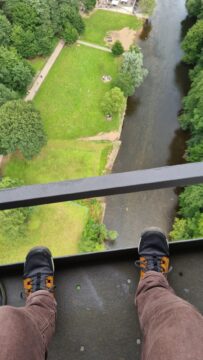
Anxiety is the dizziness of freedom: Should you want to be free, knowing that your decisions could yield catastrophic results?

The principal argument of the previous column was that without the possibility of making genuine choices, no AI will ever be capable of originating anything truly novel (a line of reasoning first proposed by science fiction author Ted Chiang). As algorithmic systems, they can transform information they’re given, but any supposed ‘creation’ is directly reducible to this initial data. Humans, in contrast, are capable of originating information—their artistic output is not just a function of the input. We make genuine choices: in writing this sentence, I have multiple options for how to complete it, and make manifest one while every other remains in the shadow of mere possibility.

This is of course a controversial proposition: just witness this recent video of physicist Sabine Hossenfelder making the case for free will being an illusion. In particular, she holds that “the uncomfortable truth that science gives us is that human behavior is predetermined, except for the occasional quantum random jump”. I think this significantly overstates the case, in a way that ultimately rests on a deep, but widespread misunderstanding of what science can ‘give us’—and more importantly, what it can’t.

Before I make my argument, however, I feel the need to address an issue peculiar to the debate on free will, namely, that typically those on the ‘illusionist’ side of the debate consider those taking a different stance to do so coming from a place of romantic idealization. The charge seems to be that there is a deep-seated need to feel special, to be in control, to have authorship over one’s own fate, and that hence every argument in favor of the possibility of free will is inherently suspect. I think this is a bad move. First of all, it poisons the well: any opposing stance is tainted by emotional need—just a comforting story its proponents tell themselves to prop up their fragile selves. (Hossenfelder herself describes struggling with the realization of having no free will.)

But more than that, I just don’t think it’s true—disbelief in free will can certainly be as comforting, if not more so. After all, if I couldn’t have done otherwise, I couldn’t have done better—I did, literally, my best, with everything and always. No point beating myself up about it afterwards. Read more »
Monday, November 13, 2023

Münchhausen And The Quantum: Dragging Ourselves Out Of The Swamp

by Jochen Szangolies

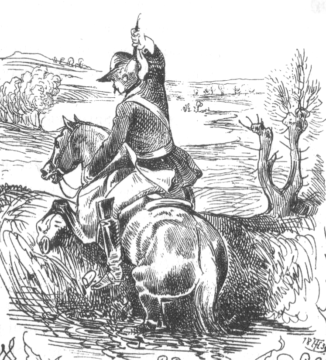
Münchhausen dragging himself out of the swamp. Image credit: public domain.

There seems no obvious link between tall war-tales, shared among a circle of German aristocrats in the 1760s, and quantum mechanics. The former would eventually come to form the basis of the exploits of Baron Münchhausen, the partly fictionalized avatar of Hieronymus Karl Friedrich, Freiherr von Münchhausen, famous for his extravagant narratives, while the latter is the familiar, yet vexingly incomprehensible, theory of the ‘microscopic’ realm developed more than 150 years later. Both, however, seem to equally beggar belief: which is stranger—riding a cannonball across a battlefield (and back), or seemingly being in two places at once? Reconnecting a horse bisected by a falling gate, or deciding the fate of a both-dead-and-alive cat by opening a box?

But beyond mere bafflement, the stories of Münchhausen’s exploits have inspired a philosophical conundrum relevant to the question of quantum reality. Perhaps the Lügenbaron’s most famous story, it concerns his getting trapped in the swamp on his horse, a conundrum which is solved by pulling the both of them out by his own plait of hair.

The power of this image was appreciated by Friedrich Nietzsche, who in Beyond Good and Evil likened the concept of ‘free will’ to being a causa sui, “with a courage greater than Munchhausen’s, pulling yourself by the hair from the swamp of nothingness up into existence”. But in its most famous formulation, due to the German philosopher Hans Albert, who died last week at the venerable age of 102, it comes in the form of the Münchhausen-trilemma. Any attempt at finding a final justification, according to Albert, must end in either of the following options:

  • Infinite regress: whatever is supposed to yield this justification must be justified itself (turtles all the way down)

  • Circularity: the justification of some proposition presumes that very proposition’s truth (the turtle stands on itself)

  • Dogma: the regress is artificially broken by postulating a ‘buck-stops-here’ justification that is assumed itself unassailable and without need for further explanation (the final turtle is supported by nothing)

Each of the above seems to frustrate any attempt at finding any sort of certain ground to stand on—and, lacking Münchhausen’s ability to drag ourselves out by our own hair, sees us firmly bogged down in the mire of uncertainty. An infinite regress will never reach its conclusion, thus, like a parent frustrated with an endless series of ‘Why?’, we may be tempted to cut it short by an imagined regress-stopper—‘because I/God/the laws of physics say so’, but just because the journey stops, doesn’t mean we’ve arrived at our destination.

What can be done in the face of the trilemma? Read more »