Little Cousin Bernie Swears He Can Fly Like Buck Rogers — The Memoir of a Free-Range Professor Continues

by Barbara Fischkin

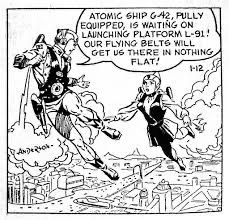
Buck Rogers wearing his flying belt. Vintage comic strip panel.

Eight weeks have passed since I wrote about my Cousin Bernie—and how, posthumously, he adds to my own memories of him. As readers may remember from my last offering, Cousin Bernie’s widow, Joan Hamilton Morris, sent me the pages of an incomplete memoir her late husband pecked out on a vintage typewriter in an adult education class he took after retiring as a university professor of psychology and mathematics.

If Cousin Bernie were alive today he would be 102. Those pages of memoir chapters, some more worn than others, remain in a place of honor, tucked into a corner of my own writing table. I feel that “Cousin Joanie,” as I call his widow, sent them to me for safekeeping—and for presentation to the world. Originally I thought I could do this in one or two chapters. A deeper read has revealed a surprising amount of insight. Here is my fourth take on my cousin, who fascinates me despite his evergreen persona as a nerdy, chubby, lost boy from Brooklyn. There will be a fifth offering and probably a sixth. If it seems Bernie is taking over my memoir, I am fine with this. I have written a lot about my mother’s side of the family. Now it is my father’s family’s turn.  And what better way to bring them into the light, than through Cousin Bernie?

What follows is Cousin Bernie, Part Four. I’ve only edited it slightly, less so I think than his Adult Education teacher. So far, my minor editing has provoked no lightning bolts from the heavens. I have discovered another Bernie, a child who believed he could fly like his comic strip hero.

“I was eight years old, and my sister, Gertie, six. We had just been transplanted to Bridgeport, Connecticut from Brooklyn, New York. My father, a home painter and decorator, felt that he could do better in terms of finding work in a smaller city.

“Here, a whole new set of stimuli presented itself: A Benjamin Franklin stove in the kitchen, a gas water heater in the bathroom, which had to be lighted so we could bathe, and a coal bin on the back porch. There was a scuttle for bringing in coal for the stove. The Saturday Sabbath meal preparations—gefilte fish, stewed chicken and beef, challahs, cookies and pies—began as early as Wednesday night. The stove was banked and allowed to go out on Saturday night.

“We slept as the stove died down and, on Sunday mornings, my sister and I would climb into my parents’ big bed. Pop got up wearing his union suit, put on a robe, removed the ashes, kindled a new fire in the stove and came back to bed with us for my reading of the Sunday comics. My sister, Gertie, pointed to each speech bubble, as I read them. It seemed to me that Andy Gump’s nose or chin was strange looking. I disliked it when the bubbles were long. But it was here in the Sunday comics that I encountered the adventures of ‘Buck Rodgers in the Twenty-Fifth Century.’  Read more »
Monday, December 5, 2011

Comics Creator Column #02: Joey Esposito and “Footprints”

by Tauriq Moosa

DEC111216This week in my Comic Creator Column, I’ll be interviewing and discussing funny book issues with JOEY ESPOSITO. Last week I held a brilliant interview (not because of me but because of her) with the amazing Alex de Campi. You can read that Comics Creator Column #01 here.

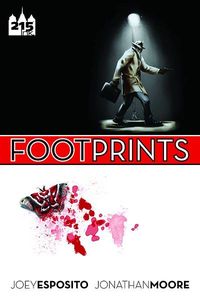
If you have the internet – which I think anyone reading this should – and read comics, chances are you know who this gentleman is. He is Comics Editor at one of the most influential entertainment websites, IGN. He is, more importantly I think, writer on the wonderful comic miniseries FOOTPRINTS, with artist Jonathan Moore, published by 215Iink.

As Joey will explain, Footprints is a wonderful noir tale with a great twist. It’s appropriately violent, compelling and well-plotted. What’s wonderful for me, of course, is that it’s not superheroes but it still involves the supernatural. I’m not a fan of the supernatural in general, being what Americans call a ‘skeptic’, but when used appropriately in fictional stories, it can add a wonderful foil to help us consider reality anew. Esposito wrangles in a tale of fraternity and love betrayed, using creatures so unhuman that it’s a testament to his writing that we come to actually care about ugly, humanoid half-men and horrid, impish creatures.

Please support this wonderful talent, with beautiful artwork by Jonathan Moore, by purchasing the series. Or you can use the first link above to purchase the already sold-out-but-coming-back Trade Paperback of the whole, brilliant series.

Joey also provides some great insights for us aspiring writers – though you’ll see he hates that term. I disagree with him, but, well, you can see for yourself that we just agree on what ‘aspiring’ means. On with the interview…

TAURIQ MOOSA: Who the hell are you and how did you get into my inbox! Police!

SOME GUY: My name is Joey Esposito, I’m the writer of the comic FOOTPRINTS, published by 215 Ink! I’m also the Comics Editor at IGN.com and a huge fan of cats.

TM: Fine. I believe you. So, tell us, Joey – Why should people care about comics?

JE: I think the question is “why shouldn’t they”? Comics have everything. Any genre, any art style, infinite possibilities. I think the most common and unfortunate misconception is that comics only consist of capes and tights. There are even people who refuse to read anything BUT capes and tights. If you say “I love comics” and downright refuse to explore beyond superhero comics, I say you’re a liar. If you give it a shot and PREFER capes and tights, that’s different. That’s fine. My point is, much like everyone can find a movie, TV show or album that they love more than any other, the same is true in comics. There’s a comic book for everybody, I don’t care who you are. It’s just a matter of getting your hands on the right one.

Read more »

Monday, November 21, 2011

Comics Creator Column #01: Alex de Campi and “Ashes”

by Tauriq Moosa


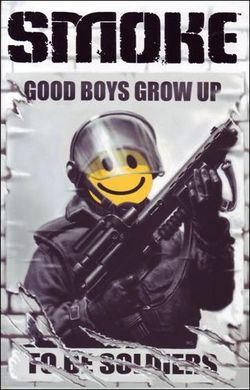
SmokeThis will be the first in, so far, a four-part series where I will be (reviewing the work of and) talking to comics creators. My aim is to provide an insight into the medium and the creative process, as well as exclusive interviews with some of the most talented people in the medium. This is mainly aimed at comic writers, rather than artists since that’s what I am (trying to be). In many instances, this is also an obvious plea for you, the readers, to help support this industry via the very creators who are doing the hard-work to produce quality. If you’re fed up with stagnant stories, stale characters and stereotypes (i.e. so much of the superhero genre), then these are the very people we need to be supporting.

The comics industry is a strange beast. Some view it as squatting in-between word-exclusive prose books and full-motion films. Lately, it has been the latter that’s been appropriating comics’ offspring – with Watchmen, Spider-Man, and The Walking Dead all appearing on the silver or television screen. Yet, viewing comics as nestled in-between prose and films is too simplistic a view of the medium, which has, for too long, become entangled in the webs and capes of superheroes. Indeed, many simply equate the comic medium with the superhero genre, which is like equating fiction books with only Dan Brown’s, um, ‘writing’. This does not mean the superhero genre is bad, but that the medium is not limited to one genre. Whether it’s the horror and drama of Robert Kirkman’s The Walking Dead, Alan Moore’s complex investigation into psychopathy, Jack the Ripper and the history of England in From Hell, Neil Gaiman’s fantastical Sandman, or, my current focus, Alex de Campi’s mature, dystopian and elegantly-narrated Smoke, we have amazing stories wonderfully placed utilising the full extent of sequential art and words.

Comics elicit awe and wonder in the way art as a whole is (sometimes) meant to. It can be as simple as beautiful artwork – open any page of Gaiman and McKean’s Mr Punch to view the genius of Dave McKean – or amazing narration – Jamie Delano’s writing in John Constantine Hellblazer is better than most novels I’ve read. But, truly, it is the mixture of the two that shows what this medium can do. Alan Moore’s work uses everything the page offers to highlight his themes. Whether we are watching the Earth from space, as the narration compares the spinning of the earth to the idea of not having a hold on life (as he did in an issue of Swamp Thing); or whether we are watching a young man read a comic about pirates while, in his reality, men of power try usurp people’s freedom (in Watchmen); Moore and his art team utilise economy of words and illustration to tell powerful stories.

The friction of words and pictures ignites many themes. The trouble is, if not used correctly, it can therefore also completely destroy them.

Read more »