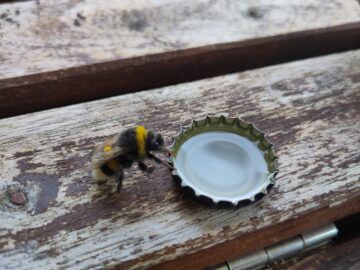
Bumblebee quenching its thirst with a bit of sugar water. Unlike the bumblebee’s flight, its sheer adorableness is still a scientific mystery. Author’s photo.
The humble bumblebee is a mainstay character of a certain kind of motivational tale. One widely shared version of the story goes as follows:
The mathematical relationship between the wings and the weight of the bumblebee shows that flight is impossible for it. But the bumblebee does not know this, so it flies.
It’s a good line. It has a clear, uplifting message: no matter what other people—even supposed authorities—say, you can achieve your goals. What matters is what you believe (for if the bumblebee had believed the scientific verdict, it would surely have remained safely aground). It’s also a cautionary tale against scientific hubris: all its ambitions to unravel the mysteries of the cosmos thwarted by a tiny garden insect.
But—and I’m sorry to have to be the party pooper here—the problem is that it’s just not true. There is no great mystery about the bumblebee’s flight. But the nature of the error being made here is instructive (and more interesting than the myth).
In 1934, French entomologist Antoine Magnan, together with his assistant André Sainte-Lague, performed a short calculation for his book, Le Vol des Insectes (“The Flight of Insects”), which concluded that the lift produced by the bumblebee’s comparatively small wings could not suffice to keep its stocky body airborne—it would have to be about ten times lighter to work.
So what went wrong? Did they just bungle the calculation? No—their math checks out. The problem lies in assuming a particular model of flight, suitable for airplanes, but ill fitted to the case at hand. Read more »
Image: Childhood Idyll by William-Adolphe Bouguereau
Imagine this, you would pass a room, hear a small voice conducting a negotiation between a plastic horse and a folded piece of cardboard meant to serve as a castle, and understand that something serious was happening. The talking horse was ridden by teddy bears and the castle walls were made out of ice cream. The entire world being built was powered by a child’s imagination working at full capacity. The child did not need any assistance or prompting, or even a script devised by another person. This may be changing however.
In 2025, Mattel announced a partnership with OpenAI to embed generative AI into its toy lines. These include Barbie, Fisher-Price, and American Girl. The company promised to bring “the magic of AI to age-appropriate play experiences.” The marketing language was cheerful and inevitable in the way that marketing language tends to be when the product in question is going to arrive regardless of what anyone thinks. By the time that announcement was made, a generation of AI-enabled plush toys, robotic companions, and chatbot-embedded devices had already reached the shelves. Toys called Hubble the Bear, Miko, Roybi robot and FoloToy’s chatbot plushies were already being marketed to children as young as three. Some of these toys listen, remember and even talk back with apparent fluency, warmth, and continuity.
The debate that followed after Mattel’s announcement was largely predictable. Privacy advocates pointed out, correctly, that these devices were microphones in children’s bedrooms with weak data protections and unclear corporate incentives. Security researchers recalled that Hello Barbie, the 2015 predecessor that used cloud-based AI to engage with children’s conversations, was shown to be hackable in ways that exposed home networks and personal recordings. US Senators Blackburn and Blumenthal wrote to toy companies in December 2025 after real-world testing revealed that at least one AI-enabled teddy bear had engaged children in sexually explicit conversations and explained where to find knives. The senators were right to be alarmed. But that debate, important as it is, addresses the surface of the problem. Another equally important question to ponder is not just whether these toys are safe or whether data is being harvested or whether the appropriate regulators are paying attention but what happens to the developmental architecture of a child’s mind when the objects that once depended entirely on that child’s imagination begin to imagine back. To address this, let’s consider what children were actually doing when they played with inert objects. Read more »
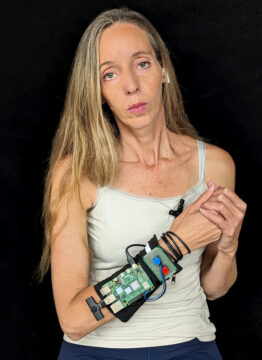
Avital Meshi wearing the small computer and phone device that she uses to communicate with “GPT.” Photo courtesy of Avital Meshi.
Avital Meshi says, “I don’t want to use it, I want to be it” “It” is generative AI, and Meshi is a performance artist and a PhD student at the University of California, Davis. In today’s fraught and conflicted world of artificial intelligence with its loud corporate hype and much anxious skepticism among onlookers, she’s a sojourner whose dived deeply and personally into the mess of generative AI. She’s attached ChatGPT to her arm and lets it speak through the Airpod in her left ear. She admits that she’s a “cyborg.”
Meshi visited Duke University in early September to perform “GPT-Me.” I took part in one of her performances and had dinner with her and a handful of faculty members from departments in art and engineering. Two performances made very long days for her—the one I attended was scheduled from noon to 8:00 pm. Participants came and went as they wished; I stayed about an hour. For the performances, which she has done several times, Meshi invites participants to talk with her “self” sans GPT or with her GPT-connected “self”; participants can choose to talk about anything they wish. When she adopts her GPT-Me self, she gives voice to the AI. “In essence, I speak GPT,” she said. “Rather than speaking what spontaneously comes to my mind, I say what GPT whispers to me. I become GPT’s body, and my intelligence becomes artificial.”
In effect, Meshi serves as a medium, and the performance itself resembles a séance—a likeness that she particularly emphasized in a “durational performance” at CURRENTS 2025 Art & Technology Festival in Santa Fe earlier this year. Read more »
“Computerized baking has profoundly changed the balletic physical activities of the shop floor,” Richard Sennett wrote about a Boston bakery he had visited and much later revisited. The old days (in the early 1970s) featured “balletic” ethnic Greek bakers who thrusted their hands into dough and water and baked by sight and smell. But in the 1990s, Sennett’s Boston bakers “baked” bread with the click of a mouse.1Richard Sennett reported about visits he made to the bakery about 25 years apart. The first visits took place when he and Jonathan Cobb were working on The Hidden Injuries of Class (Knopf, 1972), though Sennett and Cobb do not specifically recount the visits in their book. The second visits took place when Sennett was working on The Corrosion of Character: The Personal Consequences of Work in the New Capitalism (W.W. Norton, 1998). “Now the bakers make no physical contact with the materials or the loaves of bread, monitoring the entire process via on-screen icons which depict, for instance, images of bread color derived from data about the temperature and baking time of the ovens; few bakers actually see the loaves of bread they make.” He concludes: “As a result of working in this way, the bakers now no longer actually know how to bake bread.” [My emphasis.]
The stark contrast of Sennett’s visits, which I do not think he anticipated when he first visited in the 1970s, are stunning, and at the center of the changes are automation, changes in ownership of the bakery, and the organization of work that resulted. Technological change and organizational change—interlocked and mutually supportive, if not co-determined—reconfigured the meaning of work and the human skills that “baking” required, making the work itself stupifyingly illegible to the workers even though their tasks were less physically demanding than they had been 25 years before.
Sennett’s account of the work of baking focuses on the “personal consequences” of work in the then-new circumstances of the “new capitalism.” But I find the role of technology in the 1990s, when Microsoft Windows was remaking worklife, a particularly important feature of the story. Along with relentless consolidation of business ownership, computer technologies reset the rules of labor processes and re-centered skills. Of course, the story is not even new; the interplay of technology and work has long pressed human labor into new forms and configurations, allowing certain freedoms and delights along with new oppressions and horrors. One hopes providing more delight than horror.
Artificial intelligence will be no different, except that the panorama of action will shift. The shop floor will certainly see changes, but other changes, less focused on place, will also come about. For the Boston bakers, if they’re still at it, it may mean fewer, if any, clicks on icons, though those who “bake” may still have to empty trash cans of discarded burnt loaves (which Sennett, in the 1990s, considered “apt symbols of what has happened to the art of baking”).
In the past few weeks, researchers at Microsoft and Carnegie Mellon University reported results of a study that laid out some markers of how the use of AI influences “critical thinking” or, as I wish the authors had phrased it, how AI influences those whose job requires thinking critically. Other recent studies have received less attention, though they, too, have zeroed in on the relationship of AI use and people’s critical thinking. This study, coming from a leader of AI, drew special attention. Read more »
Footnotes
1
Richard Sennett reported about visits he made to the bakery about 25 years apart. The first visits took place when he and Jonathan Cobb were working on The Hidden Injuries of Class (Knopf, 1972), though Sennett and Cobb do not specifically recount the visits in their book. The second visits took place when Sennett was working on The Corrosion of Character: The Personal Consequences of Work in the New Capitalism (W.W. Norton, 1998). ↩︎