
by Charles Siegel
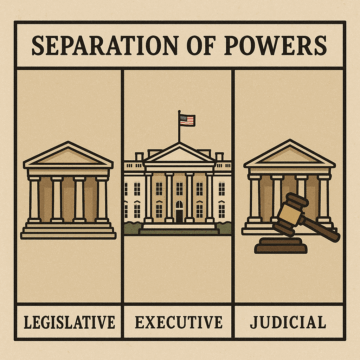 Americans learn about “checks and balances” from a young age. (Or at least they do to whatever extent civics is taught anymore.) We’re told that this doctrine is a corollary to the bedrock theory of “separation of powers.” Only through the former can the latter be preserved. As John Adams put it in a letter to Richard Henry Lee of Virginia, later a delegate to the First Continental Congress, in 1775: “It is by balancing each of these powers against the other two, that the efforts in human nature toward tyranny can alone be checked and restrained, and any degree of freedom preserved in the constitution.” As Trump’s efforts toward tyranny move ahead with ever-greater speed, those checks and balances feel very creaky these days.
Why do we care? What “balance” is to be preserved? “Separation of powers” is a defining concept of our government. But the phrase itself does not appear in the Constitution. What does it mean?
There is no official answer, of course. But Congress has provided a definition: at its direction, every ten years the Library of Congress publishes the “Constitution Annotated,” a “comprehensive, government-sanctioned record of the interpretations of the Constitution” that appears on Congress’ website. According to the Librarian of Congress, then, “separation of powers” is a “well-known concept derived from the text and structure of the Constitution. The Framers’ experience with the British monarchy informed their belief that concentrating distinct governmental powers in a single entity would subject the nation’s people to arbitrary and oppressive government action. Thus, in order to preserve individual liberty, the Framers sought to ensure that a separate and independent branch of the Federal Government would exercise each of government’s three basic functions: legislative, executive and judicial.” The Constitution sets those powers out in Articles I, II and III respectively.
The Constitution Annotated also quotes James Madison’s statement in the Federalist Papers (no. 48) that “the accumulation of all powers, legislative, executive and judiciary, in the same hands, whether of one, a few, or many, and whether hereditary, self-appointment, or elective, may justly be pronounced the very definition of tyranny.” Professor Erwin Chemerinsky, a prominent liberal legal scholar and currently the Dean of the U.C. Berkeley Law School, wrote in the first paragraph of the first edition of his treatise on constitutional law that “the division of powers among the branches was designed to create a system of checks and balances and lessen the possibility of tyrannical rule.”
The Supreme Court, of course, has had plenty to say about separation of powers over the years. In 1803 in Marbury v. Madison, still the first case most law students read in the first week of law school, the Court held that the judicial branch has the power to strike down acts of the legislative and executive branches. In 1986 the Court stated that “even a cursory examination of the Constitution reveals the influence of [the] thesis that checks and balances were the foundation of a structure of government that would protect liberty.”
How is that division of powers faring now? Is it lessening the possibility of tyrannical rule? It doesn’t feel that way. Just last year, in its infamous decision bestowing on Trump near-blanket immunity from prosecution, the Court held that “the President is not above the law. But Congress may not criminalize the President’s conduct in carrying out the responsibilities of the Executive Branch under the Constitution. And the system of separated powers designed by the Framers has always demanded an energetic, independent Executive.” Well, that they most certainly have now.
That case, of course, was decided before Trump won the 2024 election (and the decision, and the great length of time the Court took to make it, helped him immensely in winning it). Since then, the administration has taken scores of measures to expand executive power far beyond its traditional sphere. Sadly, the other two branches have largely acquiesced in this unprecedented power grab.
Consider the legislative branch’s abject surrender. One obvious example is the ridiculously unqualified nominees the Senate has confirmed. Republican senators confirmed a Fox News weekend host with a drinking problem, who had paid to settle sexual-assault allegations, as Secretary of Defense. They confirmed a conspiracy theorist, with well-known sympathy for Putin and Assad, as Director of National Intelligence. And they confirmed a former heroin addict who doesn’t believe HIV causes AIDS, and who regularly disparages vaccines, as Secretary of Health and Human Services. Yes, they put him in charge of health.
Do Republican senators even think they have a role anymore? Is there anyone they would not vote to confirm? (They were spared from having to vote on Matt Gaetz’s nomination to be Attorney General, which only resulted in them unanimously voting to confirm Pam Bondi, whose main qualification for the job was her vocal support for Trump’s false claim that there was widespread fraud in the 2020 election.)
Beyond confirming his appalling nominees, in many other contexts Congress – and by “Congress,” of course, I mean Republicans, since they control both houses – has simply done nothing, while Trump does whatever he wants. For example, only Congress can fund the government. Yet Trump has simply frozen billions of dollars in federal grants – money that has already been committed by Congress. The legislative branch has ordered that the money be spent, but the executive branch simply won’t spend it.
The Washington Post reported three weeks ago that “the administration is preparing to test a 1974 budget law by refusing to spend congressionally mandated funds — an escalation that could change the balance of power between Congress and the White House….The administration appears to be readying to push the boundaries of the law meant to prevent the president from unilaterally overturning spending decisions made by Congress.” And on June 30th the administration simply impounded $7 billion of Department of Education funding for after-school and summer programs, teacher training and other projects. This money had already been appropriated by Congress, but the DOE head, former wrestling CEO and current “Ring Boys” sexual-abuse defendant Linda McMahon, didn’t even bother to offer an explanation. Why would she?
Another dismal example is the destruction of the Agency for International Development. It was just a few months ago that Elon Musk, beginning his stint as the head of DOGE, gleefully chirped on X that “we spent the weekend feeding USAID into the wood chipper. Could have gone to some great parties. Did that instead.” A study published two weeks ago in the Lancet estimates that 14 million additional deaths will result, in the next five years alone, from the loss of agency programs, so roughly 15,000 people will die every weekend while the DOGE bros party. The Trump administration might as well have deliberately engineered a new global pandemic. The day after the study was published, Secretary of State Rubio grotesquely posted that “the era of government-sanctioned inefficiency has officially come to an end. Under the Trump administration, we will finally have a foreign funding mission in America that prioritizes our national interests.”
The horrific human toll, of course, is the worst part. But the implications of USAID’s gutting for our system of government are grim too, for it couldn’t have happened without Congress’ silent acquiescence. Congress created the statutory authority for USAID in 1961, at President Kennedy’s urging. It has since continuously reaffirmed its support for the agency; in fact, just 16 months ago Congress increased its funding.
Only Congress can create or destroy federal agencies. Yet there hasn’t been a word from Congress since Musk fired up his wood chipper. No hearings, no subpoenas, nothing. Some Democrats gave speeches denouncing it, but not a peep from Republicans. No wonder Trump thinks, less than halfway through the first year of his term, that he can do anything.
And then there’s TikTok. Last year Congress passed, with wide bipartisan support, a law that requires the app’s ownership structure to change so that it is no longer controlled by ByteDance, a Chinese company. The law was based on national security concerns, and the Supreme Court upheld it in January. Yet Trump has now granted three extensions of the deadline for the change in ownership. It has been widely noted that while Trump tried unsuccessfully to ban TikTok during his first term, he completely changed his stance after meeting with Jeffrey Yass, one of his largest megadonors, during the 2024 campaign. Yass just happens to own a 15% share in ByteDance.
Letters that Attorney General Bondi sent to the major tech companies regarding their continuing business with TikTok were disclosed last week through a Freedom of Information Act request. These letters purport to “irrevocably relinquish any claims” against the companies for violating the law during the non-enforcement periods declared by Trump. “For my friends, everything; for my enemies, the law.”
Last month, the New York Times quoted Alan Rozenshtein, a former national security adviser to the Department of Justice and now a law professor at the University of Minnesota: “This is just a wild situation that we’re in – the president has essentially nullified a law because he doesn’t like it.” In a post last week on the Lawfare blog, he called it a “major rule-of-law crisis” that illustrates this administration’s imperial conception of itself.” The primary argument advanced in the letters is one Rozenshtein calls “astonishing in its breadth and implications for executive powers.” Trump is said to have determined that a shutdown of TikTok would “interfere with the execution of his constitutional duties to take care of the national security and foreign affairs of the United States.” As Rozenshtein puts it:
The executive branch is asserting that if a president determines that a duly enacted statute is inconvenient for the conduct of foreign affairs—and that’s assuming this is about a good-faith view of foreign policy, and not, say, the financial interests of a major campaign donor with a massive stake in TikTok’s parent company—he can simply set it aside. This interpretation effectively creates a foreign-affairs exception to the President’s duty to “take Care that the Laws be faithfully executed.” This argument conveniently ignores that Congress has its own significant, constitutionally enumerated powers in the realm of foreign affairs. The law falls squarely within Congress’s power to “regulate Commerce with foreign Nations,” a core legislative function under Article I. The logic of Bondi’s letters suggests that this power exists only at the sufferance of the president. Whenever a president finds a congressional commercial regulation to be an obstacle to his foreign policy goals, he can, by this reasoning, simply ignore it. Today it’s a social media app; tomorrow it could be any number of sanctions, trade, or immigration provisions that a president unilaterally decides to ignore based on some generic assertion of foreign affairs authority.
Any number of further examples could be cited. Just the cases involving indiscriminate firings in various government agencies could provide several of them. Everything from the State Department to the Consumer Financial Protection Bureau to OSHA.
A federal judge in San Francisco blasted DOJ lawyers for making unfounded arguments in one of the cases about mass firings. The government, she said, wanted her “to either declare that nine presidents and 21 Congresses did not properly understand the separation of powers, or ignore how the executive branch is implementing large-scale reductions in force and reorganizations.” She entered a preliminary injunction against the mass terminations, while allowing individual agencies to present reorganization proposals to Congress.
And what of the third branch? So far, lower court judges have been doing their level best to address the more than 400 suits that have been brought challenging the administration’s actions. Many of those actions have been halted or significantly pared down. These rulings have been made by judges nominated by presidents of both parties, including Trump.
The Supreme Court, however, has for the most part adopted the same posture as Congress – which is to say supine. Last week the Court vacated the San Francisco judge’s injunction, largely deferring to Trump. Most lamentably, though, the Court is undermining the judicial branch’s own coequal status. I will demonstrate how in part 2 of this column next month.