
by Leanne Ogasawara
1.
Standing before Bosch’s Garden of Earthly Delights in the Prado is an act of surrender. Eyes are consumed by details: naked bodies cavorting in crystalline ponds, human-sized strawberries and a multitude of dripping cherries. There are birds devouring humans, whilst cities are collapsing into flames at the far edge of vision. Each figure is rendered with miniature precision, yet together they overwhelm, producing an excess that resists containment.
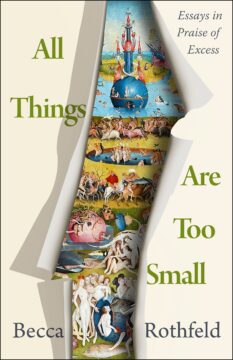
Bosch offers no single story; the painting’s power lies in its refusal to be reduced. It is “too much”—and therein lies its meaning. I was not surprised, therefore, to find details from the painting on the cover of Becca Rothfeld’s 2024 book All Things Are Too Small: Essays in Praise of Excess. I had heard so much about this book before finally picking up a copy. Offering a strong critique of our contemporary aesthetics of minimalism, I thought it was a perfect book to pack for my summer of writing. First, working on a novel manuscript at two writers’ residencies, one in Vermont and the next in Virginia, I then made my way to the Sewanee Writers’ Conference and then to Bread Loaf. It was two-and-a-half months living out of a small suitcase with that one book along for the ride– in hardcover, of course.
From Marie Kondo’s call for us to “take out the trash” –where trash is defined as anything we are not currently using and enjoying– to the multi-million-dollar mindfulness industry, which similarly sells ways for us to de-clutter, Rothfeld’s book asks us to consider that less is not always more.
Sure, sometimes it is.
Especially for Americans whose lives do so often seem to be spinning out of control, not least of all because of all the stuff we endlessly buy and throw away, by all the choices we have, and how these endless choices seem to define who we are. Maybe for people constantly loading up at Costco and traveling overseas several times a year, with households with so many moving parts, a car per person, Kondo’s style of clean consumerism can feel like a relief, of sorts. I get it. Read more »