
by Mark R. DeLong
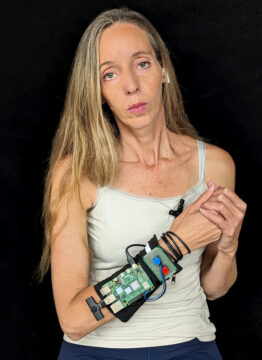
Avital Meshi says, “I don’t want to use it, I want to be it” “It” is generative AI, and Meshi is a performance artist and a PhD student at the University of California, Davis. In today’s fraught and conflicted world of artificial intelligence with its loud corporate hype and much anxious skepticism among onlookers, she’s a sojourner whose dived deeply and personally into the mess of generative AI. She’s attached ChatGPT to her arm and lets it speak through the Airpod in her left ear. She admits that she’s a “cyborg.”
Meshi visited Duke University in early September to perform “GPT-Me.” I took part in one of her performances and had dinner with her and a handful of faculty members from departments in art and engineering. Two performances made very long days for her—the one I attended was scheduled from noon to 8:00 pm. Participants came and went as they wished; I stayed about an hour. For the performances, which she has done several times, Meshi invites participants to talk with her “self” sans GPT or with her GPT-connected “self”; participants can choose to talk about anything they wish. When she adopts her GPT-Me self, she gives voice to the AI. “In essence, I speak GPT,” she said. “Rather than speaking what spontaneously comes to my mind, I say what GPT whispers to me. I become GPT’s body, and my intelligence becomes artificial.”
In effect, Meshi serves as a medium, and the performance itself resembles a séance—a likeness that she particularly emphasized in a “durational performance” at CURRENTS 2025 Art & Technology Festival in Santa Fe earlier this year.
“Betwixt and between”
The connection of technology and some manner of spirit world is hardly new. In a journal entry from September 12, 1851, Henry David Thoreau rhapsodized about the telegraph, its wires then beginning to stretch across the landscape. While on a hike, Thoreau “heard the telegraph wire vibrating like an AEolian Harp. It reminded me suddenly … of what finer & deeper stirrings I was susceptible—which grandly set all argument and dispute aside—a triumphant though transcient exhibition of the truth.” Later in the entry, Thoreau wrote that “the wind which was conveying a message to me from heaven dropt it on the wire of the telegraph…. It merely said ‘Bear in mind, Child—& never for an instant forget—that there are higher plains of life than this thou art now travelling on.” Thoreau’s enthusiasm for the music of the telegraphic AEolian Harp was relatively restrained in comparison to others of the age, who adopted the metaphor and vocabulary of the telegraph and applied them to spiritualism.
Seventy years after Thoreau was transported by singing telegraph wires, Thomas Edison announced, “I have been at work for some time, building an apparatus to see if it is possible for personalities which have left this earth to communicate with us.” Edison was probably serious in his hope for such an apparatus. Of course, the age had much spiritualist humbuggery, too. And the humbuggery has refreshed with each generation, each new communication technology. Wired‘s Webb Wright recently reported on the mixing of AI and new spiritualism: “A growing number of prominent social media figures are now co-opting the language of New Age spirituality, wellness, and quantum woo to position AI as a gateway to numinous wisdom, through which their followers can inch closer to enlightenment,” Webb writes. That isn’t surprising, I guess, since Sam Altman, guru of OpenAI, has referred to his company’s products as “magical intelligence in the sky.”
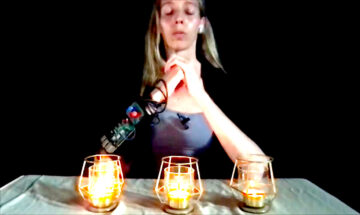
New technologies have seemingly magical and even otherworldly powers. Although their magic dims, they are transformative, shaping human society and individuals.
Even before I met Meshi, I was most interested in the space between Avital-Meshi-the-Human, and the manifestation conjured through the portable device that animated her GPT. That space, strung through ethernet and fiber cables to whisper into her ear, makes up a boundary of sorts that Meshi and GPT pass through, translating or transitioning utterances and embodying experience that GPT obviously lacks. In a sense, the boundary separating Meshi’s Airpod from her human mind is also a passageway, a transition; and I would say it’s the place where the greatest challenges of AI arise.
Such challenges have ended in breakdowns, even tragedy, in cases that popular culture has labeled “AI psychosis,” which is not a bona fide clinical diagnosis. Delusions and bad decisions can arise from too much engagement with chatbots, and people with psychological issues are probably particularly at risk. (See the bibliographical notes below for two good articles on the “AI psychosis” phenomenon.) For Meshi, however, frequent use of GPT is part of her art and her doctoral project, a circumstance that might insulate her from delusions. Her extended use—not 24/7/365, she assured me—has given her a new perspective on the influences of GPT on her own individuality and on her society. She also said that the project has improved her English.
“I stopped understanding what it means to be me,” Meshi said at one point during her performance. “I feel like this was one of the things that I learned from this project. … Why do I say the words I say? What kind of data was I trained on?”
“Have you felt like you have like lost your sense of self in this art?” asked a participant.
“I think I had an illusion of self before and now I feel like I understand that I don’t trust the self as I did before,” Meshi replied. “So yeah, and it’s not necessarily a bad thing. It’s okay, you know, to understand that the self is also a construct.” And it is fluid, an evolving construct: “My thoughts and expressions are never solely mine; they have been shaped by a myriad of factors and inputs, as claimed by Bruno Latour: ‘No one knows how many people are simultaneously at work in any given individual,’ ” she explained in an article about GPT-Me.
She’s noticed as well that tethering GPT to her life has changed some people’s relationships with her. “One of my earliest encounters while wearing it was with the train conductor, who half-jokingly inquired if I intended to hack the train or blow it up with this device,” she wrote in the article on GPT-Me. “I noticed that many people glance at the device with curiosity when I pass by. In social settings, the device often becomes a topic of discussion.”
For some, like the train conductor, the mere presence of the device affects the relationship; for others, the functional effects of the device—imagined or not—are noteworthy, even disturbing. In her performance, Meshi said that her husband is “not willing” to interact with her when she’s wearing the device, though she observed that “every now and then he would say ask this or ask that or do this or do that. But he would not have a conversation with me as GPT-Me.” Meshi’s sister responded to GPT-Me quite negatively, even trying to “break GPT” at one point. “She tried to do that when it was attached to my body,” Meshi recalled. “I felt as if she was forgetting that it’s also me and not just GPT. So I had to remind her that I’m sitting in front of her. It’s not just GPT. And she said, ‘No, it’s not you. I do not recognize you.’ But it was me, at least partially.”
The space between human Avital Meshi and composite “GPT-Me” is, in a word, liminal. By using AI for long periods and serving in a role of performing artist and as a researcher, Meshi stands between two worlds. She places her “self” betwixt and between: Between consciousness and the non-conscious (or, more charitably, the other-conscious). Between a complex of cues, inner conditions, intent—all conscious or not—in human language and utterances statistically extracted from a data corpus. Between time-bound life and timeless compilation and summation. Between remaining a detached and observant researcher and becoming a being who is enveloped, inundated by an Other.
Meshi’s art performs the liminality, though perhaps it is most apparent to her as the artist. Her in-betweenness captures in some way and in a personal space the kinds of passage that most of us find ourselves in. For those of us who use AI experience a certain amazement and, perhaps after a while, a certain apprehension. Even with our haphazard and intermittent use of ChatGPT, Gemini, Claude, or Mistral, we might think, “What deal has been struck in rubbing the lamp and letting the genie out?”
When you look at work that is presented as generative AI art or as a collaboration of artist and an AI of some kind, it is quite easy to fall into the trap of trying to answer the question “But is it art?” I’ve led classes where that question has been batted back and forth across the seminar table, often with some eloquence and good, clear thinking, though also (thank goodness) without a final and clear resolution. Of greater interest—and I think relevance to human life and understanding—is the gap between our purportedly intelligent creations and our own human intelligences. The artistic space in GPT-Me resides in the ambiguous difference, a metaphorical “space” that every relationship between close human beings confronts and, with work and luck, bridges. We do that with language, of course, but perhaps even more fully we communicate with our bodies and our gestures and our silences. In that space “between” emerges some semblance of meaning and (at least personal) truth.
Avital’s project envelopes an artificial intelligence within her own, and yet the process of performing her art consistently reveals—at least to her own intelligence—a space to be bridged, probably uniquely with every exchange. In dialogue with a created intelligence, she shapes an artwork. That artwork presses its image into her own consciousness.
Artist as artwork?
What is the art of GPT-Me? Meshi sees her work as “a relational art … a performative thing.” When she said that to me during the performance, she drew her hand before her, as if to embrace the room in gesture. She is a performance artist, surely, and the event in the Ruby Lounge last Tuesday can be counted as a performance: unique in itself and drawn together by an artist who composes the performance from unique settings and individual participants who take part but once.
Yet, this peopled environment of the Ruby Lounge wasn’t the only artistic canvas at work. The nature of GPT-Me also pushes Avital Meshi forward as an artwork.
While the self-presentation of some artists complements their artistic output, in the twentieth century (at least) the quirks and performances of artists can appear more marketing than art. Think of Salvador Dalí or Andy Warhol, whose personae annoyed and delighted but also served as attention-getting markers for their art. Indeed, Warhol more than most modern artists blurred the distinction between artwork and promotion, the works for the marketplace. Still, one can own a Warhol print that stands on its own without its creator’s hype; the artist and the artwork are linked though separate. But some artists have turned themselves into their artwork, and Meshi may stand among them, sculpting (or submitting) her consciousness, her inner core humanity, to the nudges, seductions, and confabulations of a Large Language Model.
Marcel Duchamp chose an alterego, “Rrose Sélavy,”1The extra “R”? It’s there for a reason. Duchamp’s alterego originally bore the first name “Rose,” but as the curators at the Philadelphia Museum of Art explain, “She [Rrose] eventually added an extra “R,” becoming Rrose Sélavy, a play on the French phrase ‘Eros, c’est la vie’—meaning ‘Eros [or Love/Sex], that’s life.'” The Museum has a copy of Man Ray’s portrait of Rrose, which is also viewable online. in effect creating an artistic partner—a performative extension of himself, not itself an alteration of himself qua himself. Rrose was, in effect, another canvas for Duchamp to use.
More profoundly transformative performance art uses the body of the artist. ORLAN’s “Carnal Art” is among the most shocking examples. ORLAN (née Mireille Suzanne Francette Porte) created The Reincarnation of Sainte-ORLAN in a series of plastic surgeries undertaken between 1990 and 1993. The work “was about using surgery but upending its usual goals of improvement and rejuvenation,” ORLAN explained in an interview in 2019. “The most visible change is the implants which normally enhance cheekbones but which I had put on each side of my forehead, forming two lumps…. The more that technology is involved, the more we wonder what will become of humans and the body in amongst all of that. My work isn’t a warning about the body. I am, above all, an artist, and it mattered to me to say something radical about the representation of the body.” ORLAN’s “Carnal Art Manifesto” says, “Carnal art is not interested in the plastic-surgery result, but in the process of surgery, the spectacle and discourse of the modified body which has become the place of a public debate” (my emphasis).
While not nearly as shockingly confrontational as ORLAN’s “reincarnation,” Meshi’s GPT-Me plays upon the public’s fascination with and deep apprehension about AI. The spectacle and discourse of human behaviors and beliefs modified by generative AI have also become a place of public debate. With the general anxiety among creative artists, laborers, working people of all kinds, citizens, and parents who feel trapped in worries of exposing their children to not enough and too much AI (for example), Meshi physically attaching herself to an AI—indeed merging with it, in cyborg fashion—looks at least daring, if not a bit reckless.
The fear: Such extreme engagement that blurs who is talking at a GTP-Me performance also threatens to blur who Avital Meshi “is.” I believe the perspectives of artists are indeed valuable as we contend with our relationship as humans to the non-human AI. Artists, not their engineering brethren, may in fact save us from becoming machines. They may open new spaces to explore. They may help us become more human.
Robert Saltzman, a psychoanalyst and artist, closes a recent essay in The Hedgehog Review this way, and his words seem a good summing up:
Let the machine speak. Let it echo our syntax, perform selves, mirror the shape of meaning. It won’t be stopped, and perhaps it shouldn’t. But let’s not forget:
There is a difference between fluency and feeling.
Between output and presence.
Between a mask that speaks and a face that breaks.We were never what we thought we were.
But we were never machines.
For the bibliographically curious: Avital Meshi’s personal website is https://www.avitalmeshi.com/. Two of her publications are particularly relevant to this essay: Avital Meshi, “GPT-ME: A Human-AI Cognitive Assemblage,” Proc. ACM Comput. Graph. Interact. Tech. 7, no. 4 (2024): 55:1-55:8, https://doi.org/10.1145/3664214 and Meshi, Avital, and Adam Wright. “In(A)n(I)Mate – AI-Mediated Conversations with Inanimate Objects.” Proc. ACM Comput. Graph. Interact. Tech. 8, no. 3 (2025): 36:1-36:6. https://doi.org/10.1145/3736787. Two recent articles on “AI Psychosis”: Webb Wright, “Spiritual Influencers Say ‘Sentient’ AI Can Help You Solve Life’s Mysteries,” Wired, September 2, 2025, https://www.wired.com/story/spiritual-influencers-say-sentient-ai-can-help-you-solve-lifes-mysteries/ and Miles Klee, “Should We Really Be Calling It ‘AI Psychosis’?,” Rolling Stone, August 31, 2025, https://www.rollingstone.com/culture/culture-features/ai-psychosis-chatbot-delusions-1235416826/. The journal entry from September 12, 1851 is on pages 75-76: Henry David Thoreau, Journal, ed. John C. Broderick et al., 4: 1851-1852, The Writings of Henry D. Thoreau (Princeton University Press, 1981), Internet Archive, https://archive.org/details/journal0004thor/mode/1up. This article helps to understand a way that performance art works: Kyle Chayka, “WTF Is… Relational Aesthetics?,” Hyperallergic, February 8, 2011, https://hyperallergic.com/18426/wtf-is-relational-aesthetics/. “We may be approaching a time when the illusion of selfhood is strengthened, not weakened, because we are surrounded by machines enacting it.” A thoughtful, even poetic, essay on AI and the self: Robert Saltzman, “The Self That Never Was,” The Hedgehog Review, June 16, 2025, https://hedgehogreview.com/web-features/thr/posts/the-self-that-never-was.
Enjoying the content on 3QD? Help keep us going by donating now.
Footnotes
- 1The extra “R”? It’s there for a reason. Duchamp’s alterego originally bore the first name “Rose,” but as the curators at the Philadelphia Museum of Art explain, “She [Rrose] eventually added an extra “R,” becoming Rrose Sélavy, a play on the French phrase ‘Eros, c’est la vie’—meaning ‘Eros [or Love/Sex], that’s life.'” The Museum has a copy of Man Ray’s portrait of Rrose, which is also viewable online. ↩︎