
by David Hoyt

Reading the Boghossian report on current state of the humanities in American higher education I was, as I am sure were many others, struck with a sense of déjà vu. Relativism versus realism, an irresponsible academic left versus a scolding academic right, even the same malefactors singled out, as if a cold case from the 1990’s had been exhumed by a prosecutor determined to win the conviction that had escaped them years ago. A few admittedly cringe-worthy declarations of the subjective basis of all thought, together with Inquisitorial assertions of a single truth as the measure of all knowledge lend the document a theological tenor. And as history shows, theological debates tend to conclude only when both parties exhaust themselves and the terms of the debate are somehow shifted. Until this happens, skirmishes such as this one will probably continue to flare up along an ontological front drawn a little more than a century ago, in the context of similar cultural battles, and on either side of which stand opposing models of language.
Those opposing models, based on a then-emergent “ontological Yalta” (the phrase is French anthropologist Philippe Descola’s) between the sciences of nature and the sciences of culture, a sort of Great Divide between Nature and Spirit, emerged across an axis running between Vienna-Prague and Paris-Geneva at the turn of the 20th century. They shared a similar negative relation to the intellectual world of the previous hundred years, as well as a certain methodological orientation emphasizing logical coherence freed of and independent of historical determinations. The study of language, which had underwritten the historicism of the 19th century on the basis of comparative grammar, was being reworked and tested for its potential to provide a theoretical framework for the practice and meaning of science itself.
In light of the Boghossian report’s concern with what it claims is the politicization of scholarship in the humanities, it is important to recognize that what took shape in Saussurian linguistics and the philosophical enterprise of the Vienna Circle in the first three decades of the 20th century were two explicitly political projects. Read more »
 In 1984 when Ronald Reagan was re-elected president of the United Staters I asked myself: how is this possible? How was it possible that an ignorant but affable B-rated actor who continually confused his role in Hollywood films with historical reality and his own experience, and whose mental capacity was clearly on the decline, get re-elected president? How did his “
 Javier Milei’s libertarian government in Argentina recently laid out a new


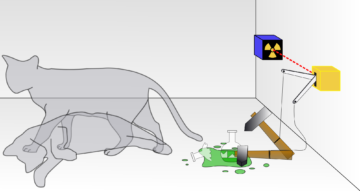
 My cat died of pancreatic adenocarcinoma a few weeks ago. In March she had an annual check up and was deemed to be in good health for 13, although a bit overweight. We noticed that she was walking a little funny sometimes, so the vet suggested we think about arthritis medication. Then one day in May, just before our appointment to start meds for her suspected arthritis, she went into hiding. A more in-depth vet appointment discovered that her changed gait wasn’t from her joints, but from a huge abdominal mass. It took some tests to find out what it was, then came the dreaded decision-making about what to do about it. Apparently cats can live for months with the condition but often with a very dismal quality of life.







 The Republican Party has forever faced a serious statistical obstacle: There are always more Democrats. Never once since the GOP was founded in 1854 have there been more registered Republicans than Democrats in the United States. Democrats are always more numerous. So how can Republicans win?