by Brooks Riley

Enjoying the content on 3QD? Help keep us going by donating now.

 Dear Readers and Writers,
Here’s your chance to say what you want to the large number of highly educated readers that make up 3QD’s international audience. Several of our regular columnists have had to cut back or even completely quit their columns for 3QD because of other personal and professional commitments and so we are looking for a few new voices. We do not pay, but it is a good chance to draw attention to subjects you are interested in, and to get feedback from us and from our readers.
We would certainly love for our pool of writers to reflect the diversity of our readers in every way, including gender, age, ethnicity, race, sexual orientation, etc., and we encourage people of all kinds to apply. And we like unusual voices and varied viewpoints. So please send us something. What have you got to lose? Click on “Read more »” below…
by David Kordahl

When I was a physics graduate student at Arizona State, one of my fellow grad students had a roommate who, after obtaining an undergraduate business degree, got a job as an office assistant for an economics professor. The roommate (remember, not a grad student) was earning like a young professional, not a wizard’s apprentice. “You know what he’s doing this week?” the grad student told us during a typical lunchtime rant. “He’s downloading files one by one from a dot-gov website and copying them into spreadsheets. A week of work, for what I could write as a five-minute script! And he’s getting $60,000 a year for this!”
Whether or not $60,000 sounds like a lot of money depends on one’s position. My whole life, I have seen claims the median physics B.S. graduate makes that much, but I personally didn’t make $60,000 until my third year as an assistant professor—and, even then, only after getting another job and negotiating a raise.
Science Nonfiction: Behind the Scenes in University Research, the new memoir from Dr. Darren Lipomi, chair of the Department of Chemical and Sustainability Engineering at the University of Rochester, addresses such issues bluntly—until it doesn’t. “There is a fair case to be made that the financial burden of research is borne not by the taxpayer,” Lipomi writes, “but by the ‘forever trainee’—the twenty-two-year-old PhD student who becomes a postdoctoral scholar at twenty-nine, and an untenured research scientist at thirty-four.” But now in his mid-forties, having more or less figured the system out, Lipomi is doing better than fine, and his memoir charts an uneasy path between celebration and critique. Read more »
by Rafaël Newman
 About ten years ago, I received an invitation to coffee from a fellow I hadn’t seen in a while. At the time, Rolf Kuhn was teaching English at a middle school in the nearby town of Baden; our acquaintance was the result of our frequenting the same English-language bookstore—Pile of Books, still run in those days by our common friend Dani Nufer—in Zurich, where we both lived. The gap in our regular contact had been due to a caesura in my personal life, which had occasioned a lengthy stay abroad, and did not reflect any deterioration of our friendship.
We met, at Rolf’s suggestion, at a place called Chez Marion, across from Zurich’s central library and just up the slope from Rudolf Brun Bridge over the Limmat. Chez Marion, which has since ceded its location to a schnitzel restaurant, was a French bistro in the evenings and an old-fashioned Zurich café by day, with curtains in the windows and frilly paper round the stems of tea glasses. Just the place for a chat with a Swiss teacher approaching retirement, I thought.
And indeed, the coming change in Rolf’s employment status soon came up, and I asked him what he was planning on doing with his free time.
“I’m going to break into the testing center at a Big Pharma company,” he responded without hesitation, “and free all the lab animals.”
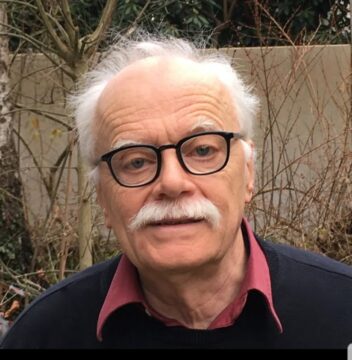
This wasn’t the answer I had been expecting to hear, from a white-haired Swiss burgher in such well-mannered surroundings. But I really shouldn’t have been surprised. After all, in the late 1990s and into the early years of the new millennium, while working at the middle school and in accordance with Switzerland’s Milizprinzip, which envisions politics as a part-time job to be performed not by professional legislators but by specialists in a variety of trades, Rolf had served in Zurich’s city parliament, or Gemeinderat, where he represented the Socialist Party and spoke up frequently on issues of social justice and environmental protection. Furthermore, one of the occasions on which he and I had first met, years earlier, at Dani’s bookshop was the time I performed an acoustic set there with The NewMen, a country-punk outfit for which I once provided lyrics and vocals—and Rolf’s enthusiasm for our rough-and-ready show that evening had been wholehearted. Finally, if only symbolically, with his walrus moustache and rugged good looks Rolf could have passed as the long-lost brother of Georges Brassens, France’s celebrated anarchiste punk troubadour, whose most notorious ballad, “Le gorille,” features an animal escaping from confinement to wreak havoc among the hypocritical patrons of a zoo… Read more »
 Sughra Raza. Self Portrait In Early Morning Reflected Light. Boston, June 2026.
Digital photograph.
Enjoying the content on 3QD? Help keep us going by donating now.
by Michael Liss
[I]t was the first solemn declaration by a nation of the only legitimate foundation of civil government. It was the corner stone of a new fabric, destined to cover the surface of the globe. It demolished at a stroke the lawfulness of all governments founded upon conquest. It swept away all the rubbish of accumulated centuries of servitude. It announced in practical form to the world the transcendent truth of the unalienable sovereignty of the people. It proved that the social compact was no figment of the imagination; but a real, solid, and sacred bond of the social union. —Secretary of State John Quincy Adams, July 4, 1821.

On some past Fourth of July, their store closed for the holiday, my parents packed up a pair of children, hats and sunscreen, coolers filled with salami and roast beef sandwiches, sliced red peppers and cucumbers, and bottles of soda “to wash things down.” Plus a pair of Rolleiflex cameras and rolls upon rolls of Agfa film (with 12 shots to the roll, you needed a lot of rolls). There were also maps (of the paper kind) and towels (of the cloth kind), sunglasses (prescription and flip-up), and packets of Sun-Maid Raisins and Planters Peanuts, just in case we got lost and had to live off the land. Important to be prepared.
North on the Taconic Parkway we went, through Westchester, through Putnam to Dutchess—destination some town or hamlet that would be having a Fourth of July celebration. I rooted for proximity to the Old Rhinebeck Aerodrome, where, along with patriotism on display, there were also biplanes, but, on this occasion, I don’t recall the merging of the secular and religious. The town for which they chose to turn off the road did not have a Sopwith Camel, but it did have a Fourth of July celebration and parade.
Signs, flags, buntings, displays. Food stands. High school marching band, leading a group of what were likely local worthies. Middle-aged WW-II vets in their (slightly tight) uniforms, their families waving at them as they went past. A fire truck. Vintage cars, and particularly the big open ones that carried the WW-I vets—everyone clapped and waved at them. How could you not?
Somewhere, at some point, the parade ended in a town square, with people merging in front of a set of stands and a podium, and, from there, a local worthy (a Mayor, perhaps even a Congressman) got up from a chair and delivered a Fourth of July Speech. Perhaps it wasn’t quite up to John Quincy Adams’s offering, but it was the kind of speech that recalled a great moment of our past and urged us to reaffirm our commitment to the ideals expressed that day. Read more »
 Tycho Brahe was a significant figure in my family. Why? Because my father’s parents were from Denmark, and Tycho Brahe was Danish. Danes were thus important in the Benzon household, as was Danish pastry (wienerbrød, Vienna bread), the real stuff with cardamom seeds, not the fluff you get in diners. And then there is rabarbergrød, a cloudy translucent rhubarb pudding laced with slithers of almonds. Not to mention Danish layer cake, five thin cookie-like layers alternating with custard and currant jelly topped with a lemon-juice & powdered sugar icing, once a year on my father’s birthday. But I digress.
We were told about Leif Erikson, who made landfall in the Americas half a millennium before the Italian. About King Christian X, known for his defiance of Hitler, which – wouldn’t you know? – became embroidered with legend. But most important of all, Victor Borge, an important comedian in mid-century America known for his dry wit and use of music as a comedic medium, which called forth his considerable skill as a concert pianist.
Whoops! I digress.
This essay isn’t about desserts, kings, or even comedians. It’s about a living intellectual, the economist Tyler Cowen. I won’t bother with boilerplate basics, you can find that in Wikipedia. As for his similarity with that long-deceased 16th century Danish astronomer, Tycho Brahe, we need to have some appreciation for what Cowen has done before stacking him up against the dead Dane.
First up, Cowen’s blog. Then we blitz through a list of 59 people he’s interviewed (out of 279 so far), then on to philanthropy, after which we slow way down to look at his current monograph, The Marginal Revolution: Rise and Decline, and the Pending AI Revolution. When we’ve gone through that we’ll understand the comparison with Tycho Brahe. Read more »
by David William Sheehan
Last monsoon, I was watching a group of students in a classroom in Coimbatore settle into a difficult conversation. Two students had reached an impasse over something that genuinely mattered — a disagreement about a community project that had moved from practical to personal without anyone quite deciding it should. The room had that particular quality of charged suspension when everyone is watching to see what the adults will do.
I did very little. And the students, to my mild surprise, did not need me to. What happened instead was a process I recognised without being able to immediately name it: a willingness to let the difficulty sit in the room rather than forcing it toward resolution, a patience with the tension that seemed to assume the room itself would eventually offer a way through. Small acknowledgements. Questions that didn’t demand answers. A quality of attention that was present without being urgent.
It was several minutes before I placed it. It was the particular Irish management of tension in a room — the communal tolerance for unresolved difficulty that operates in Irish social life as a kind of distributed emotional intelligence, held collectively rather than managed by any individual. I had not taught anyone to do this. I had not named it as a practice. No curriculum framework I have ever read describes it as an outcome. It was formation, arriving in a Tamil Nadu classroom because I had carried it out of Kerry without knowing what I was carrying — and recognising it, after fifteen years of working in contexts where I had no particular reason to expect it, felt like watching a river I grew up beside appear in geography I had never mapped.
You don’t notice what formation has made of you while you’re still inside it. You notice it when the same instinct arrives in a context that had no reason to produce it, and you have to ask yourself where it came from. Read more »
by Lei Wang
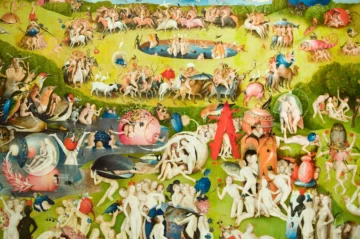
The first meditation retreat I ever went to was also the worst one, at least circumstantially. A new meditation center was in the process of being built and in the meantime, we were in a series of concrete boxes with tiny fortress windows, fluorescent lights, and corrugated tin roofs with the nails showing. This fit with the original purpose of meditation (the whole point of meditation is to triumph over circumstances with attitude), though not the modern spiritually materialist one. Reluctant renunciates of luxury, we lay on our thin mattresses in our metal bunks, eight to a room, staring at the nails in the ceiling; we ate on benches outside in the summer tropical island humidity, out of tin bowls with tin chopsticks that we washed ourselves. The meditation hall with its industrial blue foam puzzle mat floor and air conditioning was the nicest environment around, which made meditation more appealing. I avoided going to the separate, mold-grown outhouse whenever possible.
I learned years later that there is a practice in Tibetan Buddhism that specifically trains the disgust response: by eating increasingly stranger and stranger foods to you, and reacting calmly, even neutrally, you rewire this evolutionary reaction. (This is also one of the secrets behind cold showers, which I appreciate theoretically: one’s nervous system is meant to greet the cold ever more gently instead of tensing up, which then applies to other things.) So potentially even a miasmic outhouse can become, through training, if not desirable, at least not actively repulsive. Though ask even a well-trained monk what he would truly prefer and you’d be hard-pressed to find one who wouldn’t want a nice hotel room with accompanying restaurant and hot tub over a shanty and gruel.
Meditators are not supposed to care about these things, but of course we do. We are still mammals after all, as my therapist likes to remind me whenever I feel guilty about wanting love and good food and coziness. Worse: we are mammals with minds! In subsequent meditation retreats, the conditions were better, but the materialism was still there because the mind with its meaning-making was (and me with my bad attitude). Then it became about who got the slightly better bed or room, who brought the extra seasoning cleverly hidden in a miniature vitamins bottle (this really happened, and I really was jealous). Not that I didn’t squirrel in my own illicit snacks amidst austerity: a sleeve of chocolate digestive biscuits that I hid amongst my bathing essentials and ate in the shower stall. Read more »
by Ken MacVey
The Heritage Foundation in its Project 2025 volume—a 900-page blueprint for a right-wing take-over of America—urged that the Comstock Act of 1873 be enforced to ban mifepristone, the so-called abortion pill. Justice Clarence Thomas last month ended up championing the Heritage Foundation’s cause.
On May 1st, the Fifth Circuit US Court of Appeals issued a nation-wide preliminary injunction against FDA regulations that allowed physician prescriptions and mail delivery of mifepristone without requiring in-person consultation. The state of Louisiana, which has a strict ban on abortion, brought a lawsuit challenging the FDA regulations. A federal district court judge initially agreed with Louisiana that it had standing to sue, and that on the legal merits the FDA regulations probably had not been approved as required by the federal Administrative Procedures Act. But the district court declined to issue an injunction that would have prohibited telehealth and mail delivery prescriptions of the pill because the FDA prior to the lawsuit was already conducting administrative review of the regulations and an injunction could derail that review.
Unhappy with this outcome, Louisiana went to the Fifth Circuit Court of Appeals. The Fifth Circuit confirmed Louisiana had standing but it overruled the district court on the injunction issue. The Fifth Circuit issued a nation-wide injunction prohibiting telehealth and mail delivered prescriptions of the pill. In doing so, the Fifth Circuit held that the recent Supreme Court’s decree prohibiting lower courts from issuing nation-wide injunctions didn’t apply. Although the decision found Louisiana had demonstrated legal standing based on its specific claims of injury, the Fifth Circuit did not confine the injunction to Louisiana where these injuries purportedly occurred or to the geographic boundaries of the Fifth Circuit. It was widely recognized that the injunction could generate chaos and disrupt the medical community and women healthcare throughout the country.
On May 14, per an emergency application by mifepristone manufacturers, the US Supreme Court blocked the Fifth Circuit’s injunction for the duration of appellate review, which included pending Fifth Circuit review on the legal merits and potential Supreme Court review. The practical effect was to assure status quo access to the pill at least through most of 2026 and maybe longer. Read more »
by Christopher Hall
One thing the commotion over Jamir Nazir’s Commonwealth Prize-winning story “The Serpent in the Grove” – allegedly written by AI – has proven is that close reading is definitely not dead. I doubt if any recently published story, prize winning or not, has come under such scrutiny. Phrases denoting the presence of the machine are hunted out, scrutinised, parsed as certain shibboleths. There are the weird, incoherent metaphors and similes: “She had the kind of walking that made benches become men.” “The girl smiled like sunrise over a sink.” There’s some evidence of verbal cliches, like the pairing of a concrete noun with an abstract one in the same description: “…the air sweet with cane and forgetting.” But aren’t there some decent turns of phrase here as well? “She wore the island’s mixed bloodlines like a crown – African in the hips, Spanish in the cheekbone, East Indian in the hair when the rain kinked it, Carib in the way her gaze could bless and warn at once.” (Wait – is it that good? You can’t wear a crown on your hips or your cheekbones. Does that qualify as a hallucination?) The story is propulsive even amid the florid language. Are the characters a little on the undercooked side? Well, nothing’s perfect. How far exactly are we supposed to delve – what are we not accepting here that would pass by unremarked in a story that was unquestionably written by a human? We could say it’s not deserving of the prize it won – I’ll make no judgement here – but the questions this controversy poses go well beyond that.
I’m reasonably sure that I never would have thought the story was not written by a person if it hadn’t been suggested to me. That’s not surprising, though, as most people who don’t use AI a lot (while I’m bound to look out for AI use as a college teacher, I’ve found thus far I’m rather bad at it, and I don’t use it in my writing) are not good at identifying its hallmarks. Is it, in the end, a good story? Read more »
by Robert Jensen

Cornelia Gipson is trying to understand the hold that whiteness has on white people.
“I grew up black in Mississippi, and from the time I was 4, I knew I was black and what that meant,” she said. “How do white people come to understand they’re white? When did you first realize what it meant to be white?”
Gipson, who now lives and works in Nashville, asked me that question on a Zoom call that she initiated after reading my 2005 book, The Heart of Whiteness: Confronting Race, Racism and White Privilege. My answer: I didn’t think seriously about being white until I was 30. Better late than never.
Gipson didn’t want to lecture me but was looking for honest conversation, which meant not just grilling me but reflecting on herself.
For example, she told me about pursuing a promotion and getting rebuffed by a white colleague. When Gipson pushed back, pointing out her qualifications, the colleague said, “You don’t know your place.”
“I think of it as the night Trump showed up at my house,” Gipson said, when she had to acknowledge how quickly subtle white supremacy can turn blatant. Read more »
by Tim Sommers

It’s not often that you get a new argument on such a well-canvassed issue, but starting in 2018 Perry Hendricks began energetically defending variations on what he calls the impairment argument against abortion. It attempts to establish the wrongness of abortion without taking a stand on whether the fetus is a person, in much the same way that Judith Jarvis Thomson’s famous violinist example tried to establish the permissibility of abortion even if the fetus is a person. Hendricks’ argument has generated an extensive secondary literature in bioethics and, basically, nothing anywhere else. Here I want to present his argument and my own counterexample, which I will call the Pro-Choice Astronaut.
Hendricks’ original argument can be presented in five steps. If it is immoral to impair the fetus by giving it fetal alcohol syndrome, then, all other things being equal, it is immoral to kill the fetus. It is immoral to impair the fetus by giving it fetal alcohol syndrome; therefore, it is immoral to kill the fetus. To abort a fetus is (in most cases) to kill it. So, all other things being equal, to abort a fetus is (in most cases) immoral. The strength of the argument is that it operates by analogy from a case in which the wrongness is widely accepted even by those who think abortion is permissible.
On the other hand, imagine an astronaut, call her Sally, who is pregnant and who has agreed to a space mission of substantial duration. She knows that the radiation exposure and other stresses of extended spaceflight will severely impair the fetus she carries. She also intends, on return, to terminate the pregnancy. She is not deceived about what the mission will do to the fetus and she knows what she will do upon return. After careful reflection on the facts, her own psychological states, and, perhaps, after consulting with others, she undertakes the mission.
There is no question of irresponsibility here, apart from the question of whether or not the abortion is, in and of itself, irresponsible. Sally is not drinking, taking drugs, or behaving recklessly or thoughtlessly. She is doing her job, which happens to be a job for which she has trained, with which she has been entrusted, and which (we will stipulate in the first variant) carries great social value. The fetal impairment is foreseen and accepted as part of the cost of doing the mission, but the fetus she would otherwise carry to term is not being prepared for a life of impairment. It is being impaired and, then, separately, will be aborted. Read more »
by Nils Peterson
1. Today mind wanted to think back to all of the houses I lived in with my parents growing up and on into my young manhood. There were five, and mind tried to walk through each of the rooms in all of the houses. It was more difficult than I would have thought. I remember so much and forget so much. Give it a try. It is interesting because sometimes you are still there and you can find yourself.
One of the things I noticed was that all of them had formal dining rooms with a good table and matching buffet. It was a room not used except for dinners. And I realized that this was true of all the houses, even the humblest, of my parents’ friends, a formal place to be used in a formal way when guests arrived, the best china taken out of the buffet along with the silver and set carefully around, along with maybe an elegant crystal center piece. I am struggling now to remember if we used it for supper after my father would come home from work in the evening, of course with ordinary plates and flatware. My mind seems unable to answer yes or no when I ask it that question. I think we might have eaten in the kitchen though I can’t quite picture the kitchen table though the word is familiar.
But I started thinking about how in the modern house, there is no such room to be formally gathered together in for a meal, no dining room and no front room (what we called the living room) either where easy chairs, sofa and the Stromberg Carlson radio would sit. Everything is freeform, a flowing from one state of being to another. No sense of a room for this and a room for that, a place for everything and everything in its place. Even the kitchen is open and part of the flow. Well, that’s the way we live now. Is this a memory of loss? an elegy? an “In Search of Lost Time or Space?” Can’t quite tell if this is an important observation about the world we live in or just a wondering. Read more »

Avian bombardment of an outdoor staircase in Franzensfeste, South Tyrol.
Enjoying the content on 3QD? Help keep us going by donating now.
by Jim Hanas
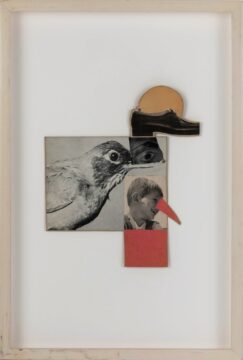
There is a room at the Museum of Modern Art where you can stand with a Henry Darger at your right shoulder and look at Robert Rauschenberg’s Rebus on the perpendicular wall. It feels like an important position, this corner, where one can see—or imagine that one is seeing—naive immediacy and cultivated immediacy at once, though this immediately leads to questions. Was Darger, perhaps, more self-conscious than we imagine, and might Rauschenberg have been more intuitive, despite his credentials? How can you tell the synthesis from the thesis, once the former has become the latter and is ready for another go ’round? Maybe you can’t, any more than the Athenians could distinguish Socrates from the sophists.
In this corner, between the two paintings, there is a doorway with a glowing, code-mandated “Exit” sign above it. The doorway leads into the next gallery, but I like to think that the door itself is Ray Johnson.
Johnson—the inscrutable collagist and mail artist—is part Rauschenberg, part Darger. Part insider, part outsider. It’s been possible in recent years to see a wide range of Johnson’s work in New York. There was an exhibition at the Morgan Library that focused on Johnson’s late use of photography—which took in a lot of his other mature work as well—and one at the Craig Starr Gallery that showcased his surviving Bauhaus-inspired paintings and traced his movement into assemblage and collage. I’m also lucky enough to have a friend who managed to get on the mailing list for Johnson’s New York Correspondence School as an art student growing up on Long Island. Examining the mailings she received, still in their original envelopes, was a thrill—one of these things you move to New York hoping to experience.
Two weeks ago, my wife and I headed to Ashville, North Carolina, to the Black Mountain College Museum, for the opening of Black Mountain COLL(A)GE, an exhibition—running through Labor Day—focused on collage work produced by artists associated with the college. Black Mountain, though a relatively short-lived institution, was among the mid-century’s most fertile hubs for the emerging American avant-garde. As European artists fled to America, Josef Albers brought Bauhaus practices to the Blue Ridge Mountains, where he taught from 1933 to 1949, hosting a who’s who of interdisciplinary artists, including John Cage, Merce Cunningham, Willem de Kooning, Jacob Lawrence, Robert Rauschenberg, Susan Weil, Cy Twombly, and—of course—Johnson. Read more »
by Ashutosh Jogalekar

In 1966, Michael Polanyi began his book The Tacit Dimension with a sentence that every experimental scientist understands: “we can know more than we can tell.” Polanyi had been a chemist before he became a philosopher. He knew the difference between the written account of an experiment and the experience of doing it. His point was not that science is vague or mystical, it was that scientific judgment rests on inherited practice, trained perception, and habits learned from other people. The University of Chicago Press summary of The Tacit Dimension describes tacit knowledge – tradition, inherited practices, implied values, and prejudgments – as a crucial part of scientific knowledge.
The point is easy to see in chemistry. A synthetic procedure may ask the chemist to warm a solution with “gentle swirling,” to add a reagent slowly enough to maintain a “gently exothermic reaction,” or to continue stirring until the mixture turns “pale yellow.” These are ordinary phrases. They are also compact pieces of apprenticeship. A young chemist wants to know how gentle is gentle, how pale is pale, and how much warmth counts as a controlled exotherm. The experienced chemist has seen enough flasks to supply the answer. Even Organic Syntheses, perhaps the most careful journal of synthetic procedures, acknowledges the difficulty. Its instructions say that its procedures are written in greater detail than usual journal procedures, checked for reproducibility in an editor’s laboratory, and still may cause trouble when checkers try to reproduce the submitters’ results.
There are foundational examples in the old seminal papers. Alexander Fleming’s 1929 paper on penicillin begins with an accident that would have annoyed most bacteriologists. He had set aside plates of staphylococci on a laboratory bench. During repeated examinations they were exposed to air and became contaminated. Around one contaminating mold colony, he noticed that the staphylococcal colonies “became transparent and were obviously undergoing lysis.” A spoiled plate became a discovery because Fleming knew what he was seeing. The later paper contains numbers, dilutions, temperatures, and culture conditions. The first act was visual judgment. It was the recognition that a nuisance had become a phenomenon to be investigated.
A second example comes from a very different part of science. Read more »
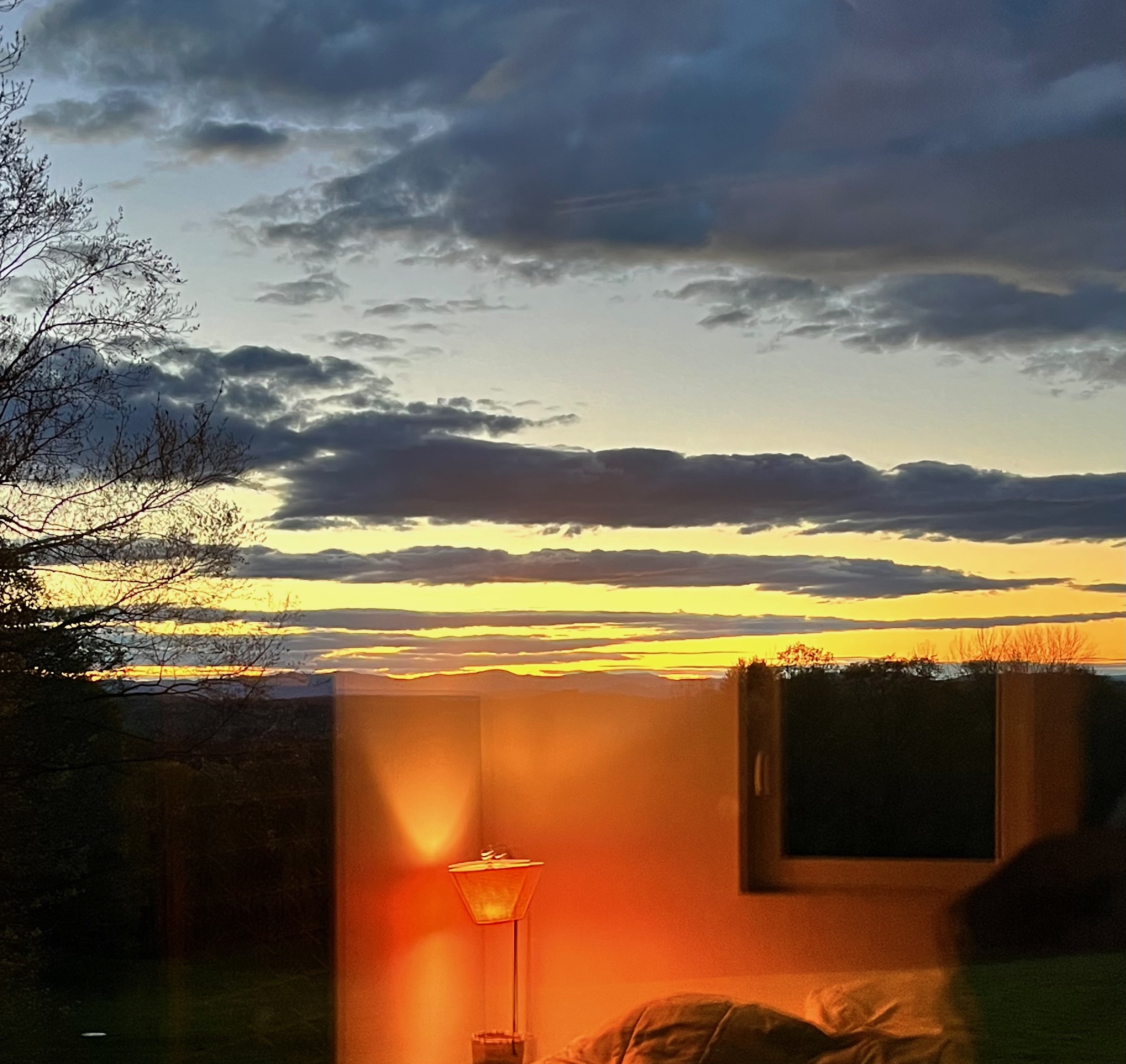 Sughra Raza. Surreal Sunsets, Vermont, May 2026.
Digital photograph.
Enjoying the content on 3QD? Help keep us going by donating now.
by Dwight Furrow
 A moat is what protects a business from competition. The term comes from Warren Buffett’s image of a castle surrounded by water. The castle is the business; the moat is whatever prevents rivals from storming the walls. A moat might be a famous brand, a patent, a network effect, control over scarce resources, high switching costs for consumers, or a regulatory barrier that makes it difficult for competitors to enter the market. The deeper the moat, the easier it is for a firm to charge high prices, preserve margins, and survive imitation.
That is a problem for AI companies. They are spending staggering sums on chips, data centers, engineers, and research, yet it is not obvious that they have a durable moat. Among the top three frontier labs, the latest system from one company is only slightly better than the latest system from another and who is on top changes depending on who has released their latest model. And free-to-use, open-access models from China are only a few months behind the frontier labs in their development. If these trends persist, the AI business begins to look precarious. Enormous cost, rapid imitation, and uncertain customer loyalty does not make investors joyful. The castle is there but the water around it may be ankle-deep.
What is the solution for the AI labs? Anton Leicht’s Substack essay “Cut Off” suggests a solution, although his concern is not corporate profitability.
His argument is that access to the most advanced AI systems will become more limited, not less. The familiar assumption is that market pressure will make advanced AI abundant. Better models will proliferate; prices will fall; the future will belong to those who use AI most skillfully. Leicht thinks recent events point in another direction. “Access to frontier AI,” he writes, “will soon be limited by economic and security constraints.” That sentence should make investors, regulators, start-ups, and foreign governments pay attention. Read more »