
by David Greer
 The smallest spider I’ve ever seen is slowly descending from the little metal lampshade above my computer. She’s so tiny, a millimeter wide at most, I have to look twice to make sure she isn’t just a speck of dust. The only reason I can be certain that she’s not is that she’s dropping straight down instead of floating at random.
It’s become almost automatic to reach for the iPhone to obtain a visual record of a wildlife encounter out of the ordinary, and so I do. However, the spider’s size and the fact that she’s now spinning like a miniature dervish presents a challenge beyond my iPhone’s capabilities. You’ll just have to take my word for it that that’s her in the image to the right, the tiny golden blob to the left of the lamp stem.
Perhaps I shouldn’t make assumptions about the spider’s gender, but her size makes verification problematical. Ever since I fell in love with Charlotte’s Web I’ve been inclined to think of spiders as feminine in the absence of evidence to the contrary. I would no more call her an “it” than I would a human, and she doesn’t strike me as a probable “they.” So “she” it will have to be.
Having observed many swarms of aimlessly scrambling baby spiders fresh out of their communal egg sacs, I know that in the not distant future she’ll be many times her current size. And however small she may be today, a few clicks worth of research confirms that she’s a giant compared to some of her cousins. A full-grown Patu digua, quite possibly the smallest spider species on the planet, maxes out at around 0.37 millimeters, about four times the width of an average human hair (75 micrometers).
Accurately determining the size of the tiniest creatures on the planet can be a challenge using standard units of measurement. The good citizens of Swabia, a region in southwestern Germany, frustrated with the limitations of those standard units when it came to visualizing the size of practically invisible objects, decided to create their own. One imagines the passionate debate that must have transpired before the burghers finally reached consensus. The result was “Muggeseggele”, literally “housefly’s scrotum”. In a readers’ survey conducted by a Stuttgart daily newspaper a few years ago, Muggeseggele was chosen the most beautiful Swabian word by a wide margin of votes.
It’s mind-boggling that creatures as small as a housefly’s scrotum (if indeed such exists) somehow manage to have legs and hearts and eyes and all of the other attributes that make up a member of the animal kingdom, but such is the magnificence of evolution. Normality is in the eye of the beholder, and humans are distinctly abnormal in the grand scheme of things. The vast majority of animal species on the planet border on invisibility. About 6,500 mammal species have been identified to date. By comparison, it’s considered likely that more than 100,000 plankton species drift in the seas. That number in turn is dwarfed by the estimated half million or more mite species that inhabit the soil and your carpets and your skin.
Speaking of mites, a while ago my itsy bitsy spider stopped twirling and commenced to spin a web, albeit rather a small one. I doubted that the small gap between my desktop and my desk lamp would be an optimal location for a spider’s web, yet now I see her fussing with something impossibly small that appears to have floated into her elegantly woven trap (something else to boggle the mind, constructed as it was by instinct alone). 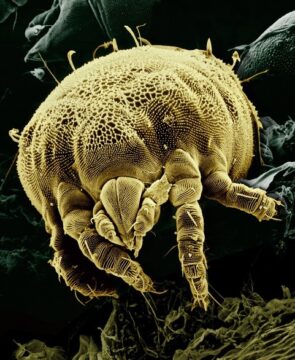 Whatever it is looks to me like nothing more than a speck of dust, until I remember that infant spiders may survive largely on a diet of dust mites (or their detritus) and pollen. There’s no shortage of dust mites in the average house and, by extension, inside my studio. You may not remember setting eyes on a dust mite, but you’re assuredly at close quarters with them every night. The average well-used pillow harbors thousands of dust mites, doing you the favor of ingesting the flakes of dead skin that you scatter around in your sleep and thereby sparing you the inconvenience of worrying how to clean up your dead skin cells, which you shed in large quantities if you’re an average human being—30,000 to 40,000 a minute, or around a million a day, though some estimates are multiple times higher. Dust mites are so called because they look for all the world like specks of dust, albeit multiple-legged specks of dust, though their legs will be invisible to you.
Little things mean a lot. The tiniest creatures play an outsized role in maintaining ecological balance. Mites and plankton alike convert dead organic material into vital nutrients. Agriculture depends on the nutrients created by soil mites breaking down organic material. Similarly, plankton break down dead organic material descending through the water column, converting it into nutrients such as nitrogen and phosphorus to enrich marine ecosystems. Through photosynthesis, phytoplankton generate roughly half of the oxygen on the planet. In addition, plankton form the foundation of the marine food chain. The largest animal ever to have inhabited the Earth, the blue whale, subsists almost entirely on krill, a shrimplike form of plankton.
Species of all sizes are vulnerable to the consequences of human activities, whether intentionally or as collateral damage, and mites and plankton are no exception. Many mite species are presumed to have vanished through destruction of habitat. Plankton species are vulnerable to a variety of human impacts, from ocean warming to shifting currents to the pervasive spread of microscopic plastic particles inadvertently ingested by zooplankton. In addition, with the depletion of marine fish populations ravaged by industrial fisheries, some countries have turned their attention to larger plankton such as krill.
In 2024, industrial trawlers from several countries operating in the Antarctic took half a million tonnes of krill, a keystone species in the Southern Ocean, to be processed into food for pets and farmed fish. In October 2025, a scientist preparing to travel to a conference organized by the Commission for the Conservation of Antarctic Marine Resources was arrested by Russian authorities and accused of high treason for supporting a restriction on krill harvesting in the Antarctic. The commission planned to discuss establishing a marine protected area around the Antarctic Peninsula to protect krill, considered to be an essential foundation for the food chain in the Southern Ocean.
What’s next? Mousse made of harvested mites? Of one thing there can be no doubt: the human appetite for plundering other species’ protein, regardless of the ecological consequences and implications for the survival of other species, knows no limits. Myopia abounds, unintended consequences be damned. Humanity appears to have achieved the Buddhist ideal of enlightenment: live in the (monetized) moment, and beyond that, que sera, sera.
Fortunately for spiders, they have not as yet been identified worthy of industrial harvesting, though never say never. For the time being, they can carry on their preferred practise of dining on insects that humans view as pests. (Insects have their own issues with population declines, but that’s a discussion for later. Meanwhile, the number of wild bee extinctions is doubling in some regions, thanks to habitat destruction and the use of pesticides such as neonicotinoids.)
Closer to home, my itsy bitsy spider has disappeared from my lampshade and her web and resurfaced on my IPhone, only to be apprehended in the course of texting. What to do? As is my practise with spider visitors, I very carefully cover her with a tiny cup, insert an index card underneath, and carry her to the great outdoors to freedom and a new tomorrow. Cue the violins for emotional farewells. May God bless her and keep her safe.