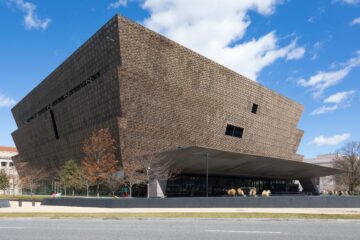
National Museum of African American History and Culture, Washington, D.C.
This year’s Black History Month is different.
Black history itself has become contested. Not debated at the margins but questioned at its core. School curricula are scrutinized, and institutions that preserve Black memory are accused of being “divisive.” Should Black history exist, or should it disappear, erasing its many uncomfortable truths and leaving a more homogeneous national narrative?
Narratives are what hold us together as individuals and as societies. To have the wholeness and continuity essential to our survival, our stories must be heard, recognized, and validated by others. Identity is not a monologue in an empty room; it requires an audience and a full cast.
History is our shared narrative. It is how a nation understands what has happened and who it is. It is also how we relate to those who came before us. To deny or erase significant portions of that history is not merely to rearrange a syllabus. It distorts the self-understanding of the entire society. A narrative that excludes central truths becomes brittle. It depends on selective memory and strategic forgetting. That society’s connections to reality inevitably fray, eventually breaking.
As a psychiatrist, I have spent much of my professional life listening to narratives. Read more »
The greatest privilege of my childhood was growing up in a house where books had their own room.
My father’s library occupied the second floor, the only room without a window air-conditioning unit. On summer afternoons in Washington, DC, when the heat and humidity pressed down like a weight, the rest of the house hummed and rattled with machines straining to keep up. The air in the library stayed stubbornly still. It was the early 1970s, and I was on summer break after tenth grade, retreating there to find the peculiar solitude this room alone offered. Each book I opened sent up a cloud of dust that glittered in the angled sunlight. Shutting the door turned the room into a sauna, but in that quiet stillness, I didn’t mind. It felt like the price of admission to a different world.
The previous summer had unfolded differently. I had just finished ninth grade, where we surveyed the classics of English literature and retraced the decisive moments of Western civilization, reliving the deeds of its great men and women. I spent long afternoons in the library, sinking into those books as the heat pooled around me. I melted into a reclining chair and wandered through the past. That immersion had felt complete, even sufficient. But this summer, I arrived with a different appetite. I was growing skeptical of the Eurocentric narratives threaded through everything I was learning. I sensed there were other stories and vantage points, and I came looking for them.
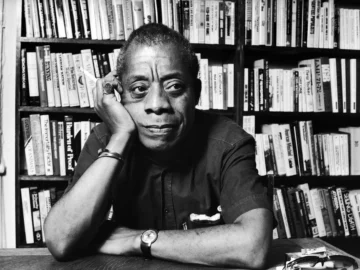
I picked up the book I had been reading a few days earlier and turned to the page marked with an index card. I searched for the sentence I remembered, but at first the words slipped past me. James Baldwin was writing about a Swiss village, about children shouting “Neger” as he walked through the snow. Seeing the word on the page registered instantly, not as surprise but as recognition. I had learned early what it meant to be called that name in its American form. That knowledge had settled into my body long before I could articulate it. Read more »
According to James Baldwin’s outdated thinking, “The purpose of education, finally, is to create in a person the ability to look at the world for himself, to make his own decisions . . . to ask questions of the universe, and then learn to live with those questions . . . But no society is really anxious to have that kind of person around. What societies really, ideally, want is a citizenry which will simply obey the rules of society. If a society succeeds in this, that society is about to perish.”
Though universities have traditionally been associated with educating students, I don’t think that it makes sense anymore. There’s too much at stake.
Education requires wonder, discipline, personal attention, liberal learning, standards, mentorship, transformation, reading. Let’s face it. These things don’t scale well, especially when it comes to generating the revenue universities need for their survival or economic growth. The jobs of not just professors, chairs, administrative assistants, provosts, and presidents are on the line—also deans, student life directors, recruitment officers, assessment coordinators, and usually associate and assistant versions of all those positions, among many others.
Maybe it was feasible for universities to aim for education when they received more public funding. But those days are over. Few people care about being an educated person, let alone about educating the populace at large. Plus, most people—even many in the university itself—don’t distinguish between being educated and being trained for a job.
But universities shouldn’t just focus on research and jettison teaching and learning altogether. The revenue stream of students is too vital.
Universities should attract students with what they really want: concerts, sporting events, gaming stations, food courts, swanky dorms, fewer requirements, and so on. (At the same time, it’s savvy to put fees on some of these goods to generate more revenue for the university.) But the university shouldn’t just be an expensive four-year resort experience. There needs to be a value-add that justifies public support and the increasing cost of tuition and room and board. The ostensible value of the university needs to involve credentialing students for successful entrance into the economy.
The beauty of a credential is twofold. First, money. Universities should drive home that a credential is a ticket to a well-paying job. Second, status. If disciplines like the arts and humanities have any value, it’s to equip students with moral and political vocabularies that socially elevate them above the uncredentialed. That way, even if by chance a plumber without a college diploma makes more money than a university graduate, the credentialed will have the consolation of looking down on the plumber. Read more »
I learned in New Jersey that to be a Negro meant, precisely, that one was never looked at but was simply at the mercy of the reflexes the color of one’s skin caused in other people. —James Baldwin, Notes of a Native Son
I am invisible, understand, simply because people refuse to see me. —Ralph Ellison, Invisible Man
…American society is blind to hundreds, even thousands of murders perpetrated in its name by agents of governments. — John Lewis
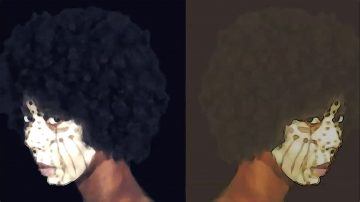
Françoise Soulé Zinsou Duressé, je suis ce que je suis (still), 2018, single-channel video (color, sound), 4:50 minutes, courtesy of the artist.
I had begun thinking about how the coronavirus made very visible the shambles of our society, when the murder of George Floyd took place. Disasters pull aside the veil, and make an underlying reality more apparent. Already the coronavirus had exposed the reality of racism, capitalist economics, the weakness of our food system, our health care crisis, the extreme vulnerability of so many populations, and the built-in structural violence. The George Floyd murder, and the subsequent protests and riots, were police brutality made visible, and rage against the brutality made visible.
Activist and epidemiologist Gregg Gonsalves, referring to the way the virus has been mishandled, asks:
How many people will die this summer, before Election Day? What proportion of the deaths will be among African-Americans, Latinos, other people of color? This is getting awfully close to genocide by default. What else do you call mass death by public policy?
His comments apply equally to the public policy that allows so many to be killed by police. Writing in 2014, civil rights leader John Lewis mentions a recent study that reported that “one black man is killed by police or vigilantes in our country every 28 hours, almost one a day.” Read more »